
Contribution of packaging to the in-store experience
TL;DR:
- Packaging plays a crucial role in the retail experience by quickly and unconsciously influencing brand perception.
- Sustainable and luxurious packaging enhances customer reliability, loyalty, and willingness to pay.
Packaging is the most direct carrier of brand experience on the shop floor: it influences purchase decisions within seconds, even before a customer touches the product. The contribution of packaging to the retail experience goes beyond protection or transport. Packaging communicates brand values, guides emotions, and helps determine whether a product stays on the shelf or ends up in the shopping cart. According to research by NielsenIQ from 2025, 64% of consumers try a new product because of its packaging. This figure makes it clear that packaging is not an afterthought, but a primary sales tool for every retail professional.
How does packaging influence purchasing behavior in physical stores?
Consumers make purchasing decisions at lightning speed. Nielsen research shows that shoppers spend an average of 13 seconds choosing a brand in-store. In those 13 seconds, packaging must attract attention, communicate the brand, and inspire trust. There is no room for noise or ambiguity.

Psychologists call this mechanism “thin slicing”: the unconscious evaluation of packaging occurs within 50 milliseconds. This means that color, shape, and material already form an opinion before the consumer consciously reads what is on the packaging. For retail professionals, this is the most underestimated fact in packaging strategy.
The elements that make the quickest impression are:
- Color: Warm colors like red and orange activate impulse purchases. Cool tones like blue and green signal reliability and quality.
- Shape: Round shapes are associated with softness and accessibility. Angular shapes communicate precision and strength.
- Tactile properties: Weight, material sound, and surface texture unconsciously influence quality perception. A heavy box feels more valuable than a light one, even if the contents are identical.
- Recognizability: Consistent visual language across product lines reduces cognitive effort for the consumer and speeds up choice.
A common mistake is to overload packaging with information and graphic elements. An excess of visual stimuli leads to cognitive overload, causing consumers to disengage or delay purchase. Less is structurally more here.
Pro-tip: Test your packaging for recognizability by showing it to someone who doesn't know the brand for three seconds. Can that person then name the product and the brand value? If not, the design is too complex for the shop floor.
What role does packaging play in brand experience and customer loyalty?
Packaging is the first physical point of contact between brand and customer. In physical stores, packaging determines the first impression. In e-commerce, the unboxing moment is the stage where brand experience begins and loyalty is built or lost. Both moments require a conscious approach.
The role of packaging in brand experience becomes concretely visible in four mechanisms:
- Consistent visual language: Brands like Apple and Rituals use packaging as an extension of their brand identity. Every color, every font, and every material is a repetition of the same story. This consistency builds recognition and trust.
- Personalization: Packaging with a name, a personal message, or a seasonal design increases emotional connection. Read more about the benefits of personalizing packaging for concrete retail applications.
- Sustainability as a brand value: According to McKinsey research from 2024, 70% of consumers consider sustainable packaging important in purchasing decisions. Sustainability is no longer a nice-to-have. It is an expectation that makes the brand credible or incredible.
- Luxury appearance and willingness to pay: Luxurious packaging increases consumers' willingness to pay by 25%. A product in a high-quality box with a satin ribbon is judged differently than the same product in a standard cardboard box.
“The packaging is not the product, but it does determine how the product is perceived. Investing in packaging is investing in the perception of quality.”
Ipsos research from 2018 confirms this: 72% of American consumers say packaging design influences their purchase evaluation. This percentage has only increased in the years since due to the growth of social media, where packaging is shared and reviewed by millions of people.
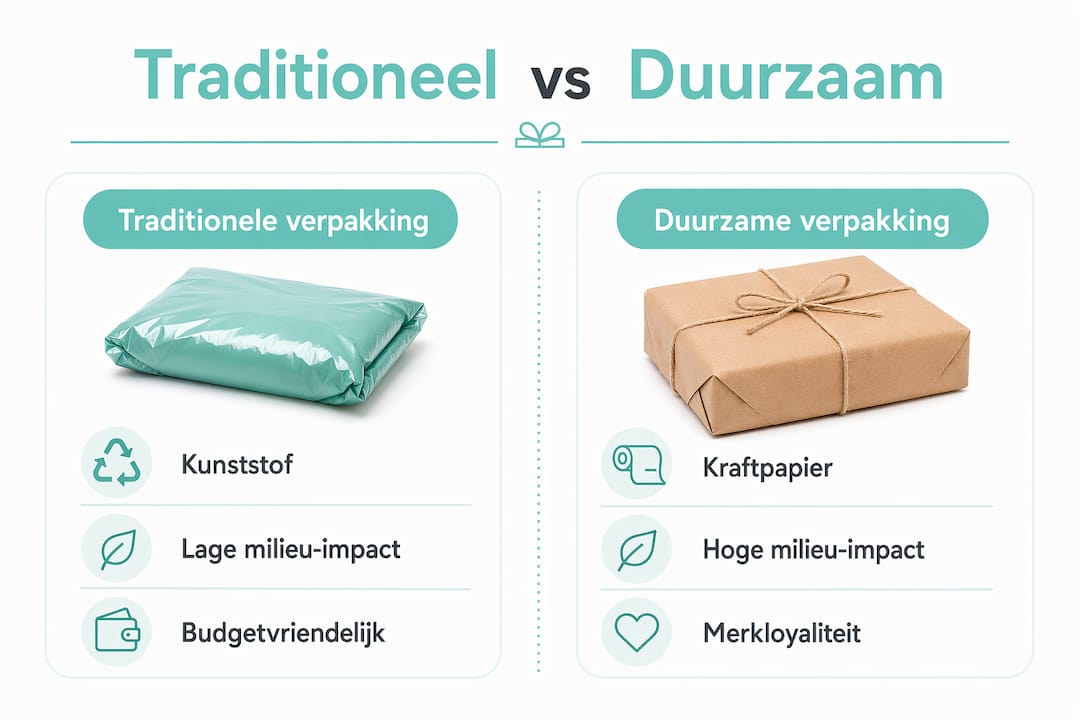
Traditional versus sustainable packaging: what works better in retail?
The choice between traditional and modern sustainable packaging materials is not purely an aesthetic decision. It directly relates to brand credibility, customer experience, and legal obligations. Specialists from Koninklijke Hordijk state that technical sustainability builds more credibility than loose marketing claims. An "eco-friendly" sticker on plastic packaging no longer convinces anyone.
| Feature | Traditional Packaging | Sustainable Modern Packaging |
|---|---|---|
| Material | Plastic, non-recycled cardboard | Recycled cardboard, kraft paper, FSC-certified paper |
| Appearance | Glossy, uniform, predictable | Natural, texture-oriented, distinctive |
| Credibility | Low with environmentally conscious customers | High if technically substantiated |
| Cost | Lower with large volumes | Comparable with economies of scale |
| Customer Experience | Functional, little emotional added value | Enhanced experience through material feel and story |
| Regulations 2026 | Increasing restrictions | Complies with EU packaging directives |
Experience shows that sustainable materials like kraft paper and recycled cardboard not only score better on environmental impact but also provide a higher tactile quality perception. Rough, natural textures activate positive associations with craftsmanship and authenticity. This is a direct contribution to the retail experience that traditional glossy packaging rarely achieves.
For retail implementation, three concrete guidelines apply. Choose materials with certification such as FSC or Cradle to Cradle, so the sustainability claim is verifiable. Match the finish to the brand profile: a luxury brand chooses coated kraft paper with foil printing, a craft brand chooses uncoated natural cardboard. Also, check the packaging materials for stores for an overview of material types and their applications.
Pro-tip: Always ask your supplier for technical specifications of sustainability claims, such as the percentage of recycled material and the origin of raw materials. Customers and regulators will no longer accept vague claims in 2026.
How do you design packaging that is both functional and an experience?
Effective packaging combines functionality with experience. That sounds obvious, but in practice, many retailers choose one or the other. Packaging that is only functional misses the opportunity to enhance brand experience. Packaging that is only beautiful but poorly protects or is difficult to open frustrates the customer and damages the brand.
Ariane and Art of Now New Next state that packaging design must win both the mind and the shop floor. This requires an approach that combines behavioral psychology, category context, and brand strategy. Below are the steps for packaging that achieves both goals.
- Define the function first. Determine what the packaging should do: protect, inform, present, or all three. The function determines the structure and material. Only then comes the design.
- Design for the category, not just the brand. Packaging must stand out within its category. Analyze what competitors are doing and consciously choose a distinct color, shape, or material that stands out without leaving the category.
- Build a clear information hierarchy. Brand logo and product name are at eye level and legible at a glance. Secondary information such as ingredients or instructions is on the back or side. Never put everything on the front at once.
- Invest in the opening moment. The way packaging opens co-determines the experience. Tissue paper, a ribbon, or a personalized card significantly enhance the brand experience during unboxing. This applies to both physical stores and online orders.
- Test for consistency across all touchpoints. The in-store packaging, shipping box, and gift wrap must together tell one brand story. A consistent brand story in packaging, down to technical details such as colorfastness and surface texture, strengthens credibility and customer trust.
- Evaluate after launch. Measure return rates, customer feedback, and repeat purchases. Packaging that works well reduces returns and increases customer loyalty. Packaging that works poorly is visible in the figures.
The must-have retail packaging that enhances presentation always combines these six steps. Retailers who follow this process consistently achieve better results than retailers who treat packaging as a cost item rather than an investment in customer experience.
Key insights
Packaging determines the retail experience through design, material, and functionality, influencing purchase decisions within 13 seconds based on color, texture, and brand consistency.
| Point | Details |
|---|---|
| Fast decision time | Consumers choose a brand in 13 seconds; packaging must communicate directly. |
| Sustainability is an expectation | 70% of consumers consider sustainable packaging; substantiate claims technically. |
| Luxury increases willingness to pay | High-quality packaging increases willingness to pay by 25%. |
| Unboxing builds loyalty | The opening moment determines brand loyalty; tissue paper and ribbon make a difference. |
| Consistency strengthens trust | One visual language across all packaging touchpoints increases recognition and credibility. |
What I see retailers still underestimate
After years of working with retailers and packaging suppliers, one pattern stands out to me: most entrepreneurs understand that packaging is important, but they treat the budget for it as a residual item. They invest in a good product, a beautiful interior, and a strong marketing plan, and then choose the cheapest packaging available. That is a strategic mistake.
What I see in practice is that retailers who consciously invest in packaging material, including the quality of the ribbon, tissue paper, and finish, consistently achieve higher customer satisfaction scores. Not because customers consciously think "what beautiful packaging," but because the overall experience is right. The feeling of quality begins with the first touch of the packaging, even before the product is visible.
What also strikes me is that sustainability in packaging is still too often used as a marketing gimmick instead of a genuine choice. Customers see through that. A kraft paper bag with an FSC label and an honest story consistently scores better than plastic packaging with a green leaf on it. The technical substantiation of sustainability claims will no longer be an option in 2026; it is a basic requirement.
My advice to every retail professional: treat packaging as part of your brand strategy, not as a logistical necessity. The packaging as a marketing tool is the most underutilized instrument in most retail formats. Those who change this immediately gain a competitive advantage.
— M
Enhance your retail experience with packaging from Kadopapier
Kadopapier supplies high-quality packaging materials for retailers who take their customer experience seriously. From luxurious organza Christmas ribbons in glitter and wired versions to decorative elastic in metallic colors: the assortment is compiled for professional use at scale. If you are looking for a specific product, Kadopapier also offers the red organza ribbon in a luxurious version that does not fray and directly contributes to a strong presentation. All products are available in wholesale quantities, with same-day delivery for orders placed before 15:00. View the full range at kadopapier.net and give your packaging the look your brand deserves.
FAQ
What is the contribution of packaging to the retail experience?
Packaging contributes to the retail experience by enhancing brand perception and influencing purchase decisions through design, color, material, and functionality. Consumers unconsciously evaluate packaging within 50 milliseconds, making the initial visual impression crucial for purchase intent.
How quickly do consumers make a decision based on packaging?
Consumers spend an average of 13 seconds choosing a brand in-store, with the initial evaluation occurring within 50 milliseconds based on color and shape. Packaging must therefore communicate directly and clearly without visual overload.
Why is sustainable packaging important for brand experience?
According to McKinsey research from 2024, 70% of consumers consider sustainable packaging important in purchasing decisions. Brands that technically substantiate sustainability with certifications like FSC build more credibility than brands that only use marketing claims.
How does luxury packaging increase willingness to pay?
Luxurious packaging increases consumers' willingness to pay by 25% because high-quality materials and finish increase the perceived product value. This effect occurs even before the customer has evaluated the product itself.
What makes an unboxing experience effective for customer loyalty?
An effective unboxing experience combines visual surprise with tactile quality, such as tissue paper, a ribbon, or a personalized card. This moment significantly influences brand loyalty and trust, as it strengthens the emotional connection with the brand at the moment of highest engagement.