
Choosing brown kraft paper: tips, types and expert advice
TL;DR:
- Grammage doesn't tell the whole story about the thickness or tear resistance of kraft paper.
- Always ask suppliers about caliper and fiber structure in addition to grammage.
Grammage is at the top of every product specification, but packaging specialists know that 80 gsm from one supplier behaves very differently from 80 gsm from another. Choosing brown kraft paper goes beyond a single number on a datasheet. Thickness, fiber structure, surface finish, and caliper together determine how the paper behaves when wrapping sharp edges, heavy products, or delicate gifts. This article explains which criteria truly matter, what types are available, and where most buyers go wrong.
Table of Contents
- What to look for when choosing brown kraft paper
- Key types of brown kraft paper and their applications
- Comparison of popular brown kraft paper choices
- Common mistakes and smart advice for packaging applications
- Our vision: why we always opt for combinations of criteria
- High-quality brown kraft paper and decoration: order directly from Kadopapier.net
- Frequently asked questions about brown kraft paper
Key Insights
| Point | Details |
|---|---|
| Don't just look at grammage | Caliper and material composition also determine the quality of brown kraft paper. |
| Request sample rolls | Samples are crucial for testing suitability and sturdiness for your applications. |
| Choose the right type | Matching the application prevents tearing and saves on procurement costs. |
| Compare alternatives | Use a comparison table for an informed choice. |
What to look for when choosing brown kraft paper
Now that we've outlined the importance, let's first look at the key selection criteria.
Grammage: what it does and doesn't tell you
Grammage (g/m²) is the weight of one square meter of paper. It's a useful basic indicator, but certainly not a complete picture. As stated in the Graphic Dictionary, grammage itself doesn't directly say everything about thickness. Caliper, also known as paper thickness, is a separate quantity that indicates how thick the sheet actually is.
Thus, two rolls of 90 g/m² can have a measurably different thickness, depending on fiber density and production method. For standard gift packaging, this difference is often small. For industrial applications or wrapping products with sharp edges, it is crucial.
Fiber structure and material composition
Kraft paper is made via the kraft process, where wood pulp is chemically treated to retain long, strong fibers. Unbleached brown kraft paper contains more lignin than bleached variants, which provides higher tear strength. Short fibers give a smoother surface but less toughness. Long fibers result in rougher, stronger paper.
This has direct practical consequences. Paper with long fibers is more resistant to tearing when folding corners. Paper with short fibers is easier to print on, but tears more easily under mechanical stress.
Thickness, stiffness, and absorption
Thickness is expressed in micrometers (μm) or millimeters (mm). Stiffness is a derived property: thick paper is not automatically stiff. Paper with a low density can be thick but flimsy. This behaves differently when folding and packaging.
Absorption plays a role if you combine paper with stamps, ink, or damp products. Smooth kraft paper absorbs less and is therefore better for printing. Rough or ribbed paper absorbs more, which offers advantages in protecting products that may cause condensation.
For every new supplier, always ask for both the grammage and the caliper (μm). Two numbers say more than one.
When to request samples or trial rolls
For small orders or known applications, a specification sheet is sufficient. For larger volumes, new suppliers, or critical applications, a trial roll is indispensable. This allows you to test how the paper behaves with your specific products, machines, and packaging speeds.
Pro-tip: Also ask the supplier about the direction of the fibers (machine direction). Paper tears more easily along the grain direction. If you use rolls on a packaging machine, you want the grain direction parallel to the machine's running direction.
Read more about sustainable brown packaging if you want to combine the choice of kraft paper with a broader sustainability strategy.
Key types of brown kraft paper and their applications
If you know what properties you're looking for, you can make a targeted choice from different types.
Smooth versus ribbed kraft paper
Smooth kraft paper has an even surface and is suitable for gift packaging, printing, and light products. It looks neat and is easy to fold. Ribbed or striped kraft paper has a texture of fine ribs. This structure significantly increases stiffness and tear resistance, without needing to increase the grammage.
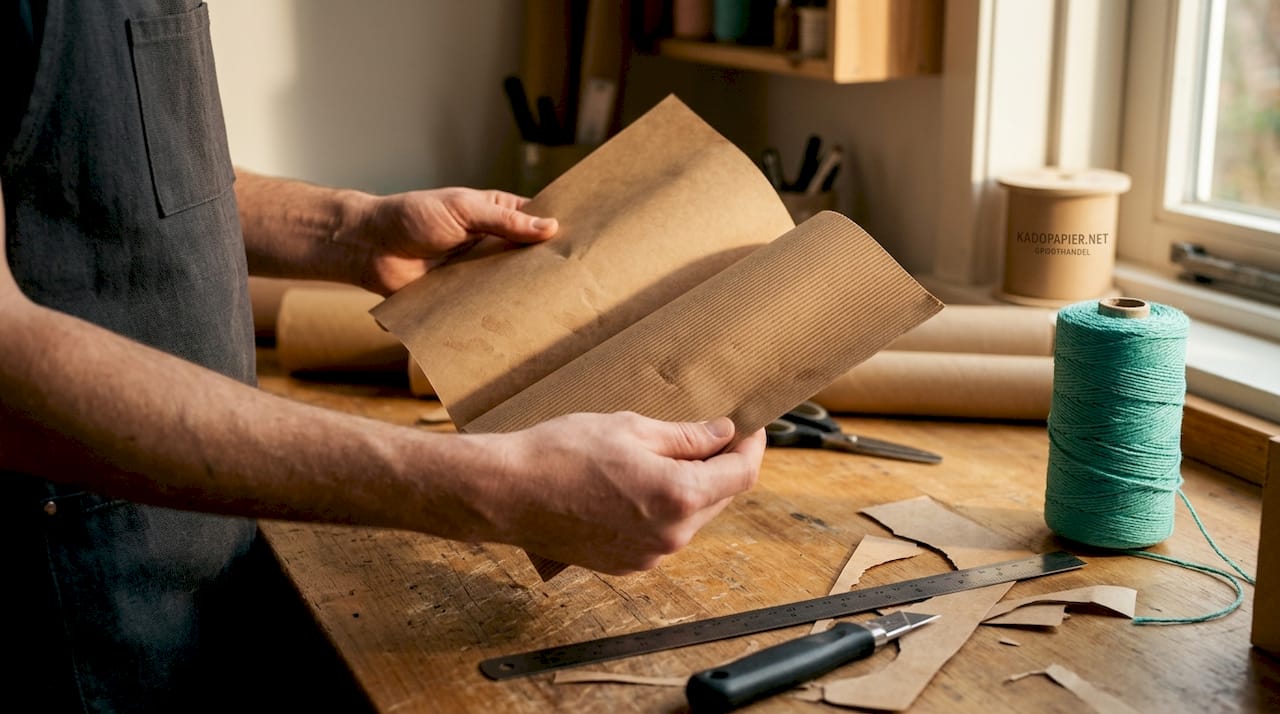
Ribbed paper is popular for packaging heavier products, carrier bags, and industrial applications. The ribs also provide better grip when holding packages.
Light, standard, and extra thick
- Light (40 to 60 gsm): Suitable as box lining, protective sheet, or for light gifts. Not suitable for products with sharp edges.
- Standard (70 to 90 gsm): The most common category for retail and gift packaging. Good balance between strength and workability.
- Thick (100 gsm and higher): For heavy products, luxury packaging, or situations where the paper also serves as primary protection.
But beware: as the Graphic Dictionary indicates, grammage is insufficient to predict stiffness or puncture resistance. Caliper and material composition, such as fiber length, density, and finish, can strongly influence behavior. For critical applications, always ask for thickness and construction in addition to grammage.
Applications per type
- Lining and protection: Light smooth kraft paper, 40 to 60 gsm. Quick to process, cheap per meter.
- Retail gift packaging: Smooth or lightly ribbed, 70 to 90 gsm. Professional appearance, easy to fold.
- Carrier bags and pouches: Standard to thick, 80 to 120 gsm, preferably ribbed for extra strength.
- Heavy or sharp products: Extra thick ribbed, 100 gsm or higher, with high caliper.
- Seasonal and themed packaging: Smooth paper, suitable for printing or combination with ribbon and decoration.
Pro-tip: Combine kraft paper with types of tissue paper for layered packaging. Tissue paper as the inner layer protects the product and enhances the unboxing experience.
Comparison of popular brown kraft paper choices
The differences become clear when you compare standard types side by side.
| Type | Grammage | Caliper | Surface | Typical application |
|---|---|---|---|---|
| Light smooth | 40 to 60 gsm | Low | Smooth | Lining, protective sheet |
| Standard smooth | 70 to 90 gsm | Average | Smooth | Retail gift packaging |
| Standard ribbed | 70 to 90 gsm | Average to high | Ribbed | Carrier bags, sturdy packages |
| Thick smooth | 100 to 120 gsm | High | Smooth | Luxury packaging, printing |
| Thick ribbed | 100 gsm and higher | High | Ribbed | Heavy products, industrial |
As the Graphic Dictionary confirms, grammage is a distinct quantity from thickness. Two paper types with the same grammage can have a measurably different caliper. You don't see that difference in the table, but you feel it directly when packaging.
Advantages per category:
- Light smooth: lowest cost per roll, quick to process, minimal storage space required.
- Standard smooth: widely applicable, good printability, professional appearance.
- Standard ribbed: higher tear resistance than smooth at comparable grammage, better grip.
- Thick smooth: premium appearance, suitable for brand packaging and luxury retail.
- Thick ribbed: maximum protection, resistant to mechanical stress.
Cheap versus luxury: what do you really get?
Cheap variants save on purchase price but often have a lower caliper and shorter fibers. This means faster tearing, less attractive folds, and a less polished appearance. For high volumes with low quality requirements, this is acceptable. For retail and gift packaging visible to the customer, the extra cost of a higher quality variant quickly pays for itself.
Also check out the range of plain matte brown and gold wrapping paper for a combination of classic kraft with a decorative element. Or choose brown tissue paper as an addition for the inside of packaging.
Common mistakes and smart advice for packaging applications
Finally: what should you avoid doing and what can you act on immediately?
The five most common mistakes
- Selecting by grammage alone. Grammage says nothing about caliper, stiffness, or puncture resistance. Always ask for the thickness in μm as well.
- Not testing trial rolls with new suppliers. Specifications on paper and real-world behavior can vary greatly. Always test before placing a large order.
- Choosing the wrong type for the application. Smooth paper for heavy products with sharp edges tears easily. Ribbed paper for fine printing gives a messy result.
- Assuming sustainability without verification. Not all kraft paper is certified recyclable or sourced from sustainably managed forests. Check FSC or PEFC certification.
- Ignoring grain direction in machine processing. Paper running across the grain direction through a machine tears more often and leads to more waste.
For every new batch of brown kraft paper, always ask for both grammage AND caliper. These are two separate pieces of information and both are needed for a proper assessment.
Practical advice from the industry
As the Graphic Dictionary indicates, caliper and material composition can strongly influence the behavior of paper. This makes it useful to request thickness and construction in addition to gsm, especially for critical applications.
Ask suppliers specifically for:
- Caliper in μm
- Fiber length (long or short)
- Surface treatment (smooth, ribbed, coated)
- Certifications (FSC, PEFC, recyclable)
Pro-tip: Always keep a sample of each approved batch. If a subsequent delivery deviates, you have a reference to address the supplier.
For seasonal applications, such as holidays and themed packaging, December paper brown kraft offers a ready-made solution that matches the look of the season.
Our vision: why we always opt for combinations of criteria
After all the facts and examples, we share our own practical experience with brown kraft paper.
The industry almost always focuses on grammage. This is understandable: it's a number on every invoice and easy to compare. But in practice, this regularly causes problems. A customer orders 90 gsm kraft paper based on previous experience, gets a different supplier, and notices that the paper feels thinner, tears more easily, and folds less neatly. The grammage is correct, but the caliper is lower.
As the Graphic Dictionary clearly states, grammage is a distinct quantity from thickness. This distinction is crucial in practice. We have seen cases where two rolls with identical grammage had calipers that differed by more than 15%. This difference is visible and palpable in the final result.
Our recommendation is simple: use grammage as a first filter, but make caliper and material composition part of every purchasing discussion. Always request a trial roll from a new supplier or for a new product. This costs a small investment in time, but prevents expensive mistakes with large volumes.
For those who also want to add color to their assortment: matte moss green and brown wrapping paper combines the sturdiness of kraft with a contemporary color option, without sacrificing functional properties.
The industry tends to reduce quality to a single number. This is efficient, but not accurate. Those who consistently purchase based on multiple criteria will experience less waste, fewer complaints, and a more consistent end product.
High-quality brown kraft paper and decoration: order directly from Kadopapier.net
Do you want to get started immediately with the right materials? Kadopapier.net offers a wide range of brown kraft paper in various grammages, calipers, and finishes. From light smooth for lining to extra thick ribbed for heavy products. You can order brown wrapping paper quickly and easily online, with same-day delivery if ordered before 3:00 PM. Combine your packaging with decorative elastic, ribbon, or bows for a complete, professional look. Free shipping from 100 euros ex. VAT. Need advice on the right paper choice? Contact us via the website.
Frequently asked questions about brown kraft paper
What is the difference between grammage and caliper for brown kraft paper?
Grammage (g/m²) indicates the weight per square meter. Caliper indicates the actual thickness in micrometers. As the Graphic Dictionary states, these are two separate quantities that together determine quality.
Why should I request sample rolls when purchasing brown kraft paper?
Because caliper and material composition vary by producer and determine behavior during packaging. As the Graphic Dictionary confirms, grammage is insufficient to predict stiffness or puncture resistance. A trial roll provides certainty for large orders.
For which applications is thin brown kraft paper suitable?
Thin kraft paper (40 to 60 g/m²) is ideal as a box liner, protective sheet or for light gifts without sharp edges or heavy weight.
Is brown kraft paper always sustainable?
Most unbleached kraft papers are recyclable, but sustainability is not automatically guaranteed. Always check product information for FSC or PEFC certification for assurance.
What is the advantage of ribbed kraft paper?
Due to its structure, ribbed paper has higher stiffness and tear resistance than smooth paper at a comparable grammage. This makes it ideal for packaging heavy or sharp products and for carrier bags.