
How to create an effective price list for packaging materials
TL;DR:
- A clear price list saves time, reduces errors, and increases customer trust.
- Gather complete product and cost information, including volume discounts and additional costs.
- Regularly update your pricing and market data to optimize your margins and competitive position.
As a retailer of packaging materials or gift items, you know how quickly things can become unclear. Purchase prices for wrapping paper, gift bags, and ribbons change regularly, volume discounts vary by supplier, and additional costs are too often forgotten. The result: margin loss or price confusion at the counter. A clear, well-structured price list prevents exactly that. In this guide, you will learn step-by-step how to create a clear price list for all your packaging products, from preparation to optimization.
Table of Contents
- The Importance of a Clear Price List for Packaging Materials
- Gathering All Necessities and Data
- Step-by-step: Creating a Clear Price List
- Comparing, Calculating, and Optimizing Prices
- Our Vision: Efficiency and Flexibility in Price Lists are Essential
- Discover the Best Packaging Materials and Solutions
- Frequently Asked Questions
Key Insights
| Point | Details |
|---|---|
| Structure provides clarity | A clear layout in your price list prevents errors and disputes at the checkout. |
| Compare suppliers | Periodically comparing multiple providers keeps you competitive. |
| Consider margin | Calculate your profit margin carefully and don't forget additional costs. |
| Update your list regularly | An up-to-date price list ensures transparency and prevents surprises. |
The Importance of a Clear Price List for Packaging Materials
A price list is not a luxury. For retailers of packaging materials, it is a practical working tool that saves time and prevents errors daily. Without an up-to-date overview, you too quickly miscalculate, unintentionally give discounts, or lose margin on products that should actually be profitable.
A well-designed price list offers several concrete benefits:
- No disputes at the counter. Prices are in black and white. Employees don't have to guess or ask.
- Faster work. You no longer have to look up the cost of each product. Everything is in one place.
- Fewer errors. A fixed structure reduces the chance of typos or forgotten items.
- Easy adjustment. If a supplier raises their price, you adjust one cell, and the entire list is updated.
- Transparency for customers. Customers appreciate clarity. They ask fewer questions and have fewer doubts.
That last point is not unimportant. Increasing customer trust starts with honest, consistent price communication. Those who present their prices clearly build a loyal customer base more quickly.
“A clear price list increases customer trust and prevents misunderstandings.”
For stores that also want to offer budget-friendly packaging to their customers, an up-to-date price list is also a sales argument. You can immediately show which options are cheaper and which offer more value.
In addition, a fixed structure helps to quickly implement price changes. Purchase costs for paper and packaging materials fluctuate due to raw materials, transport, and currency fluctuations. Those who keep their list well updated react faster and protect their margin better than competitors who do not.
In short: a price list is not an administrative burden. It is a strategic tool that directly impacts your profitability and customer satisfaction.
Gathering All Necessities and Data
Before you start compiling your price list, gather all relevant information. That sounds simple, but this is where many retailers go wrong. Products are forgotten, purchase prices are outdated, or additional costs are not included.
According to building an accurate price list starts with fully mapping all products and associated costs. Use a structured approach for this.
Start with a complete product overview. Think of:
- Wrapping paper (per roll, per sheet, per kilogram)
- Tissue paper and silk paper
- Gift bags in various sizes
- Ribbons: satin, kraft, organza
- Bows and decorations
- Boxes and cardboard packaging
- Labels, stickers, and closures
For each product, note the purchase price, the selling price, and the minimum order quantity. Also, consider volume discounts. Many suppliers offer lower prices for larger orders. This discount should be visible in your list, so you know when it pays to buy more.

| Product | Purchase Price (per piece) | Selling Price | Volume Discount From |
|---|---|---|---|
| Wrapping paper roll 50m | €3,20 | €5,95 | 10 rolls: €2,80 |
| Medium gift bag | €0,45 | €1,25 | 50 pieces: €0,38 |
| Satin ribbon 10mm | €1,10 | €2,50 | 20 rolls: €0,95 |
| Cardboard box S | €0,60 | €1,75 | 100 pieces: €0,50 |
Don't forget the additional costs. Think of printing costs if you have your own logo on bags, storage costs for large inventories, or presentation materials for the store. These costs belong in your calculation, even if they are not on your supplier's invoice.
A complete product overview also gives you insight into which product groups generate the most revenue and which you might be able to eliminate.
Pro-tip: Create a separate column for "last update date" per product. This way, you can see at a glance which prices haven't been checked in a long time.
Step-by-step: Creating a Clear Price List
With all the data gathered, you can actually build the list. A systematic approach ensures that prices remain clear and fair, even as your assortment grows.
Follow these steps:
- Create product categories. Group products logically: paper, bags, ribbons, boxes, decorations. This makes the list scannable.
- Choose fixed columns. Use at least: article number, description, unit (piece/roll/pack), gross price, net price, and volume discount.
- Add a discount column. Note the discount threshold and the discount percentage or discount price.
- Use color coding. Mark seasonal products in one color, regular items in another. This helps to quickly identify temporary offers.
- Add a notes column. For specifics such as “order only” or “new in assortment.”
A simple comparison table helps choose the right setup:
| Setup | Advantage | Disadvantage |
|---|---|---|
| Simple list | Quick to create | Little detail |
| Table with tiers | Complete overview | More maintenance needed |
| Digital spreadsheet | Automatic calculation | Requires some knowledge |
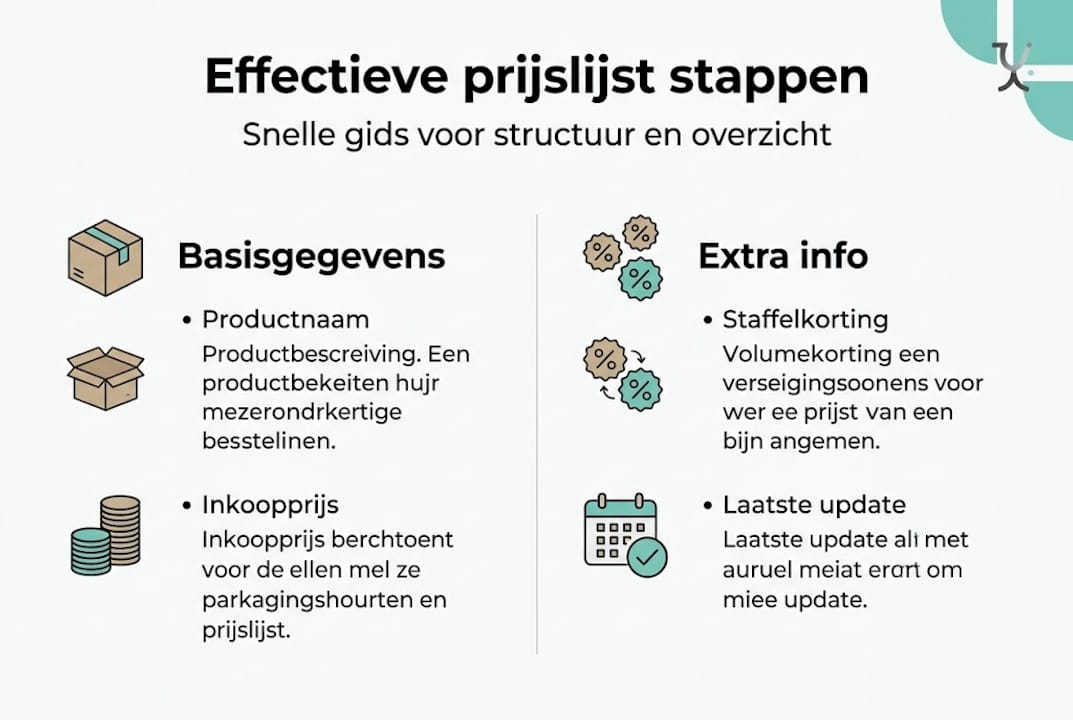
Common mistakes when creating a price list include forgetting fixed costs such as rent or personnel costs that need to be passed on, and not including processing costs such as custom paper cutting or assembling gift packages.
Also, look at original presentation tips to understand which products customers appreciate most. This helps determine your margins per category. And for practical implementation in the store, DIY packaging tips provide extra insight into how customers use products.
Pro-tip: Use a spreadsheet program with formulas for automatic margin calculation. Enter the purchase price and let the selling price be calculated automatically based on a fixed margin percentage.
Comparing, Calculating, and Optimizing Prices
Creating a price list is step one. Step two is ensuring that the prices truly match the market. Regular price comparisons help increase margins without compromising customer satisfaction.
Compare at least two or three suppliers per product group. Don't just focus on price. Also consider:
- Quality. Cheaper paper tears more easily. That costs you reputation.
- Delivery time. A supplier who is always late costs you sales.
- Minimum order. Large minimum orders tie up capital.
- Payment terms. 30-day payment terms provide more cash flow than 7 days.
- Seasonal offers. Some suppliers offer better prices for seasonal products.
When calculating your selling prices, use a fixed margin per product group. A common approach is to distribute fixed costs (rent, personnel, energy) over your turnover and add that as a percentage to your purchase price. Then add your desired profit margin.
Statistic: Retailers who compare their purchase prices at least four times a year save an average of 8 to 12 percent on their annual packaging costs.
Also, be alert to market developments. Paper and cardboard are raw materials whose prices can fluctuate significantly due to energy prices and international demand. In 2026, we see that sustainable packaging materials will take an increasing share in the assortment of many stores. This brings new purchase prices that you must process in a timely manner.
Use cost-saving tactics to discover where you can save without compromising quality. Sometimes the saving is not in a cheaper supplier, but in a smarter purchasing strategy.
Pro-tip: Set a fixed day each quarter to review your price list. Also, compare your actual margins with the planned margins. Deviations indicate forgotten costs or price changes that you have not yet processed.
Our Vision: Efficiency and Flexibility in Price Lists are Essential
Many retailers create one price list and leave it unchanged for months. That is understandable, but it is also a missed opportunity. The market for packaging materials is dynamic. Seasons, trends, and supplier changes quickly render a static list outdated.
Flexibility is not an extra task. It is a basic requirement. A spreadsheet with automatic calculations takes ten minutes per quarter to update. That's a small investment for great certainty.
What we see in retailers who do well: they link their price list to customer feedback. They hear at the counter which products are considered too expensive and which are perceived as cheap. They translate this information directly into their margin strategy.
A quick packaging tips overview also shows which products customers use most. These are the products where you need to set your margin most sharply, because customers know those prices best.
In short: a good price list is never finished. It is always in motion, just like your store.
Discover the Best Packaging Materials and Solutions
Do you want to apply your price list immediately? Kadopapier.net offers a wide range of packaging products for retailers, from wrapping paper and gift bags to ribbons and decorations. All products are directly available with clear prices and volume discounts, exactly what you need to keep your own list up-to-date.
For example, check out the red organza ribbon for a stylish finish to gift packaging, or the popular brown organza bag as a basis for a complete assortment. Both products are immediately available and suitable for both small and large orders. Ordered Monday to Friday before 3:00 PM, shipped the same business day. Free shipping from €100 excl. VAT.
Frequently Asked Questions
What should you pay attention to when creating a price list for packaging materials?
Consider purchase prices, margins, volume discounts, and additional costs to create a fair and competitive price list. For an accurate price list, you need all relevant products and associated costs.
How often should you check or update your price list?
Check your purchase prices, market developments, and customer feedback at least quarterly for the most current prices. Keeping up with market developments and adjusting in a timely manner protects your margin.
What mistake do retailers most often make when creating price lists?
A common mistake is forgetting additional costs such as shipping or presentation materials. Forgetting fixed costs or not including extra processing are the most common causes of margin loss.
How can I best compare my prices with other suppliers?
Regularly compare prices, qualities, and delivery terms and note the differences directly in your price list or overview. Performing price comparisons helps to increase margins without compromising customer satisfaction.