
Choosing a Paper Certification: Reliable Labels for Packaging
TL;DR:
- Certifications like FSC and PEFC guarantee responsible sourcing and production of paper.
- Always verify the license number via official websites to prevent greenwashing.
- Certified paper increases credibility, customer loyalty, and helps comply with regulations.
Paper packaging feels sustainable. But without a reliable certification, as a business owner or crafter, you can't be sure what you're really holding. The market is full of logos, terms like "eco" and "green," and promises that aren't always true. For retail businesses and artisanal makers who work daily with wrapping paper, gift bags, and decorative packaging materials, this uncertainty is a real risk. Customers are asking more questions. Regulations are becoming stricter. This article explains which certifications exist, what they guarantee, how to verify them, and what certified paper concretely offers you as a business owner.
Table of Contents
- What does a paper certification mean?
- The most important paper certifications at a glance
- How certification works: from forest to shop floor
- Environmental impact of paper: recycling and alternatives
- What does sustainable paper cost in practice?
- The true added value of a paper certification according to the expert
- Get started directly with sustainable packaging material
- Frequently asked questions about paper certification
Key Insights
| Point | Details |
|---|---|
| Choosing the right certification | FSC, PEFC, and Blauer Engel provide assurance of sustainable origin and production. |
| Verifying traceability | Always request a valid certificate and verify the license number of the supplier or manufacturer. |
| Environmental and cost considerations | Sustainable paper comes with a small premium but offers significant environmental and reputational benefits. |
| Alternatives available | Consider tree-free and recycled materials as additional eco-friendly options. |
What does a paper certification mean?
A paper certification is an independent, externally issued certificate that demonstrates that paper has been produced responsibly. This means: responsible forest management, fair labor conditions, minimal environmental damage, and traceable origin. Without such a certification, as a buyer or seller, you can never be sure whether a supplier's claims are true.
Paper certification primarily refers to FSC (Forest Stewardship Council), an international certification for paper from responsibly managed forests. FSC is the most recognized standard worldwide, and its logo is recognizable to consumers. But there are more certifications, and not every certification guarantees the same.
Common certifications you'll encounter as a retailer or maker:
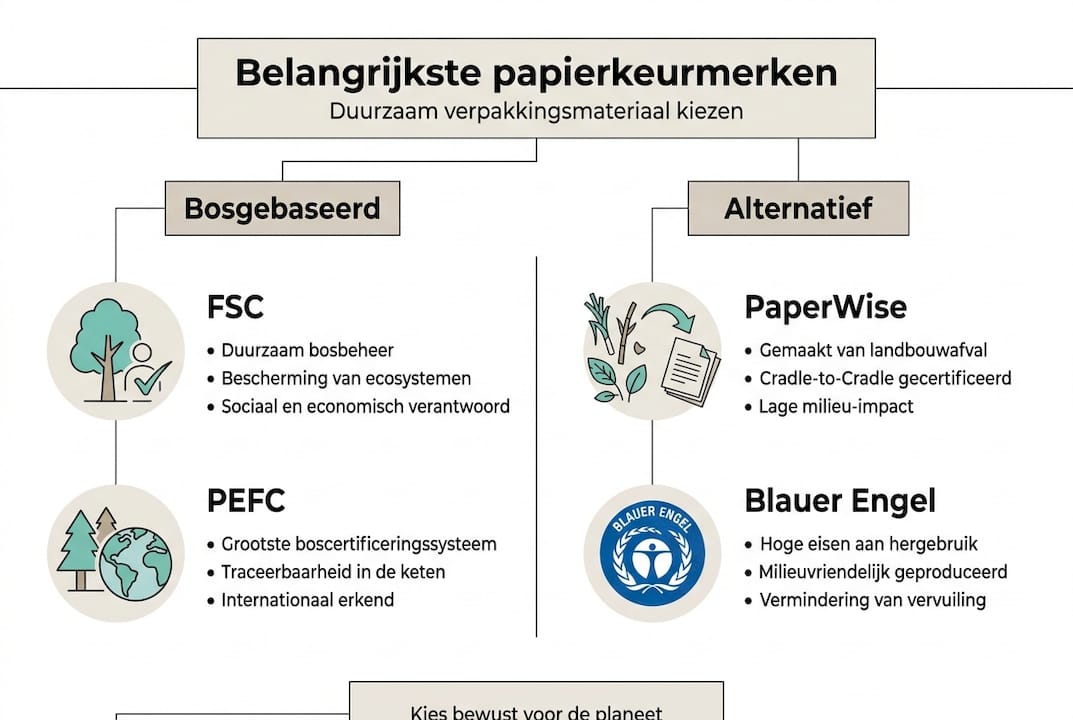
- FSC (Forest Stewardship Council): International, strict standards for forest management, three product labels possible.
- PEFC (Programme for the Endorsement of Forest Certification): European approach, national standards, widely used.
- PaperWise: Tree-free paper made from agricultural waste such as rice straw. No wood needed.
- Blauer Engel: German eco-label, only for 100% recycled paper without harmful substances.
“A logo on paper is not proof. Only a valid license number, verifiable via the official certification website, proves true certification.”
Greenwashing is a concrete problem in the packaging industry. Suppliers sometimes place a green logo on their packaging without official certification. This costs you, as a business owner, credibility with customers and can lead to legal problems, especially now that the EU actively enforces misleading environmental claims. The European Greenwashing Directive requires companies to demonstrably substantiate environmental claims from 2026.
Customers are increasingly asking for proof. Consumer research shows that a growing number of shoppers are willing to pay more for demonstrably sustainable packaging, but only if the proof is concrete and verifiable. A vague "eco-friendly" label no longer convinces anyone. Want to know more about what the certification means in practice? The FSC certification meaning explains the details.
In short: a paper certification is not just a marketing tool. It is an operational instrument that protects your purchasing policy and strengthens your communication with customers.
The most important paper certifications at a glance
Not every certification works the same way. Below you will find the most relevant labels for retail businesses and crafters, how they work, and their limitations.
FSC works through three product labels. FSC has three variants: FSC 100% (entirely from certified forests), FSC Mix (combination of certified wood, recycled material, and controlled wood), and FSC Recycled (minimum 85% post-consumer recycled material). FSC 100% is the strictest choice. FSC Mix is the most common variant in practice, as it is more flexible for producers.
PEFC takes a different approach. PEFC works bottom-up, through national certification programs that are then internationally recognized by PEFC. PEFC is considered by some to be less strict than FSC, but it is widely accepted in Europe and works well for Scandinavian and Central European wood.
PaperWise is a completely different category. This paper is made from agricultural waste that would otherwise be burned or discarded, such as rice straw or wheat stalks. No trees are cut. This makes it attractive for makers who want to work completely tree-free.
Blauer Engel is the strictest certification for recycled paper. Paper with this label consists of 100% waste paper, without optical brighteners and with minimal chemical burden. Especially suitable for office paper and packaging materials where color and purity are less critical.

| Certification | Basis | Origin | Control | Strictness level |
|---|---|---|---|---|
| FSC 100% | Certified forest | Worldwide | Independent | Very high |
| FSC Mix | Mix certified/recycled | Worldwide | Independent | High |
| FSC Recycled | Min. 85% recycled | Worldwide | Independent | High |
| PEFC | National forest certificate | Europe-wide | National/international | Medium/high |
| PaperWise | Agricultural waste | International | Independent | High (tree-free) |
| Blauer Engel | 100% waste paper | Germany | Official German | Very high |
What should you pay attention to per certification as a business owner?
- FSC: Always check the license number, not just the logo.
- PEFC: Ask which national program applies.
- PaperWise: Suitable if you want to communicate tree-free to customers.
- Blauer Engel: Ideal if you want to prove that paper is chemical-free and fully recycled.
Pro-tip: Always keep a copy of the supplier's certificate with your purchase orders. In case of a complaint or audit, you will immediately have proof that you have purchased carefully.
Want to know how FSC and PEFC relate to each other in practice? The FSC or PEFC explanation provides a good comparison.
How certification works: from forest to shop floor
The certification on your packaging roll means little if the chain behind it isn't right. Certification works according to the principle of Chain of Custody, which means that every link in the production chain, from forest manager to paper mill to printer to wholesaler, must be separately certified.
Certification requires Chain of Custody: every link in the chain from forest to final product must be certified. You can check your supplier's license number via the official FSC website. This check takes two minutes and prevents you from purchasing incorrectly labeled material for years.
Steps from forest to packaging material on your counter:
- Forest manager applies for certification from an accredited certification body (such as SGS or Bureau Veritas).
- Paper producer applies for a separate Chain of Custody certificate.
- Printer or converter obtains certification to be allowed to carry the logo.
- Wholesaler applies for certification to be able to sell certified products.
- Retailer or crafter checks supplier's certificate upon purchase.
As an end-user, you do not need to have an FSC certificate yourself to sell certified paper. But your supplier must have one. This is a common mistake: business owners think that the logo on the product is sufficient. It is not.
| Link | Required certification | Verify via |
|---|---|---|
| Forest manager | Forest management certificate | FSC/PEFC website |
| Paper mill | Chain of Custody | FSC certificate register |
| Printer/converter | Chain of Custody | Supplier documentation |
| Wholesaler | Chain of Custody | Purchase invoice + certificate |
| Retailer | No own cert. needed | Check supplier |
Only certified companies may claim the logo. For retail: always check the supplier's certificate. The EUDR (EU Deforestation Regulation) and previously the EUTR set stricter requirements for importers of wood products. Importers who do not comply risk fines and exclusion from the market.
Pro-tip: Store your suppliers' certificate numbers in a simple spreadsheet. This way, you can immediately prove that your procurement chain is correct in case of a customer query or inspection.
Want to read more about sustainable choices in your store? The page on recycling gift packaging provides practical steps for retailers.
Environmental impact of paper: recycling and alternatives
A certification guarantees origin. But what is the actual environmental impact of your paper choice? That's another question, and an important one for businesses that genuinely want to procure sustainably.
Recycled paper saves compared to virgin paper: 50% less energy, a fraction of water consumption (1/7 to 1/3), and 15% fewer greenhouse gas emissions. Specifically: a ream of 500 sheets of recycled paper saves 5.5 kg of wood and 7.5 kWh of energy compared to virgin paper.
“Recycled paper is not always the perfect choice for every use, but for packaging material where appearance is less critical, it offers substantial environmental benefits.”
When does recycled paper really make sense?
- For packaging material that doesn't need to be visibly white, such as brown kraft paper or tissue paper.
- For large volumes where the cumulative energy savings are significant.
- If your communication to customers focuses on transparent environmental claims.
Recycled paper also has limitations. After multiple recycling rounds, the fibers become shorter and weaker. The quality decreases. For high-quality presentation material or durable packaging where sturdiness matters, virgin FSC-certified paper is sometimes a better choice.
Alternatives are also worth considering:
- PaperWise: Made from agricultural waste, tree-free, similar properties to standard paper.
- Stone paper: Made from calcium carbonate (stone dust), waterproof and tear-resistant. No wood, no water in production.
- Biodegradable paper with coating: Compostable, but check if the coating is truly biodegradable and does not contain microplastics.
As a retailer or crafter, do you want to be able to explain to customers why you make conscious choices? Then use concrete figures. "Our wrapping paper saves 5.5 kg of wood per pack" is more convincing than "we choose sustainable." Also, check out packaging alternatives for practical inspiration. And for step-by-step advice on responsibly handling used packaging, the page on recycling wrapping paper tips offers concrete guidance.
What does sustainable paper cost in practice?
Price is the first hurdle for many entrepreneurs when it comes to sustainable purchasing. This hurdle is actually quite manageable, but you need to be aware of it.
FSC-certified paper costs an average of 5 to 15% more than comparable conventional paper. For large purchase volumes, this difference becomes relatively smaller, as certification costs are partly fixed overhead for the producer.
| Paper Type | Average price increase | Suitable for |
|---|---|---|
| FSC Mix | 5 to 8% | Daily packaging work |
| FSC 100% | 10 to 15% | Premium presentation |
| FSC Recycled | 0 to 5% | Budget and environmentally conscious |
| PaperWise | 10 to 20% | Tree-free positioning |
| Blauer Engel | 5 to 10% | Chemical-free recycled |
What does the extra cost yield?
Branding is the first return. Customers who consciously choose stores with demonstrably sustainable packaging are more loyal and spend more. An FSC logo on your packaging material is a visible signal. It strengthens your positioning without requiring a lot of extra marketing budget.
Risk management is the second return. With certified paper, you comply with current and future regulations. The EU Green Claims Directive mandates demonstrable substantiation of environmental claims. Those who already purchase certified products now will not have to restructure later.
Cost control tips:
- Buy larger volumes to reduce the extra cost per unit.
- Combine FSC Mix for standard use with FSC 100% for presentation material.
- Use recycled FSC paper for the back and fillers, reserve premium paper for the front.
- Always compare the total price including transport and delivery time, not just the unit price.
Also check out the range of sustainable packaging for concrete product choices that align with responsible purchasing.
The true added value of a paper certification according to the expert
Certifications are not a formality. They are a practical tool, but only if you actively use and understand them.
The most underestimated risk in practice: suppliers displaying the FSC logo on their website but unable to provide a valid chain-of-custody certificate. This happens more often than you think, even with established names. The check takes two minutes via the FSC website, but most entrepreneurs never do it.
For retailers and crafters: choose FSC or PEFC for paper with forest origin, choose PaperWise if you want to communicate tree-free, and always verify your supplier's license number and chain of custody. Otherwise, it remains a logo without coverage.
What suppliers don't always tell you: FSC Mix can legally contain only a small percentage of certified wood. The name sounds robust, but the standard allows a significant proportion of uncontrolled wood. For stores that really want to make an impact, FSC 100% or FSC Recycled is a better choice.
Communication to customers also deserves attention. Don't just put a logo on your packaging. Explain what it means. "This paper is FSC Recycled: made from at least 85% recycled material" is concrete and verifiable. Customers appreciate that. And if you also work with biodegradable wrapping paper, combine that with a clear explanation of what biodegradable means in your context.
Buying a certification is easy. Understanding and actively using it as part of your purchasing strategy and customer communication is where real value is created.
Get started with sustainable packaging materials
Choosing certified paper is step one. The rest of your packaging line deserves the same attention. At Kadopapier.net you will find a wide range of packaging materials that align with responsible purchasing choices. From practical decoration elastic wholesale for custom finishing to decorative details such as the paperlook curling ribbon pink for gift presentation. If you want to work with seasonal collections, the organza Christmas ribbon wholesale offers attractive options in large volumes. Order Mon-Fri before 3 PM, shipped the same business day. Free shipping from €100 excl. VAT.
Frequently asked questions about paper certification
How do I know if paper is truly sustainably certified?
Always check the FSC or PEFC license number via the official website and ask your supplier for the chain of custody certificate. Only a valid, verifiable number proves true certification.
What is the difference between FSC Mix and FSC Recycled paper?
FSC Mix combines certified wood, recycled material, and controlled wood in one product, while FSC Recycled consists of at least 85% post-consumer recycled paper. FSC Recycled is the better choice if you want to guarantee maximum recycled content.
Is recycled paper always better for the environment?
Recycled paper significantly saves energy and water compared to virgin paper, but fiber quality decreases with multiple recycling rounds. Labels such as Blauer Engel guarantee that the recycled paper is also chemical-free.
How much more expensive is certified paper?
The additional cost varies from 5 to 15%, depending on the type of certification and the purchase volume. For larger orders, the percentage difference becomes smaller.