
Luxury Packaging Standards in 2026
TL;DR:
- Luxury packaging determines brand perception within 2.7 seconds through tactile and visual cues. From 2026, strict European regulations such as traceability, testing standards, and recycling requirements will apply, influencing design practices. Consistent use of high-quality materials and sensory cues strengthens brand value and complies with sustainable and technical standards.
Luxury packaging determines a product's brand perception within 2.7 seconds through tactile and visual cues. That's not marketing hype. It's a fact that forces designers and businesses to take packaging more seriously than ever. Standards for luxury packaging will be under pressure from two sides in 2026: increasingly strict European regulations and rising consumer expectations regarding sustainability. This guide covers the European obligations, technical quality standards, eco-friendly trends, and design principles that truly distinguish luxury packaging today.
Table of Contents
- Key Insights
- European Packaging Regulations from 2026
- Technical Quality Standards for Luxury Packaging
- Sustainability and Eco-Friendly Trends
- Design Standards and Aesthetics for Luxury Packaging
- My Vision on Standards and Luxury Packaging
- Premium Packaging Materials from Kadopapier
- FAQ
Key Insights
| Point | Details |
|---|---|
| PPWR compliance mandatory from August 2026 | Packaging must be traceable with a batch or serial number and a documented conformity file. |
| Drop tests are the basic standard | Luxury packaging is tested via five vertical drops from 1.5 meters without allowing damage. |
| Eco-luxury requires higher investment | The switch from plastic to paper consumes 45% less plastic, but entails higher costs and slower production. |
| Design for Recycling becomes mandatory | Strict recyclability criteria apply from 2030; designers can already anticipate this for a competitive advantage. |
| Sensory cues determine brand value | Weight, texture, and closing mechanism are not details but strategic design elements in premium packaging. |
European Packaging Regulations from 2026
The Packaging and Packaging Waste Regulation, better known as PPWR, is the biggest overhaul of European packaging legislation in twenty years. For designers and companies that produce or purchase luxury packaging, much will change concretely and quickly.
From August 12, 2026, packaging must be traceable with a type, batch, or serial number. Companies are obliged to maintain a conformity file with material and safety information. This obligation applies to all companies with more than ten employees. Small workshops and designers sometimes fall outside this scope, but anyone producing for larger retailers or export markets will always have to deal with these requirements.
What many companies underestimate are the restrictions on harmful substances. The PPWR sets limits for PFAS in food contact packaging: 25 ppb per substance, 250 ppb total, and a maximum of 50 ppm fluorine content. For heavy metals, a combined limit of 100 mg/kg applies. This directly affects the choice of coatings, inks, and laminates for premium packaging.
The roadmap towards 2030 further increases the urgency:
- 2026: Traceability, conformity files, and sorting labels mandatory
- 2028: Publication of implementing acts for Design for Recycling
- 2030: Mandatory recyclability criteria and minimum requirements for recycled material content
- 2035: Stricter standards for recycled content per packaging category
Companies that already integrate recyclability and circularity into their design process will gain a measurable competitive advantage before the mandatory regulations of 2030 come into effect.
Pro-tip: Reserve space for the harmonized EU sorting label in every new packaging design. Many designers forget this and later have to redesign, which leads to extra costs and delays.
Technical Quality Standards for Luxury Packaging
Luxury packaging that looks beautiful but gets damaged during transport costs a brand more than the packaging was ever worth. Technical quality standards determine whether packaging actually meets the requirements you set for premium products.
The basic standard for drop tests consists of five vertical drops from 1.5 meters without visible damage. Two international standards frequently used here are ASTM F1140 and ISO 8295. ISO 8295 specifies the test details: a test speed of 100 mm/min with a tolerance of plus or minus 10 mm/min and a contact time of 15 seconds.
A good test plan for luxury packaging includes more than just a drop test. A professional test plan looks like this:
- Conditioning. Packaging is exposed to conditioned temperature and humidity to simulate transport conditions.
- Vibration tests. Simulation of road and sea transport to check resonant frequencies and packaging integrity.
- Compression tests. Testing how much stacking weight packaging can withstand without deformation.
- Drop tests in multiple orientations. Drop on flat surface, corner, and edge to cover realistic transport risks.
- Documentation and damage classification. Reporting with failure analysis and recommendations for corrective measures.
| Test Type | Standard | Application |
|---|---|---|
| Drop Test | ASTM F1140 / ISO 8295 | Basic test for all luxury packaging |
| Vibration Test | ISTA 2A | Road and sea transport |
| Compression Test | ASTM D642 | Stackability and storage load |
| Conditioning | ISO 2233 | Moisture resistance and temperature stability |
Major brands standardly validate transport resistance with a complete test plan including photo documentation and analysis per test phase. This is not overkill. It is the minimum standard for premium products shipped internationally.
Pro-tip: Have test results documented by a certified laboratory. Retailers and importers are increasingly asking for written proof of packaging tests for luxury product lines, especially for export to the US or Japan.
Who should be involved in quality control? In any case, the packaging designer, the production manager, and a logistics specialist who knows the transport routes. Decisions made purely aesthetically without input from logistics regularly lead to damage that was entirely preventable.
Sustainability and Eco-Friendly Trends
The shift from plastic to paper and natural materials is not a temporary trend. It is a structural movement driven by both consumer demand and legislation. For luxury packaging, this poses a specific challenge: how do you maintain a premium appearance while complying with stricter environmental standards?

The switch to paper-based alternatives consumes 45% less plastic but entails higher costs and slower production. This makes eco-luxury packaging less suitable for budget segments, but well-suited as a brand differentiator in the premium segment. A good example is Looye Kwekers, which used its packaging conversion as a brand story justifying the higher costs.
Design for Recycling, or DfR, is the design concept that will become mandatory by 2030. It means that packaging is designed so that materials are easy to separate and recycle. This means:
- No combination of non-separable material types in one package
- Avoiding foil coatings on paper that block recycling
- Using water-based inks instead of solvent-based variants
- Simple construction without glue or mechanical connections that are not recyclable
The challenges with eco-luxury packaging are real. Paper has different printing and finishing properties than plastic. Metal-free foil printing requires different production processes. Higher raw material prices put pressure on margins. Nevertheless, successful brands show that sustainability and premium appearance go hand in hand if you align material choice and design from the start.
| Strategy | Advantage | Consideration |
|---|---|---|
| Paper with textured embossing | Premium feel without plastic coating | Higher production costs |
| Recycled cardboard with foil accents | Recyclable with luxury detail | Foil must be separable |
| Biodegradable tissue paper | Sustainable and tactilely appealing | Limited color options |
| Plant-based colored materials | Authentic and distinctive | Longer production times |
Companies that anticipate recyclability and circular requirements now gain a competitive advantage over companies that wait. This lead is concrete: fewer adaptation costs in 2030 and a brand position that aligns with what consumers already expect from premium brands today. More background on how PPWR legislation influences practical choices can be found in the article on eco packaging materials and PPWR.
Design Standards and Aesthetics for Luxury Packaging
Aesthetics are not a subjective matter when it comes to luxury packaging. There are measurable design principles that determine whether packaging is perceived as premium. Sensory cues play a leading role in this.
The customer experience with luxury packaging is directly influenced by weight, texture, sound, and closing mechanism. A box that feels too light undermines the perceived value of the product inside, even if the content is high-quality. Magnetic closures, engraved relief printing, and matte lamination are not decoration. They are functional design choices that convey brand value.
Materials and finishes consistently associated with premium packaging:
- Grayboard or white board with higher grammage. Provides weight and sturdiness that consumers immediately register.
- Matte or soft-touch lamination. Reduces reflection and gives a tactile feel that plastic alternatives do not offer.
- Foil printing and UV spot varnish. Selective gloss on a matte background creates visual depth and exclusivity.
- Textured paper types. Linen, hammer-finished paper, or ribbed cardboard give an organic premium feel.
- Ribbon and finishing details. Organza or satin ribbon as part of the packaging noticeably enhances the unboxing experience.
When designing luxury packaging in 2026, you must directly consider future legal requirements. This means: reserving space for the EU sorting label, choosing recyclable materials, and avoiding finishes that block the DfR principle. This does not have to limit aesthetics. Matte, natural, and textured finishes are popular design trends and comply better with recyclability criteria than full-surface foil coatings.
Pro-tip: Test your packaging design with a small test group of end-users before production. Specifically ask about tactile experience and opening experience. What looks good visually in a digital mockup sometimes feels very different in reality.
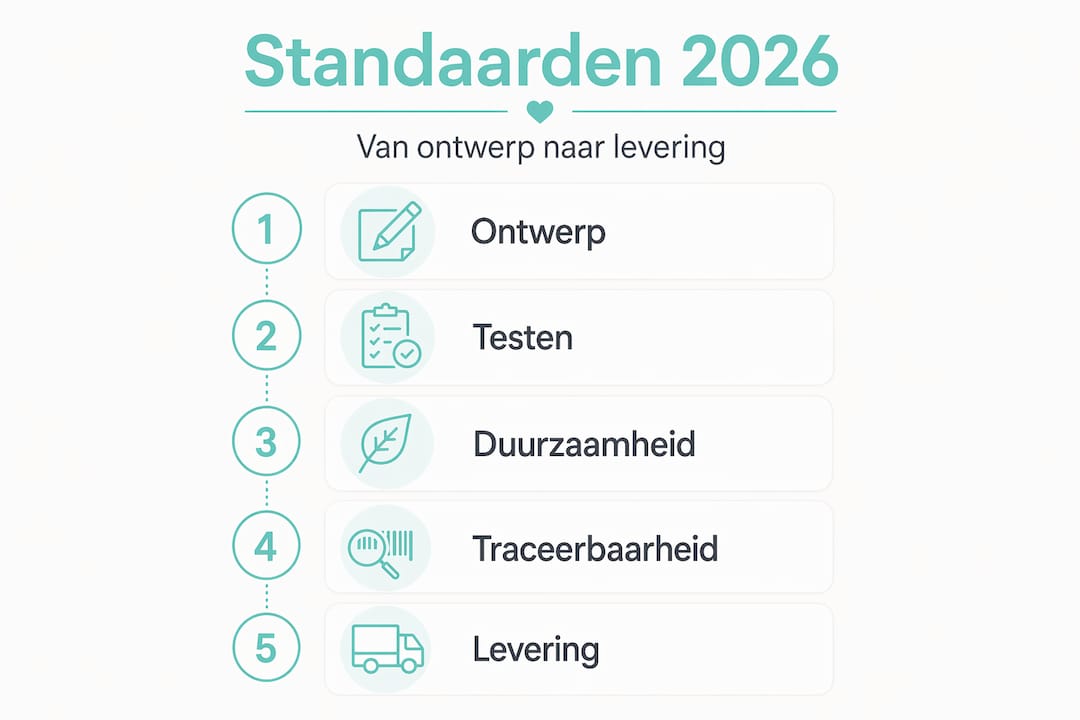
The role of packaging design in brand perception is greater than many companies realize. Consistent premium packaging design across all products and seasons strengthens brand recognition and increases consumers' willingness to pay a higher price. More concrete design tips are elaborated in the article on designing luxury gift packaging.
My Vision on Standards and Luxury Packaging
What I see in practice is that companies often treat luxury packaging standards as a checklist to be ticked off at the end of the design process. That is precisely the wrong order. Regulations like the PPWR and technical quality requirements are not limitations imposed on a finished design. They are parameters within which your design must live from the outset.
I have seen time and again that the largest cost overruns in packaging projects do not come from material prices, but from redesign processes that are needed afterwards. A designer who only discovers at the end of the process that their foil is not recyclable, or that there is no room for the EU sorting label, loses weeks and budget. The solution is trivial: involve compliance and logistics in the initial design consultation.
My most underestimated advice for 2026: choose honesty in material use. Consumers recognize packaging that claims sustainability but hides plastic behind a paper exterior. The brands that truly win are those that let their materials speak without pretension. Untreated kraft cardboard with good construction and a single organza ribbon accent often communicates more luxury than an overly laminated box.
I expect strong growth in modular packaging in the coming years: basic boxes that can be adapted per season or product line via interchangeable outer layers or closing mechanisms. This brings both cost benefits and design consistency, and perfectly aligns with the DfR principles that will become mandatory anyway.
— M
Premium Packaging Materials from Kadopapier
Kadopapier offers a wide range of premium packaging materials and accessories for companies looking to create luxury packaging that meets current design standards and regulations. The assortment includes not only wrapping paper and gift bags but also an extensive selection of finishing materials that enhance the unboxing experience.
For finishing luxury packaging, Kadopapier offers, among other things, luxury organza Christmas ribbons in glitter, wired, and non-fraying versions. This type of ribbon immediately adds a tactile and visual premium element to any packaging, which aligns with the design principles described in this article. Ordering before 3:00 PM on weekdays means same-day shipping. Free shipping on orders over 100 euros excluding VAT.
Kadopapier specifically targets businesses working with larger volumes and high-quality demands. Our product range meets the need for consistent, brand-aligned packaging solutions that are both aesthetically pleasing and functionally robust. More inspiration for exclusive packaging options for premium retail concepts is available on the Kadopapier blog.
FAQ
What are the PPWR obligations for packaging in 2026?
As of August 12, 2026, packaging must be traceable via a type, batch, or serial number. Companies with more than ten employees are required to maintain a compliance file with material and safety information.
How are luxury packages technically tested?
The standard drop test consists of five vertical drops from 1.5 meters without damage, based on standards such as ASTM F1140 and ISO 8295. A complete test plan also includes conditioning, vibration, and compression tests that simulate real transport conditions.
What is Design for Recycling in luxury packaging?
Design for Recycling, or DfR, means that packaging is designed so that materials are easy to separate and recycle. From 2030, DfR criteria will become mandatory in the EU for all packaging.
How do you combine a luxurious look with eco-friendly materials?
Choose paper with an embossed texture, matte lamination on recyclable material, or biodegradable tissue paper as inner packaging. Avoid foil coatings that cover the entire surface, as these block recycling and do not comply with DfR principles.
What design elements distinguish luxury packaging?
Weight, texture, closure mechanism, and finishing details such as matte lamination, foil accents, and high-quality ribbons determine the perceived brand value. Consumers register these sensory cues within 2.7 seconds of the first touch.