
What is budget packaging: explanation and tips
TL;DR:
- Budget packaging minimizes the total cost of ownership by balancing price, protection, and functionality.
- The TCO concept shows that the purchase price is not the only cost element, as damage and labor costs can be higher.
- Through standardization, bulk purchasing, and smart design choices, small business owners can save costs without sacrificing quality or appearance.
Budget packaging is a packaging solution that balances cost, protection, and functionality by minimizing the total cost of ownership, not just the purchase price. This distinction is crucial: the cheapest packaging is rarely the most economical choice. Small business owners who budget packaging costs at 2 to 8% of the product price know that every euro saved on material can sometimes be repaid twice in damages, returns, or extra labor hours. Smart budget packaging looks beyond the unit price and considers all costs associated with the packaging process.
What exactly is budget packaging?
Budget packaging is optimized for total cost, not purely for the lowest price. That is the core difference with cheap packaging. While cheap packaging simply has the lowest purchase price, budget packaging aims for the best balance between price, protection, and usability over the entire lifecycle.
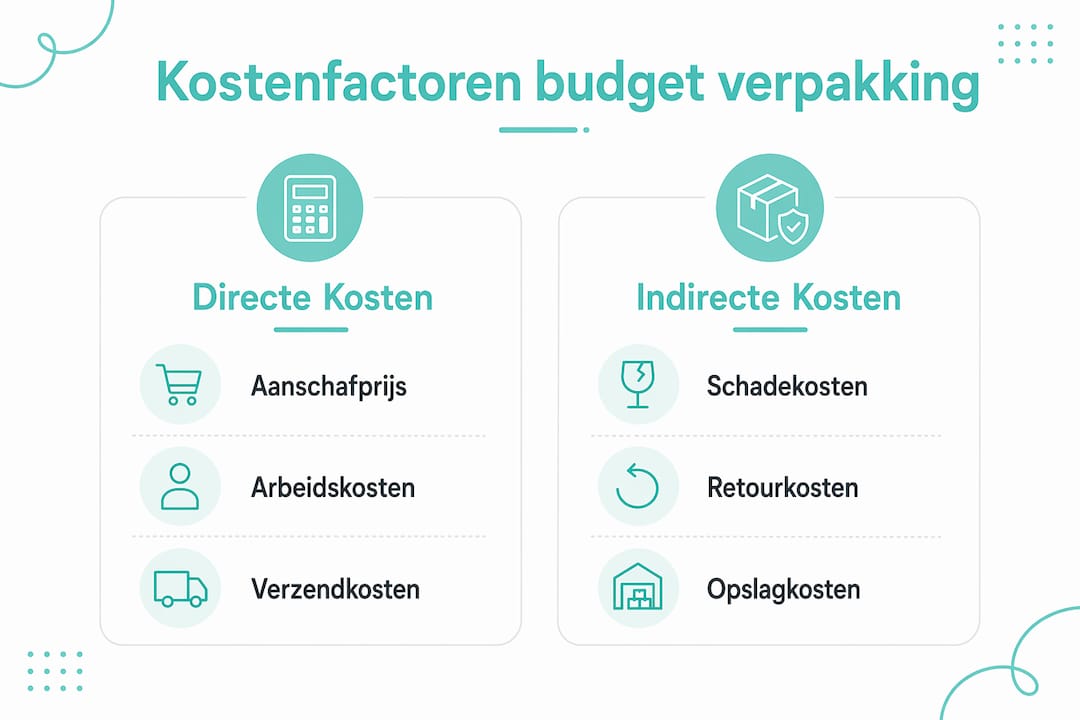
The central concept here is Total Cost of Ownership, or TCO. TCO includes not only the purchase price of the material but also transport costs, labor costs for packing, failure costs due to damage, and the costs of returns. TCO includes acquisition, transport, failure costs, and labor costs, and those who only look at the unit price miss most of the picture.
Practically speaking, this means a sturdy cardboard box costing 0.45 euro per piece can be more economical than a flimsy box costing 0.30 euro if the latter causes damage in one out of ten shipments. The hidden costs of poor packaging, such as rework costs, customer contact, and return logistics, are rarely visible in a quote but are certainly in your profit margin.
What factors determine the cost of packaging?
The price of packaging is determined by a combination of factors that you, as a business owner or consumer, can directly influence.
- Material type: Cardboard, kraft paper, tissue paper, and organza ribbon each have their own price range. Cardboard is robust and cheap in large volumes. Tissue paper is light and affordable but offers less protection for fragile products.
- Standard versus custom: Standard sizes are always cheaper than custom. Standard materials with your own personalization via stickers or labels are over 60% cheaper than fully custom. That's a concrete amount you'll see directly reflected in your purchase price.
- Order quantity: Bulk purchasing significantly lowers the unit price. Those who order 500 boxes instead of 50 often pay 30 to 50% less per piece.
- Delivery time: Express deliveries cost extra. Those who plan ahead and maintain a buffer avoid express costs that unnecessarily drive up the packaging price.
- Protection level: Packaging that offers too little protection costs money through damage and returns. Packaging that is excessively heavy costs money through material and weight. Finding the balance is at the core of budget packaging explanation.
Pro-tip: Always calculate the cost per shipment, not per package. Include labor costs for packing, shipping costs based on weight and dimensions, and a percentage for damage. That gives you the real number.
What are the advantages of budget packaging compared to cheap packaging?
Budget packaging offers structurally lower total costs than purely cheap packaging because it includes protection and efficiency in the consideration. This sounds like a small difference, but in practice, it is crucial for your profit margin.

| Aspect | Cheap Packaging | Budget Packaging |
|---|---|---|
| Purchase Price | Lowest possible | Optimal for TCO |
| Protection | Often insufficient | Sufficient for the product |
| Hidden Costs | High (damage, returns) | Low to average |
| Labor Costs for Packing | Variable, sometimes high | Optimized |
| Sustainability | Often single-use | Sometimes reusable |
Indirect costs can increase total costs by 40 to 60% for cheap packaging that offers insufficient protection. This means that packaging that is 5% cheaper per piece but causes damage twice a quarter will ultimately be more expensive than a slightly more expensive, better-protecting variant.
Slightly more expensive packaging that prevents damage is always cheaper in the long run than cheap solutions that lack product protection.
Circular and reusable packaging are a special category within budget thinking. Circular packaging solutions reduce TCO by 20 to 40% and can lower costs per use by up to 97% with 30 reuses. For small business owners who regularly serve the same customers, such as with subscription boxes or local delivery, this is a concrete saving.
Labor costs for packing and unpacking are one of the most underestimated hidden costs. With thousands of shipments per year, hundreds of extra hours of labor can suddenly make seemingly cheap packaging very expensive. Budget packaging that is quick and easy to close saves time per item. Over a year, that adds up.
How to practically save with budget packaging?
Saving on packaging isn't about buying the cheapest material. It's about making smart choices that reduce your total costs. Here are the most effective strategies:
-
Buy in bulk and standardize. Choose two or three standard sizes that fit your best-selling products. Standardizing your assortment allows you to order larger quantities per size and benefit from lower unit prices. Smart purchasing strategies reduce packaging costs by 20 to 40% without losing quality or protection.
-
Use standard packaging with your own branding. Buy neutral boxes, bags, or wrapping paper and add your logo with a sticker or label. This is the most cost-effective way to create a professional look. Standard packaging with personalization costs over 60% less than fully custom, while the result for the customer is barely different.
-
Optimize the packaging design. Use material only where it's needed. Optimization often lies in the design, for example, by placing protective material only at support points instead of fully enveloping the product. This saves material without losing protection.
-
Use modular systems and smart void fill. One basic package with varying void fill, such as kraft paper, tissue paper, or paper shreds, suits many different products. This way, you don't need to keep dozens of different boxes in stock.
-
Choose the right supplier and manage your inventory. A supplier who delivers quickly and has no minimum order quantity gives you flexibility. Maintaining a small buffer avoids rush orders with higher costs. Check out the practical savings strategies for retailers for a detailed overview of purchasing techniques that also work for small business owners.
Pro-tip: Calculate once how many packages you use per month and multiply that by 3. That's your ideal inventory level. This way, you always order in larger quantities without your warehouse filling up.
When is budget packaging the right choice?
Budget packaging is not suitable for every product and every situation. The choice depends on product value, fragility, shipping frequency, and return logistics.
Budget packaging is the right choice when:
- The product is not fragile or delicate, such as clothing, paper products, or non-fragile decorations.
- You ship a high volume, and every cent per item counts for your margin.
- The packaging primarily serves a functional role and is not part of the customer's brand experience.
- You're wrapping gifts for personal use, where appearance matters but costs need to be limited.
- As a small business owner, you're just starting and want to spread an initial investment of 500 to 2000 euros for packaging stock across standard materials.
Budget packaging is less suitable when:
- The product is fragile, expensive, or sensitive. Electronics, glassware, or jewelry require packaging that prioritizes protection, even if it costs more per item.
- The packaging plays a direct role in the customer experience, such as with luxury gifts or premium brands where the unboxing experience is part of the product.
- The return frequency is high. Packaging that cannot withstand return logistics significantly increases your costs per return.
For those who are unsure, a TCO analysis is the most reliable method. Add up the purchase price with expected damage costs, labor costs, and return costs over a year. Compare that number for two or three packaging options. The result almost always points to the budget packaging that scores best on total costs, not the cheapest on the invoice. More about sustainable choices within this framework can be found in Kadopapier's complete guide to reusable packaging.
Key Insights
Budget packaging is the packaging with the lowest total cost of ownership, not the lowest unit price, and this distinction determines whether you save or lose money in the long run.
| Point | Details |
|---|---|
| TCO is the benchmark | Always calculate acquisition, labor, damage, and return costs together, not just the unit price. |
| Standard plus personalization | Neutral packaging with a sticker or label costs over 60% less than fully custom. |
| Bulk purchasing lowers costs | Smart purchasing reduces packaging costs by 20 to 40% without loss of quality. |
| Cheap can be more expensive | Packaging that is 5% cheaper but causes damage ultimately costs more than a better variant. |
| Circular options save structurally | Reusable packaging reduces TCO by 20 to 40% over its lifecycle. |
What I've learned about budget packaging in practice
After years of working with small business owners and consumers looking for packaging solutions, one pattern keeps recurring: the biggest mistakes are made in the first purchase. Someone chooses the cheapest box, ships a hundred packages, and then discovers that ten percent arrive damaged. The costs of those returns, customer contact, and replacement shipping far outweigh the savings on the packaging itself.
What I've learned is that TCO thinking is not a complex concept. It's simply honest accounting. You don't need to create a twenty-tab spreadsheet. One simple calculation—purchase price plus expected damage costs plus labor costs per hundred shipments—already provides enough insight to make a better decision.
The second lesson is that standardization is underestimated. Business owners who use five different box sizes pay more per piece, hold more inventory, and waste more time choosing the right packaging for each order. Two well-chosen sizes cover ninety percent of needs in most cases.
Finally, budget packaging doesn't have to look cheap. A neutral kraft box with a pretty ribbon and a sticker with your logo looks professional and costs a fraction of fully custom packaging. That's exactly what budget-friendly gift wrapping for gift shops is about: smart choices that look good without breaking the bank.
— M
Affordable packaging materials at Kadopapier
Kadopapier offers a wide range of standard packaging materials directly suitable for budget packaging. From kraft paper and tissue paper to gift bags and cardboard boxes: all products are available in larger quantities at competitive prices. For small business owners who want to give their packaging a professional look without custom costs, Kadopapier provides practical solutions. Add a roll of organza Christmas ribbon to neutral packaging, and the result immediately looks luxurious, for a fraction of the price of custom packaging. Orders placed before 3:00 PM are shipped the same business day. Free shipping from 100 euros excluding VAT.
FAQ
What is the difference between budget and cheap packaging?
Cheap packaging has the lowest purchase price. Budget packaging has the lowest total cost, including protection, labor, and damage risk. These two are rarely the same product.
How much should I budget for packaging as a small business owner?
Small business owners typically budget packaging costs at 2 to 8% of the product price, with an initial inventory investment of 500 to 2000 euros, depending on volume and product category.
When is budget packaging not the right choice?
For fragile, expensive, or sensitive products, or when packaging plays a direct role in the customer's brand experience, investing in better packaging is almost always more economical in the long run.
How do I make cheap packaging look professional?
Use standard neutral packaging and add a logo sticker, a ribbon, or tissue paper. This costs a fraction of custom work and gives a similar result in appearance.
Are reusable packages also budget packages?
Yes. Circular and reusable packaging reduce total cost of ownership by 20 to 40% and are therefore one of the most effective forms of budget packaging for businesses with regular customers or repeated shipments.