
Efficient storage of packaging materials for retailers
Many retail sellers of packaging materials find that their storage space quickly becomes chaotic due to incorrect shelving choices and poor organization. This leads to unnecessary costs, loss of space, and delays in the workflow. Research shows that warehouse racking is crucial for efficient storage, but many companies do not apply it correctly. In this article, you will find proven solutions: from suitable racking types to organizational principles such as FIFO and ABC analysis, plus innovative methods for sustainable storage. You will receive concrete tools to optimize your storage space and achieve sustainability goals.
Table of Contents
- Key Points
- Effective Storage Methods for Packaging Materials
- Organizational Principles in Storage: FIFO and ABC Analysis
- The Role of Reusable Packaging in Storage and Sustainability
- Vertical Storage and Spatial Efficiency
- Practical Applications and Successful Examples in Retail
- View Our Packaging Products for Your Storage Needs
- Frequently Asked Questions about Packaging Material Storage
Key Insights
| Point | Details |
|---|---|
| Correct shelving types | Choosing the right shelving type prevents wasted space and increases efficiency. |
| FIFO and ABC analysis | FIFO ensures older stock is used first, and ABC places A items near picking zones. |
| Clear layout per shelf | Separating heavy and light materials better utilizes space and increases safety. |
| Quarterly usage evaluation | Each quarter, an assessment is made of which materials are most used, and the storage layout is adjusted. |
Effective Storage Methods for Packaging Materials
Choosing the right type of shelving is the foundation for efficient storage. Many retailers make the mistake of using one type of shelving for all materials, which leads to wasted space and inefficiency. Different packaging sizes and weights require specific solutions.
Pallet racking is ideal for heavy pallets and large volumes. They support high weights and allow for vertical stacking, maximizing capacity. Shelf racking works perfectly for light boxes, rolls of wrapping paper, and smaller materials that need frequent access. Wide-span shelving offers flexibility for irregular or bulky items such as large bags, boxes in various sizes, or decorative materials.
The layout by shelving type prevents you from wasting space on underutilized zones. A clear separation between heavy and light materials also increases safety and speeds up the picking process. Combine shelving types strategically: place shelf racking near workstations for frequently used materials, while pallet racking is suitable for bulk inventory in less accessible zones.
Pro-tip: Quarterly evaluate which materials are most used and adjust your shelving layout accordingly. This keeps your storage dynamic and efficient.
Here is an overview of the main shelving types:
| Shelving Type | Characteristics | Best Application |
|---|---|---|
| Pallet racking | High load capacity, vertically stackable, suitable for forklift | Heavy pallets, large volumes, bulk storage of boxes and rolls |
| Shelf racking | Adjustable shelves, manual access, light to medium loads | Small boxes, rolls of wrapping paper, ribbons, decorative materials |
| Wide-span shelving | Flexible layout, large bays, suitable for irregular shapes | Bulky items, seasonal decorations, various sizes |
| Drive-through racking | Access from two sides, FIFO principle, high density | Fast throughput, products with expiration dates |
For smart packaging tips that align with efficient storage, consider how your shelving choice affects the workflow. A well-organized storage not only speeds up the picking process but also reduces damage. Integrate your shelving choice with packaging material inventory management for optimal results.
Organizational Principles in Storage: FIFO and ABC Analysis
Even with the right shelving, chaos will arise without solid organizational principles. Two methods dominate in professional storage environments: FIFO and ABC analysis. These systems transform arbitrary storage into a streamlined operation.
FIFO stands for First In, First Out. This principle ensures that older stock is used first, which prevents obsolescence and waste. For packaging materials, this means that rolls of paper or boxes that have been stored the longest are picked first. Implement FIFO by creating a clear entry and exit point for each shelving compartment, placing new stock at the back.
ABC analysis categorizes products based on turnover rate. A-items have a high turnover rate and generate the most volume, B-items are average, and C-items move slowly. By placing A-items near picking zones, you dramatically reduce travel time and increase efficiency. For a retail seller of packaging materials, popular ribbons and bags can be A-items, while seasonal decorations might be C-items.
Here is a step-by-step plan to apply both principles:
- Analyze your sales data from the past 6 months to determine turnover rate per product.
- Classify products into A, B, and C categories based on volume and frequency.
- Assign A-items to the most accessible shelving locations, close to workstations.
- Implement FIFO by adjusting shelving with clear entry and exit points.
- Label each location with the receipt date and use colored stickers for visual control.
- Train staff to consistently follow FIFO and ABC principles.
- Evaluate monthly whether products remain correctly classified and adjust if necessary.
The combination of FIFO and ABC analysis creates a self-correcting system. Employees know exactly where to go for specific items, which reduces errors. For detailed implementation, consult our inventory management guide, which delves deeper into tracking and optimization.
Pro-tip: Conduct an ABC reclassification quarterly, especially after seasonal peaks. Products shift between categories, and your storage should adapt.
The Role of Reusable Packaging in Storage and Sustainability
Reusable packaging is gaining ground in retail, driven by sustainability goals and cost savings. However, it requires a fundamentally different storage approach than disposable packaging. Without proper systems, reuse leads to chaos instead of efficiency.
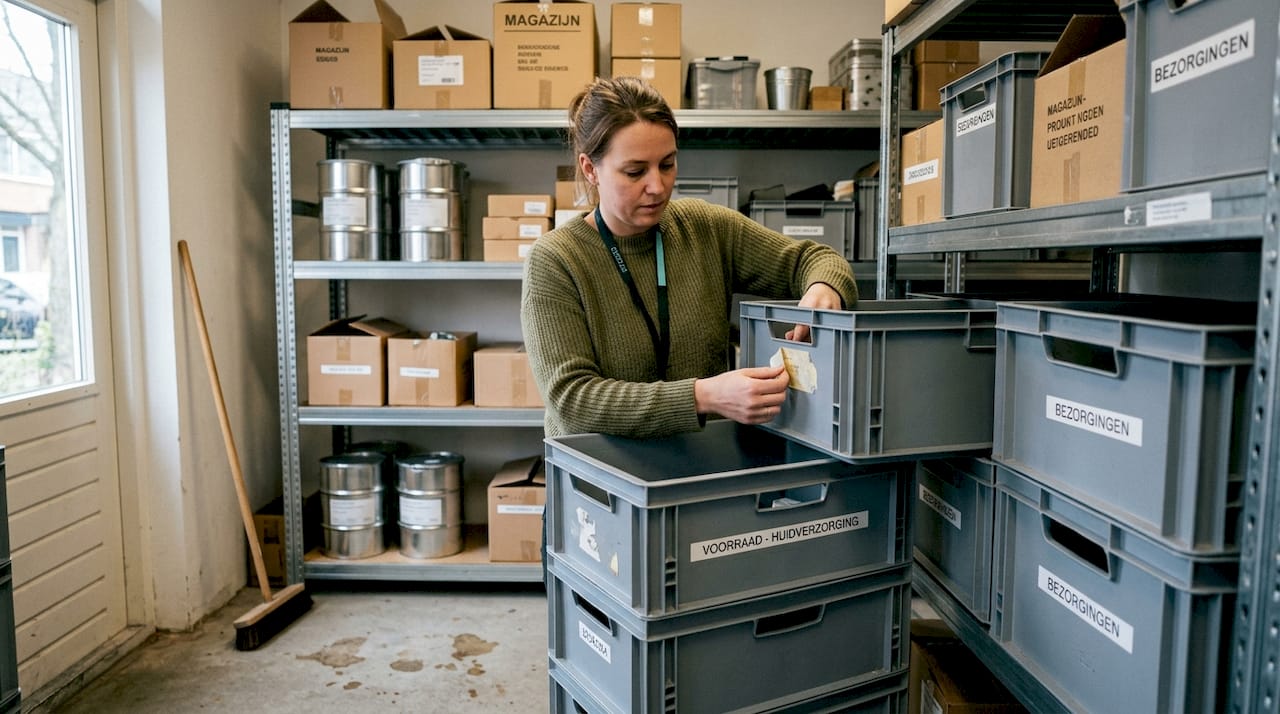
The biggest advantage is clear: reusable packaging reduces waste by up to 80%. This not only lessens environmental impact but also waste disposal costs. For retailers, this means significantly lower long-term operational costs. The initial investment in sustainable materials pays for itself through repeated use.
Tracking is at the core of successful reuse. RFID tags or IoT sensors enable real-time inventory monitoring, so you know exactly how many packages are in circulation and where they are. Without tracking, packages get lost in the chain, negating the economic benefit. Modern tracking systems integrate with inventory software and automatically indicate when packages need to be replenished.
Cleaning areas are essential for hygiene and reuse. Packaging returned from customers must be cleaned before being reused. This requires a separate zone in your storage space with access to water and cleaning agents. A closed-loop return system ensures that dirty and clean packaging remain separate, preventing cross-contamination.
“Retailers who switch to reusable packaging with integrated tracking see waste reduction up to 80% and a payback period of an average of 18 months.”
Advantages and challenges of reusable packaging:
- Drastic reduction of waste and CO2 emissions through repeated use
- Lower long-term operational costs due to less frequent purchases
- Higher initial investment in sustainable materials and tracking systems
- Need for cleaning areas and reverse logistics within storage facility
- Risk of loss without adequate tracking system, negating benefits
- Positive brand perception among customers who value sustainability
For practical implementation, see our reusable packaging guide that describes specific steps. Combine this with insights on reusable gift packaging for a complete approach.
Vertical Storage and Spatial Efficiency
Lack of space is a chronic problem in retail storage. Traditional horizontal storage wastes valuable square meters, while vertical systems offer the same capacity in a fraction of the floor area. This innovation transforms how retailers deal with limited space.
Vertical storage systems such as Kardex Shuttle save floor space while capacity remains the same or even increases. These systems use automated lifts that bring shelves to the operator instead of the other way around. This eliminates travel time and dramatically increases picking speed. For packaging materials, this means that rolls, boxes, and bags are quickly accessible without physical effort.
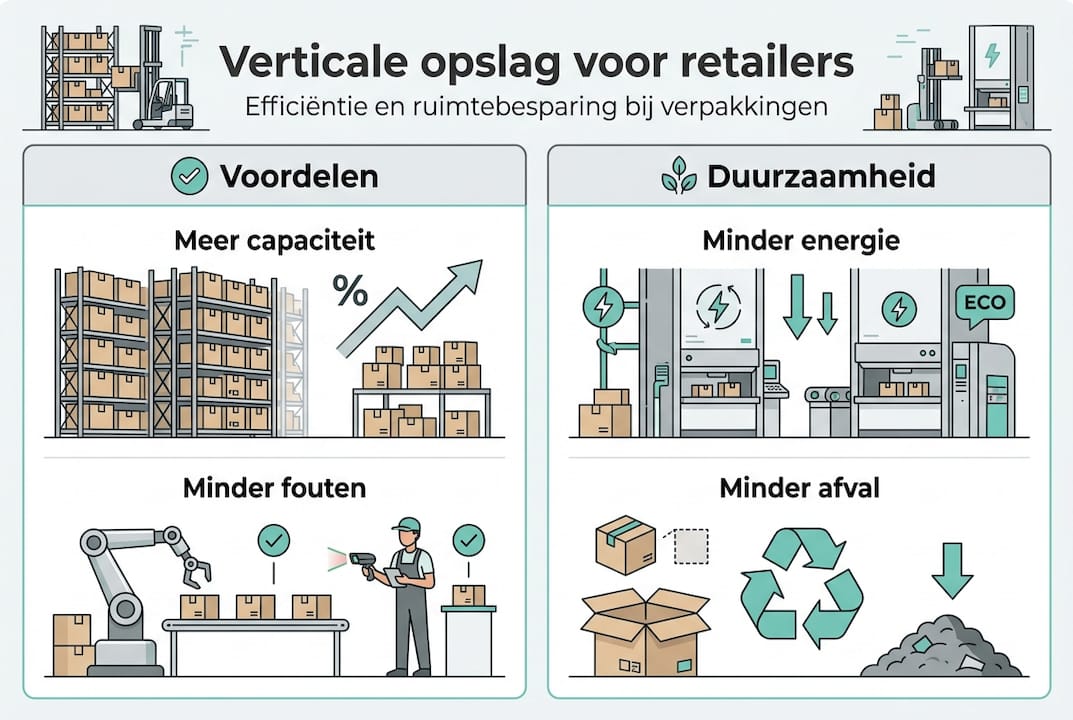
Accuracy improves significantly with vertical systems. Human errors in picking decrease because the system indicates exactly where each item is located. Software integration ensures that inventory levels are updated in real-time, preventing surpluses and shortages. This is crucial for retailers who work with many SKUs and have no room for errors.
Comparison between traditional and vertical storage:
| Aspect | Traditional Storage | Vertical Storage |
|---|---|---|
| Floor Area | High (100%) | Low (30-40% of traditional) |
| Capacity | Limited by space | High due to vertical utilization |
| Picking Speed | Slow due to travel time | Fast due to automation |
| Error Rate | 2-5% due to human factor | <1% due to system control |
| Initial Investment | Low | High |
| Operational Costs | High due to labor | Low due to efficiency |
Sustainability also benefits from vertical storage. More efficient space utilization means less energy consumption for heating and lighting per stored unit. The reduction in process errors reduces waste from damaged or incorrectly picked items. For retailers with sustainability goals, this is a concrete step towards eco-friendly packaging material and circular processes.
Pro-tip: Integrate vertical storage with ABC analysis by placing A-items at the most accessible levels. This maximizes the speed benefits of automation.
For retailers who want to know how to recycle gift packaging, vertical storage offers additional benefits through separate zones for new and recycled materials.
Practical Applications and Successful Examples in Retail
Theory only becomes valuable when applied in practice. Dutch retailers demonstrate that efficient storage yields measurable results. These examples illustrate how you can implement the discussed principles.
Albert Heijn provides an impressive example. The supermarket chain saved 21.5 million kg of packaging material since 2018, achieving its 2025 goal ahead of schedule. The focus was on more efficient forms that are easier to store and transport. More compact packaging takes up less shelf space and stacks more stably, increasing storage capacity without additional square meters.
Packaging shapes largely determine how efficiently you can store. Rectangular boxes stack better than irregular shapes. Rolls that are uniform in diameter and length fit perfectly into shelf racking. Flat items such as tissue paper can be stored vertically in special bins, saving space compared to horizontal stacking.
Practical tips for optimal storage:
- Use pallet racking for bulk inventory and reserve shelf racking for active picking zones.
- Implement color coding per product category for quick visual identification.
- Choose packaging shapes that stack compactly and leave little dead space.
- Invest in tracking via barcodes or RFID for real-time inventory insights.
- Create separate zones for reusable packaging with cleaning facilities.
- Monthly evaluate which products should move to other shelving locations for better flow.
- Regularly train staff in FIFO and ABC principles to ensure consistency.
Continuous evaluation remains crucial. What works efficiently today may be suboptimal in three months due to seasonal shifts or changing customer preferences. Performance tracking via KPIs such as picking speed, error rate, and space utilization provides insights into areas for improvement. Schedule quarterly reviews to keep your storage system sharp.
For more inspiration on sustainable choices, check out our tips on gift packaging recycling and our overview of packaging materials for retail.
View Our Packaging Products for Your Storage Needs
Now that you know how to optimize your storage, the next step is choosing quality packaging material that fits your efficient system. Kadopapier.net offers an extensive assortment that perfectly aligns with the organizational principles from this article.
Our red voile ribbon stacks compactly on shelf racking and is ideal for retailers who want to combine elegant packaging with efficient storage. The emerald curling ribbon comes on rolls of uniform size, simplifying ABC classification. For smaller items, our fuchsia organza bags offer a stylish solution that takes up little space.
Pro-tip: Combine different ribbons and bags in one shelving compartment organized by color or season. This speeds up the picking process and maintains your professional presentation.
Our products are selected with storage efficiency in mind. Uniform sizes, durable materials, and compact packaging make them perfect for retailers who want to save space without compromising on quality. Every product is available directly from stock, so you can quickly respond to changing inventory needs.
Frequently asked questions about packaging material storage
What is the best type of shelving for heavy packaging materials?
Pallet racking is the best choice for heavy packaging materials like large boxes and full pallets. They have a high load-bearing capacity and allow for vertical stacking, maximizing capacity. Ensure the racking is suitable for forklift use and complies with safety standards.
How do I implement FIFO in my storage space?
Create clear entry and exit points for each shelving bay, placing new stock at the back. Label each location with the receipt date and use colored stickers for visual control. Train staff to consistently pick the oldest stock first and evaluate monthly whether the system is being followed.
What are the benefits of reusable packaging for retail?
Reusable packaging reduces waste by up to 80% and lowers operational costs in the long term. However, they do require investment in tracking systems like RFID and cleaning areas. The payback period is around 18 months on average, after which the savings are significant.
How can I save space when storing packaging materials?
Vertical storage systems save 60-70% of floor space compared to traditional methods. Also, choose packaging forms that stack compactly and implement ABC analysis to place only fast-moving items in accessible zones. Evaluate quarterly whether your layout is still optimal.
Which sustainable storage methods are suitable for retail sellers?
Combine reusable packaging with tracking, vertical storage for efficient space use, and FIFO to prevent waste. Choose packaging materials with recycled content and create separate zones for new and recycled items. Albert Heijn demonstrates that a focus on more efficient forms saves millions of kilograms.