
Function of Transparent Packaging: A Guide for 2026
TL;DR:
- Transparent packaging enhances visibility and consumer trust by making products fully visible. Widely used in food, cosmetics, and e-commerce, it boosts sales and brand recognition. Sustainable options like mono-PET and recycled PET strengthen the circular economy and comply with regulations.
Transparent packaging is a form of packaging that makes the product fully visible while simultaneously protecting it from external influences such as moisture, oxygen, and mechanical damage. The function of transparent packaging extends beyond aesthetics: it is a proven tool for brand differentiation, sales stimulation, and quality communication. Materials like PET play a central role due to their exceptional transparency and recyclability. For retailers and manufacturers, choosing transparent packaging is a direct investment in product presentation and consumer trust.
What advantages does transparent packaging offer for product presentation and sales?
Transparent packaging directly increases the visual appeal of a product on the shelf or in the webshop. Consumers see exactly what they are buying, which eliminates doubt and increases the chance of an impulse purchase. Packaging as a marketing tool stimulates purchases and strengthens customer loyalty. This effect is measurable in higher conversion rates for products where freshness or quality can be visually assessed, such as fresh vegetables, pastries, or cosmetics.

Consumers trust what they see. For food products, visibility of the contents directly provides information about color, texture, and quantity. This reduces returns and complaints, as expectations are better managed. Retailers who use transparent packaging for fresh products report less food waste because customers assess the quality themselves before purchase.
Transparent packaging in marketing also offers room for brand differentiation. A clear package with a printed lip or a colorful closure combines visibility with branding. Personalized packaging contributes to customer trust and a recognizable brand identity. Brands such as organic snack producers and artisan chocolatiers deliberately use transparent packaging to let the quality of their product speak for itself without additional marketing claims.
Packaging acts as a crucial tool to stand out in competitive markets and foster customer loyalty. The combination of visibility and protection makes transparent packaging one of the most effective presentation tools in retail.
The impact on product sales is also noticeable in e-commerce. Product photos of transparently packaged items show the contents realistically, reducing the number of customer inquiries about content and quality. This lowers the barrier to purchase and increases the average order value for gift items and luxury products.
How does transparent packaging protect the product, and what materials are used?
Transparent packaging protects products against oxygen, moisture, light, and mechanical damage. The degree of protection strongly depends on the chosen material and the coatings applied. Standard clear bags have a water vapor transmission rate (WVTR) of 3 to 10 g/m² per day, which is sufficient for most dry food products and non-food items. For oxygen-sensitive products such as coffee or deli meats, additional barrier layers are needed.
PET as standard transparent material
PET material is the standard for transparent packaging due to its clarity, lightweight nature, and recyclability. PET does not optically distort the contents, making it ideal for product presentation. The material is resistant to a wide temperature range and offers good mechanical strength at a relatively low material thickness. Manufacturers in the food sector, cosmetics, and retail choose PET as the base material for both rigid and flexible transparent packaging.
Barrier coatings for better protection
For products sensitive to oxygen, such as nuts, dried fruit, or pharmaceutical products, EVOH coatings are applied to transparent films. EVOH coatings can bring the oxygen permeability (OTR) below 1 cc/m² per day. This makes transparent packaging with EVOH coating suitable for products where aluminum foil was traditionally preferred. The packaging remains transparent while offering protection comparable to opaque alternatives.
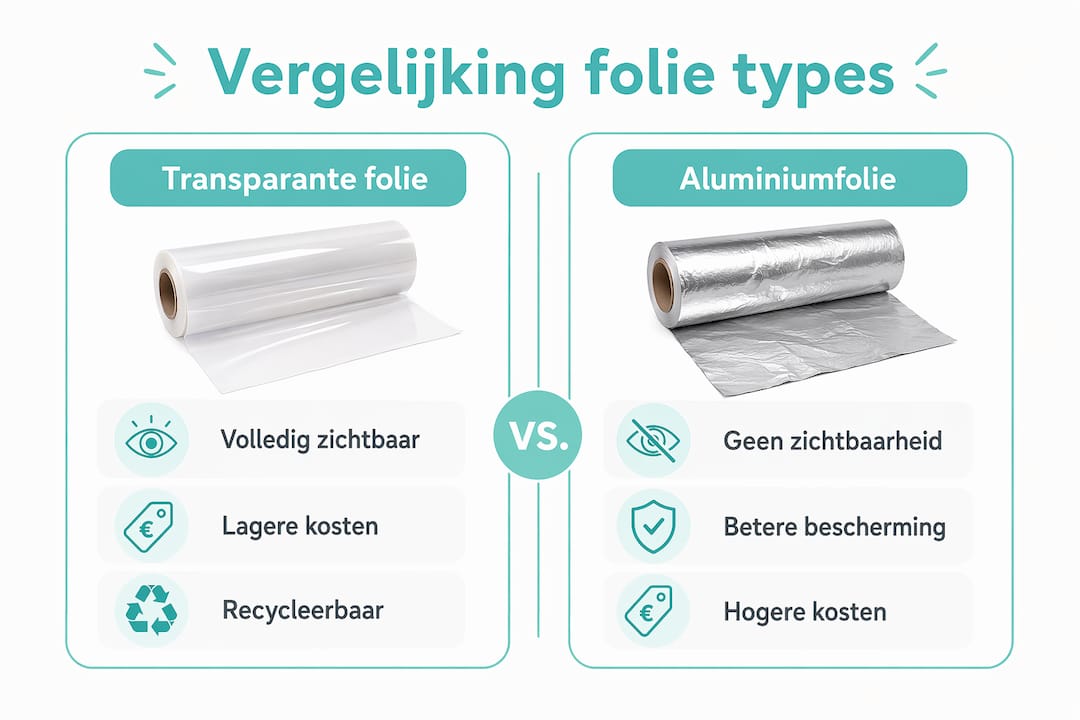
Comparison: transparent film versus aluminum foil
| Property | Transparent film | Aluminum foil |
|---|---|---|
| Content visibility | Fully visible | Not visible |
| Barrier against oxygen | Moderate to good (with EVOH) | Excellent |
| Barrier against moisture (WVTR) | 3 to 10 g/m²/day | Below 0.1 g/m²/day |
| Recyclability | Good (mono-PET) | Limited (laminate) |
| Cost | Lower | Higher |
| Suitable for presentation | Yes | No |
Transparent films perform better in visual appeal and acquisition costs, while aluminum foil offers better protection for sensitive products. The choice depends on the product and the desired balance between presentation and protection.
Pro-tip: Choose a transparent film with EVOH coating if you want to package oxygen-sensitive products without sacrificing visibility. This gives you the best of both worlds: protection and product presentation.
The packaging sector consumes 40% of plastic use in Europe, with transparent plastic packaging playing a central role in food protection and shelf-life extension. This figure underscores how widely transparent packaging is used and how great the responsibility is to choose materials carefully.
Which sectors and applications make the most use of transparent packaging?
Transparent packaging is used in virtually every sector where product presentation and protection go hand in hand. The applications of plastic packaging are broad, from fresh food to luxury gifts. Below are the most relevant sectors and their specific uses:
-
Fresh food and supermarket. Transparent trays, film packaging, and bags for vegetables, fruit, meat, and dairy products give consumers direct insight into freshness and quality. Supermarkets such as Albert Heijn and Jumbo use transparent packaging as standard for their fresh produce section. Visibility reduces returns and increases trust in the product.
-
Snacks and dry food. Transparent bags for nuts, chips, dried fruit, and sweets combine product presentation with shelf life. Clear zipper bags with printed lips offer cost savings and branding opportunities for retailers. The printed lip replaces full bag printing, reducing production costs without losing brand visibility.
-
Cosmetics and personal care products. Brands like Rituals and L'Oréal use transparent packaging for products where the color or texture of the contents is a selling point. Transparent bottles for shampoo, face cream, or perfume allow the customer to assess the contents before purchase. This enhances the sense of quality and authenticity.
-
Gift packaging and presents. Transparent packaging is indispensable in the gift sector. Organza bags, clear gift boxes, and cellophane film show the contents while protecting and presenting the gift. The presentation value is the primary goal here: the packaging enhances the experience of the gift. Retailers who assemble gift packages deliberately choose transparent materials to make the contents visible.
-
E-commerce and physical retail. In physical stores, transparent packaging attracts attention on the shelf. In e-commerce, it ensures better product photos and fewer returns. Transparent packaging for stores increases sales stimulation by optimizing product presentation. Webshops that use transparent packaging for their product photography see a higher click-through rate on product pages.
-
Pharmaceutical sector. Blister foils and clear bottles for tablets and capsules provide patients and pharmacists with direct insight into the contents. Transparency here is also a safety feature: damage or contamination is immediately visible.
What are the sustainability aspects and trends in transparent packaging?
Sustainability is the central theme in the packaging sector for 2026. Transparent packaging is under pressure due to its plastic use but also offers opportunities for circular strategies. The key lies in material selection and the production process.
-
Mono-material packaging significantly improves recycling efficiency. Material loss drops from 20 to 30% to below 10% with mono-material packaging. This means that more material is recovered and can be reused in new packaging. Manufacturers who switch from laminate packaging to mono-PET or mono-PP directly improve their recycling performance.
-
Recycled PET (rPET) is increasingly being used in transparent packaging. Phased integration of recyclate helps quality control and meets strict food safety requirements. Brands like Unilever and Nestlé have publicly set targets for using rPET in their packaging. Gradually increasing the recyclate content provides room for quality control without disrupting production processes.
-
Consumer expectations are shifting towards sustainable packaging. Consumers associate transparent packaging with quality, but also expect the packaging to be recyclable. Glass packaging is associated with higher quality and strengthens brand positioning, despite higher initial costs. This shows that consumers are willing to pay more for packaging that radiates sustainability and quality.
-
Regulations compel manufacturers and retailers to act. The European Union is imposing increasingly stringent requirements on recyclability and the use of recycled materials in packaging. Companies that invest now in mono-material packaging and rPET are better prepared for future legislation.
Pro-tip: When purchasing transparent packaging, always check whether the material is mono-material and what percentage of recycled material it contains. This makes your packaging strategy future-proof and meets the expectations of both consumers and regulators.
Sustainability as a marketing point is gaining strength. Brands that transparently communicate their packaging choices, including the use of rPET or mono-materials, build trust with conscious consumers. More information about sustainable packaging material and its impact on the environment and regulations helps retailers and manufacturers make informed choices.
Key Insights
Transparent packaging combines product protection with direct visibility, increasing sales conversion, strengthening consumer trust, and enabling sustainable material choices.
| Point | Details |
|---|---|
| Visibility increases trust | Consumers assess quality themselves, which reduces returns and encourages impulse purchases. |
| PET is the standard material | PET offers optimal transparency, recyclability, and mechanical strength for most applications. |
| EVOH coating for sensitive products | Transparent films with EVOH coating bring oxygen permeability below 1 cc/m²/day without losing visibility. |
| Mono-material improves recycling | Switching to mono-PET reduces material loss during recycling from 20-30% to below 10%. |
| Sustainability as a selling point | Brands that communicate rPET and mono-materials build trust with conscious consumers. |
Transparent packaging: what I learned after years in retail
After years of working with packaging solutions for retailers and manufacturers, one thing stands out to me: most companies underestimate the strategic value of their packaging choices. They see packaging as a cost item, not a sales tool. That's a mistake that is directly visible in sales results.
Transparent packaging is not simply a clear bag. It is a conscious choice to let the product do the work itself. An artisan cheesemaker who presents their product in transparent packaging with a sleek label sells more than a competitor who puts the same product in an opaque box. The consumer sees the quality. That trust cannot be bought with an advertising campaign.
What I also see: companies that think about sustainability too late. The transition to mono-material packaging and rPET is no longer a luxury. It is a requirement. Retailers who invest now in reusable packaging and circular strategies will be better positioned in three years than competitors who wait for legislation.
The balance between aesthetics, protection, and sustainability is achievable. It requires a conscious material choice during procurement and clear communication to the consumer. Transparent packaging is not a compromise in this regard. It is the most direct way to show quality while packaging responsibly.
— M
Ordering transparent packaging from Kadopapier
Kadopapier offers a wide range of packaging materials for retailers, manufacturers, and consumers who prioritize quality and presentation. From clear gift bags to decorative accessories: the assortment is aimed at product presentation that sells. For gift packaging and gift presentations, organza ribbons and decorative elastic are available in wholesale quantities. Kadopapier delivers Monday through Friday for orders placed before 3:00 PM on the same business day. Free shipping from 100 euros excluding VAT. View the full assortment on kadopapier.net for direct inspiration and ordering.
FAQ
What is the function of transparent packaging?
Transparent packaging fully displays the product while protecting it from oxygen, moisture, and mechanical damage. The combination of visibility and protection makes it an effective tool for product presentation and sales stimulation.
Which material is most commonly used for transparent packaging?
PET is the standard material for transparent packaging due to its clarity, lightweight nature, and recyclability. For oxygen-sensitive products, EVOH coatings are applied to improve the barrier effect without losing transparency.
How does transparent packaging influence purchasing behavior?
Consumers trust what they see: transparent packaging provides direct information about quality, color, and quantity, which eliminates doubt and encourages impulse purchases. Packaging acts as a marketing tool that directly influences purchasing decisions.
Is transparent packaging sustainable?
Transparent mono-PET packaging is highly recyclable, and material loss for mono-material packaging drops to below 10%. The use of recycled PET (rPET) makes transparent packaging part of a circular strategy.
For which sectors is transparent packaging most suitable?
Transparent packaging is most commonly used in the food sector, cosmetics, gift industry, pharmaceutical sector, and e-commerce. Any sector where product presentation and consumer trust play a direct role in the purchasing decision benefits from transparent packaging.