
Cotton bag: sustainable, stylish, and versatile in 2026
TL;DR:
- A cotton bag is a sustainable and reusable choice that lasts long and increases brand awareness.
- Certifications like GOTS and Fairtrade guarantee environmentally friendly and fair production.
- The choice between cotton and plastic depends on usage and repeated application.
Many people consider a cotton bag to be 'just a bag'. That's a misunderstanding. A cotton bag is a conscious choice with measurable benefits in terms of sustainability, appearance, and reusability. Whether you want to wrap gifts, surprise customers with promotional materials, or simply use less plastic: the cotton bag offers more than you might initially expect. In this article, you will read exactly what to look for, how to make the best choice, and why cotton is becoming increasingly relevant for both consumers and businesses.
Table of Contents
- Why choose a cotton bag?
- Sustainability and certification: what truly matters?
- Cotton bag versus plastic: what's the difference?
- Applications: from gift to promotion
- Our view: what is often overlooked with cotton bags
- Discover the most beautiful and sustainable packaging solutions
- Frequently asked questions about cotton bags
Key Insights
| Point | Details |
|---|---|
| Sustainable choice | A cotton bag is a responsible choice provided you use the bag often and choose certified cotton. |
| Versatile use | Cotton bags are suitable for gift packaging, daily groceries, and as promotional items. |
| Pay attention to certifications | Certification such as GOTS or Fairtrade prevents greenwashing and guarantees fair production. |
| Personalize as desired | With printing or decoration, you can make a simple cotton bag your own statement. |
Why choose a cotton bag?
Cotton has been one of the most widely used natural fibers in the world for centuries. This is not without reason. As a material for bags, cotton scores on several fronts simultaneously: it is strong, pleasant to use, and it looks good. But there's more.
A cotton bag is washable and retains its shape after multiple washes. This makes it ideally suited for repeated use. Plastic bags typically last only once or a few times. A sturdy cotton bag can last for years if handled properly. Cotton is a natural fiber, durable and reusable, and you immediately feel that difference in practice.
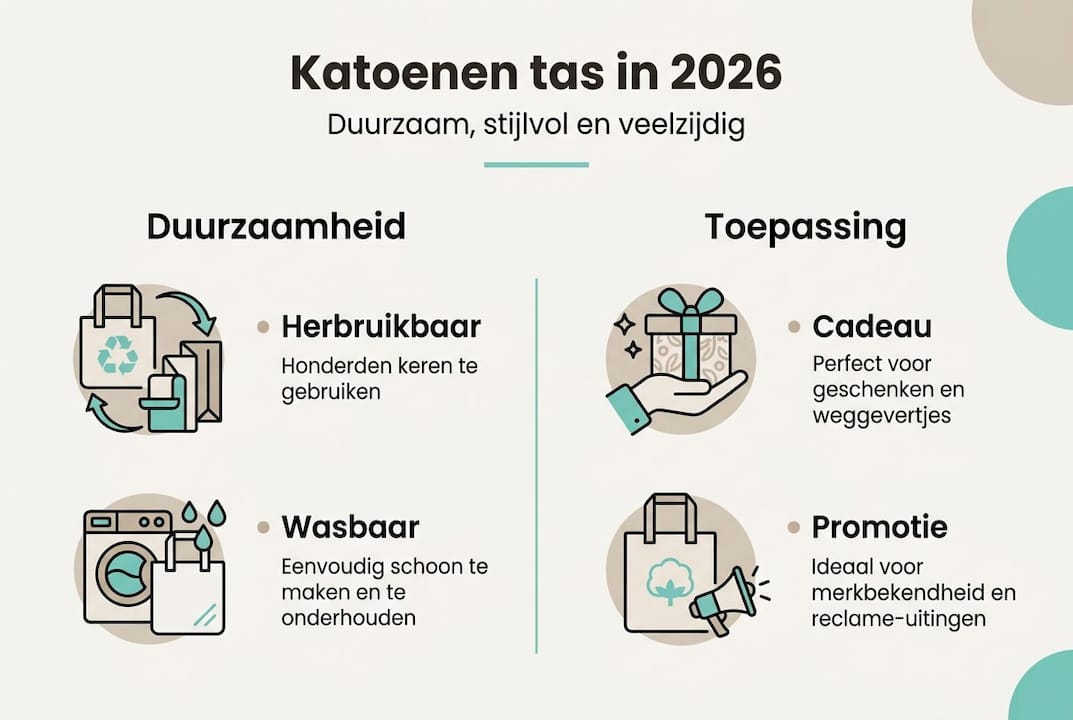
For businesses, the cotton bag is also a smart choice from a marketing perspective. A bag with your logo or corporate identity is not thrown away after use. It is taken to the supermarket, the gym, or work. This makes your brand visible in places where you could never advertise yourself. The advantages of cotton as a material are thus not only functional but also commercially interesting.
Consumers appreciate cotton bags when receiving a gift. The packaging itself has value. A beautiful cotton bag with a ribbon or sticker feels more personal than a plastic bag. It gives the recipient the feeling that thought has gone into the presentation. This effect should not be underestimated, especially for corporate gifts or special occasions.
What further distinguishes cotton:
- Natural appearance, suitable for all target groups
- Printable with logo, text, or illustration
- Available in many sizes and colors
- Strong enough for heavy contents
- Pleasant in hand, no sharp edges or risk of scratches
Pro-tip: Choose a cotton bag with a minimum density of 140 grams per square meter for daily use. Lighter variants are fine for single-use gift packaging but wear out faster with intensive use.
“A cotton bag is more than packaging. It is a statement about how you approach quality and sustainability.”
The strong and durable cotton variants are also well resistant to weight and daily use, making them suitable for a wide range of applications.
Sustainability and certification: what truly matters?
Not every cotton bag is equally sustainable. That may sound surprising, but cotton production also has a downside. Conventional cotton requires a lot of water and pesticides. That's why certifications are important. They indicate that human and environmental factors have been considered during production.
The most well-known certifications are:
- GOTS (Global Organic Textile Standard): Guarantees organically grown cotton without harmful chemicals
- Oeko-Tex Standard 100: Confirms that the end product is free from harmful substances
- Fairtrade: Focuses on fair payment and working conditions for farmers and workers
- BCI (Better Cotton Initiative): Promotes more sustainable cultivation methods worldwide
Fairtrade supports fair trade; preferring certified cotton helps avoid greenwashing. Greenwashing means that a product is presented as 'sustainable' without evidence. Unfortunately, this occurs regularly in the textile and packaging sector.
How do you recognize greenwashing? Look out for vague claims like 'eco-friendly' or 'green' without further explanation. A reliable supplier can always provide a certificate or independent verification. Just ask for it. Serious providers will answer directly.
Statistic: Organic cotton uses an average of 91% less water than conventional cotton and requires no synthetic pesticides. This makes the difference in the purchasing decision concrete and measurable.
Pro-tip: For business orders, always ask for a copy of the certificate. This protects you and your customers from misleading claims. Also, use this as an argument towards your own customers: transparency about origin and production builds trust.
For consumers, the advice is simple: check the label or product description for one of the aforementioned certifications. Is every certification missing? Then caution is in order. A durable cotton rope as an accessory for your packaging fits perfectly within a conscious, certified approach.
Sustainability is not a simple yes or no. It is a combination of material origin, production process, certification, and lifespan. Those who consider all these factors when making a choice will make a truly informed decision.
Cotton bag versus plastic: what's the difference?
The comparison between cotton and plastic is more nuanced than many people think. Cotton doesn't automatically win on all fronts. But in the right context, it is clearly the better choice.
| Criterion | Cotton bag | Plastic bag |
|---|---|---|
| Reusability | High, lasts for years | Low, often single-use |
| Environmental impact of production | Higher (water, land) | Lower in production |
| Environmental impact of use | Lower with reuse | High due to waste |
| Appearance | Natural, premium | Functional, cheap |
| Printability | Excellent | Limited |
| Cost per use | Low in the long term | Low in the short term |
Cotton is durable and reusable; plastic is often single-use. That is the core difference. But there's a nuance: a cotton bag must be used an average of 50 to 150 times to compensate for its higher production impact compared to a plastic bag. For organic cotton, that number is lower.
That doesn't mean plastic is always worse. For single-use packaging where reuse is not realistic, a thin plastic bag can sometimes have a lower overall environmental impact. But as soon as reuse is possible, cotton wins.
Practical considerations in four steps:
- Determine how often the bag will be used
- See if the recipient will keep or discard it
- Consider the appearance: what suits your brand or gift?
- Calculate the cost per use, not just the purchase price
“The cheapest bag is not always the most economical. Looking at the long term gives a different picture.”
For companies that want to make sustainable choices for plastic and cotton, it is wise to compare both options based on concrete usage scenarios. And those who want to compare plastic shopping bags with cotton alternatives will find targeted information for specific situations.
In short: cotton is the better choice if reuse is realistic. Plastic can be more efficient in specific cases. But for gift packaging and promotional items, cotton is almost always the logical choice.
Applications: from gift to promotion
A cotton bag is more versatile than most people realize. Its applications range from personal gift packaging to large-scale promotional tools for businesses.

Cotton bags are suitable for gift packaging AND promotion. This makes them unique: few packaging materials fulfill both functions equally well.
| Application | Target Group | Benefit |
|---|---|---|
| Gift packaging | Consumers | Personal, reusable |
| Event goodie bag | Businesses | Brand visibility |
| Retail packaging | Retailers | Sustainable appearance |
| Promotional material | Marketing | Long-term use |
| Seasonal gift | B2B and B2C | High appreciation |
For consumers, the cotton bag is an elegant way to present a gift. Add a piece of strong cotton rope as a closure or decoration, and the packaging is complete without extra plastic or tape.
Businesses increasingly use cotton bags as brand carriers. A bag with a logo typically stays with the recipient for weeks to months. That's advertising space you cannot buy through traditional channels. Moreover, recipients associate the brand with sustainability and quality.
Inspiration for creative applications:
- Fill the bag with small products or samples as a welcome kit
- Use it as a seasonal gift with thematic content
- Have it printed with a personal message or campaign slogan
- Combine with tissue paper or a decorative ribbon for a complete look
- Offer it as reusable packaging for purchases above a certain amount
Pro-tip: Have a cotton bag printed in a limited edition for special occasions. A small, exclusive series feels more valuable than a generic standard bag and enhances brand experience.
The cotton bag is thus not an afterthought. It is a full-fledged communication tool that combines function and aesthetics.
Our perspective: what is often overlooked regarding cotton bags
Many discussions about cotton bags revolve around the material itself. But the material is just the beginning. What truly makes a difference is how the bag is used and how long it lasts.
A cotton bag that is used twice and then disappears into a drawer is not a sustainable choice. A plastic bag that is reused daily as a garbage bag or shopping bag can be in some cases. Sustainability is about behavior, not just material.
We often see with businesses and consumers that the purchase of cotton bags is a conscious start, but the usage isn't always as well-thought-out. Choose consciously. Use repeatedly. And choose a bag that fits the actual need, not just the trend.
Also consider the lifespan: using a bag made of durable cotton as an accessory or closure extends the overall usability of the packaging. Small details make the difference between a disposable moment and a lasting impression.
Sustainability is not a label. It's a choice you make anew every day.
Discover the most beautiful and sustainable packaging solutions
Do you want to combine cotton bags with other beautiful packaging materials? At sustainable gift packaging, you will find a wide assortment that perfectly matches a conscious and stylish presentation. Add a white gift decoration curl pin for a festive accent, or choose a brown organza pouch as an elegant addition to your cotton bag. Order easily online, ordered Monday to Friday before 3 PM means shipped the same working day. This way, you combine functionality with appearance, for both consumers and businesses.
Frequently asked questions about cotton bags
How do I recognize truly sustainable cotton in a bag?
Look for certifications such as GOTS or Fairtrade and always ask for certificates or independently verified claims. Preferring certified products helps avoid greenwashing.
Is a cotton bag always better than plastic?
Cotton is only more sustainable with repeated use; for single use, plastic sometimes has less environmental impact. Cotton is durable and reusable, but usage determines the actual impact.
Can I have a cotton bag printed?
Yes, many suppliers offer the option to personalize a cotton bag with a logo, text, or design. This makes it suitable as promotional material or personalized gift packaging.
How do I best maintain my cotton bag?
Wash the bag at a low temperature without bleach and air dry it for a longer lifespan. This way, it remains usable for years and maintains the quality of the material.