
Supply Chain Packaging Explained: A Guide for 2026
TL;DR:
- Packaging affects transport costs, storage, and legal responsibilities in the supply chain.
- From August 12, 2026, companies must comply with European PPWR regulations with valid Declarations of Conformity and detailed data.
Packaging is more than just a box or a wrapper. Within supply chain management, packaging co-determines transport costs, storage capacity, damage prevention, and now also the legal liability of every company in the chain. The explanation of supply chain packaging will become more urgent than ever in 2026: the European PPWR regulation will come into effect on August 12, imposing new, binding obligations on producers, importers, and distributors. Many companies do not yet know exactly what role they play. This lack of clarity is costly.
Table of Contents
- Key Insights
- Supply Chain Packaging Explained: Basic Concepts
- PPWR: New Rules for Packaging and Supply Chain Roles
- Strategies for Efficient Packaging Management
- Comparison of Packaging Materials
- My Perspective on Packaging and Compliance
- Packaging Solutions from Kadopapier
- FAQ
Key Insights
| Point | Details |
|---|---|
| Packaging as a logistics parameter | Packaging choices directly determine palletization, transport costs, and storage efficiency in the supply chain. |
| PPWR roles per SKU | Each package requires an assigned role (producer, importer, etc.) with corresponding compliance documentation. |
| Declaration of Conformity mandatory | Without a valid DoC, packaging may no longer be placed on the EU market from August 12, 2026. |
| Master data as the foundation | Correcting erroneous packaging data costs much more than managing correct data from the outset. |
| Early involvement pays off | Integrating packaging early in logistical planning prevents costly errors and delays later in the chain. |
Supply Chain Packaging Explained: Basic Concepts
Packaging in supply chain management, also known as "packaging logistics" or "logistic packaging," is a function that extends far beyond product protection. It is a system with multiple layers, roles, and measurable consequences for every link in the chain.
Three Layers of Packaging
Logistics uses three types of packaging, each with its own function:
- Primary packaging: direct contact with the product, such as a bottle, can, or bag. This is the packaging the consumer sees and touches.
- Secondary packaging: groups multiple primary units, such as a cardboard box with twelve bottles. Used for shelf storage and trade distribution.
- Tertiary packaging: the transport unit, typically a pallet with stretch film or a display box. Designed for bulk transport and warehouse handling.
Each layer directly influences efficiency in supply chain processes. The height of primary packaging determines how many units fit on a pallet. A millimeter more or less can cost an entire layer of a pallet. Over a year and dozens of SKUs, those costs quickly add up.
Roles in the Packaging Process
The division of roles in the supply chain determines who is responsible for which packaging decisions:
- Producer: designs the packaging and determines the specifications.
- Manufacturer: produces the packaging or the packaged product.
- Importer: brings packaged products into the EU from outside.
- Distributor: handles the product without owning the packaging choice.
Packaging management demonstrably leads to less damage, lower transport costs, and better organization in the logistics chain. Processes around packaging, loading, and shipping are where errors most often occur, and where structure immediately pays off.
Packaging Choices as Hidden Costs
An often underestimated aspect: packaging choices are hidden logistical parameters that directly influence palletization, handling, and inventory management. A product that stacks poorly increases the number of transport movements. Packaging that does not fit into a standard roller conveyor system leads to manual handling. These are costs that are not visible on the packaging invoice but are reflected in logistical operations.

PPWR: New Rules for Packaging and Supply Chain Roles
The Packaging and Packaging Waste Regulation, or PPWR, will replace the old European packaging directive on August 12, 2026. The regulation establishes uniform rules for all packaging on the EU market, with an emphasis on recyclability, material use, and traceable chain responsibility.
Four Roles, Four Responsibilities
PPWR defines four core roles and links specific obligations to each role:
- Producer: the party that places the packaging on the EU market. This is not always the physical manufacturer. A retailer with its own brand is legally considered the producer for that packaging.
- Manufacturer: produces the packaging but does not independently place it on the market.
- Importer: responsible for packaging from outside the EU. The importer takes over the compliance obligations of the foreign producer.
- Distributor: handles the product and has more limited obligations, but must be able to demonstrate that the packaging is compliant.
Many companies struggle with the question of who is the producer in their specific situation. The term has a different meaning in PPWR than in everyday language. A supermarket selling private-label products is, under PPWR, the producer of the associated packaging, even if that packaging was made by an external supplier.
Declaration of Conformity and Technical Documentation
Every package on the EU market must have a valid Declaration of Conformity (DoC) by August 12, 2026, supported by technical documentation. Without a valid DoC, placement on the market is illegal. The deadline is strict.
The technical documentation includes data on material composition, recyclability, weight, and proof that the requirements have been met. This data must be available per package, down to SKU level.
Pro-tip: Create a packaging-SKU matrix with packaging type, role, and marketplace. This immediately provides insight into which packages have a valid DoC and where there are gaps in your compliance documentation.
Data, Traceability, and the Costs of Non-Compliance
PPWR requires detailed data exchange and structured reporting within the chain. Packaging data often comes from external suppliers and is not always standardized. GS1 GTIN is recommended as a standard for product identification.
Traceability also plays a critical role outside of PPWR. In the cashew nut recall, it became clear how dependent quick and targeted action is on batch and shelf-life information linked to the packaging. If this link is missing, a recall becomes a broad, costly operation.
Anyone who is not compliant by August 2026 risks a market ban on the products involved. Understanding industry packaging regulations is no longer an optional exercise.
Strategies for Efficient Packaging Management
Good packaging strategies do not start with the packaging supplier. They start with product development, purchasing strategy, and the ERP system. Packaging that is included too late in the process becomes a bottleneck instead of a lever.
Early Integration into Planning
Only adjusting packaging when problems arise is a common mistake. The best supply chain teams give packaging a permanent place in the product development phase, logistical design, and purchasing planning. This specifically means:
- Defining packaging dimensions before a product goes into production.
- Including stackability and pallet optimization in product design.
- Selecting packaging materials based on logistical and sustainability requirements.
Master Data as the Foundation
Correcting erroneous master data about packaging is much more expensive than managing correct data from the beginning. Integration into WMS and ERP is not a luxury but a prerequisite for reliable processes.
Pro-tip: Record packaging dimensions, weights, and stacking properties in your ERP when creating the item record. Changes afterwards cost at least three times as much time and lead to errors in transport and invoicing.
The table below shows how different management approaches compare on the four most important parameters:
| Approach | Long-term Costs | Error Risk | Compliance Suitability |
|---|---|---|---|
| Reactive: correct data when problems arise | High | High | Low |
| Partial: record data during procurement | Average | Average | Average |
| Proactive: integrate into ERP/WMS at creation | Low | Low | High |
Structured Data Exchange in the Chain
Much packaging data is fragmented across suppliers, internal systems, and spreadsheets. This is unsustainable given the scale and speed required by modern supply chains. Automated data exchange via standardized formats prevents errors and speeds up processing. Standardization via GS1 codes ensures that all chain partners read the same information in the same way.
Inventory management becomes directly simpler if packaging data is correctly entered and centrally available.
Comparison of Packaging Materials
Not every product requires the same type of packaging. The choice between flow-pack, stand-up pouch, and cardboard has measurable consequences for transport costs, storage capacity, and logistical handling.
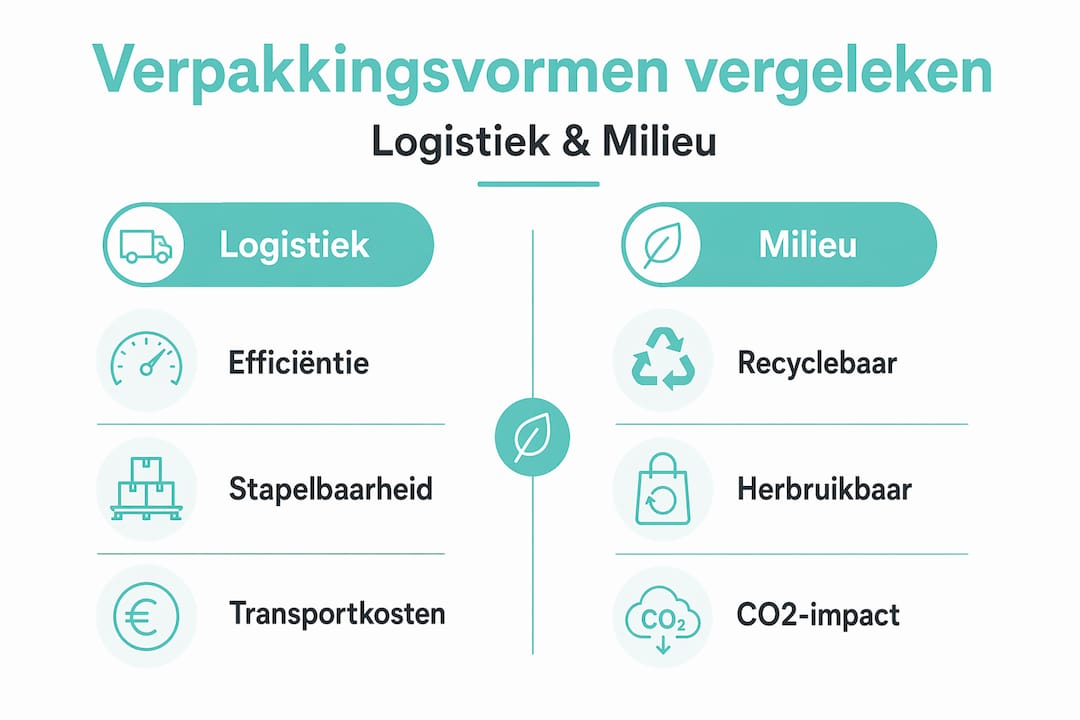
Different packaging forms show clear differences in logistical efficiency.
| Packaging Type | Transport Efficiency | Stackability | Environmental Aspects |
|---|---|---|---|
| Flow-pack | High: minimal air volume, low cost per unit | Limited: no rigid structure | Low plastic use, difficult to recycle |
| Stand-up pouch | Low: contains more air, higher transport costs | Moderate: stable when standing, not stackable | More material, partly recyclable |
| Cardboard | High for custom sizes: good fill with correct dimensions | High: uniform stacking on pallet | Good recyclability, higher material costs |
What Practice Teaches
Flow-pack is the most cost-efficient per unit for light, dry products in high volume. Stand-up pouches structurally contain more air than necessary, which makes transport heavier and more expensive for large volumes. Cardboard scores best on stackability and pallet utilization, but requires precise dimensioning.
A few practical considerations for material selection:
- Choose packaging dimensions that fit standard pallet sizes (80x120 cm or 100x120 cm).
- Consider the maximum stacking height for the chosen material.
- Check if the material meets the recyclability requirements for 2026.
Reusable alternatives are also gaining ground. The complete guide to reusable packaging provides a good overview of the options and regulations per sector.
My Perspective on Packaging and Compliance
What I see time and again in practice: companies treat packaging as an operational matter. Something that operations handles, not something strategy considers. That's exactly the pitfall.
The introduction of PPWR makes this approach unsustainable. I've seen how a medium-sized company with a hundred SKUs needed three months to determine the correct role for each package. Not because the data wasn't there, but because the data was fragmented across four systems and no one saw the need to consolidate it before.
The unexpected complexity lies in role determination per SKU. A company can be an importer for some products, a manufacturer for others, and the producer for private-label lines. Each role requires different documentation. Anyone who doesn't have this in order by August 2026 will have a problem.
My lesson learned: compliance starts with visibility. Do you know what role you play for each package and what documentation goes with it? If the answer is "not sure," that's the starting point. Not the packaging supplier, not the legal team. The data layer.
Early planning and data integration are not only more efficient. They are cheaper. Working reactively in packaging compliance is the most expensive variant of supply chain management I know.
— M
Packaging Solutions from Kadopapier
Kadopapier supplies packaging materials and decorative accessories for retail, wholesale, and professional applications. The assortment includes curling ribbon, decorative elastic in various colors and designs, and organza Christmas ribbon for seasonal and luxury packaging. All products are available in wholesale quantities.
Ordered Monday to Friday before 3:00 PM, shipped the same business day. Free shipping from €100 excluding VAT.
Whether you're looking for efficient packaging components for daily operations or decorative materials for retail presentations, Kadopapier's offerings directly meet the practical needs of professionals in packaging and logistics.
FAQ
What is supply chain packaging explanation?
Supply chain packaging describes how packaging choices influence logistical processes, including transport, storage, and compliance. It involves primary, secondary, and tertiary packaging, each with its own function in the chain.
What is PPWR and when does it take effect?
PPWR is the European Packaging and Packaging Waste Regulation and will come into force on August 12, 2026. The regulation imposes obligations on producers, importers, manufacturers, and distributors for every package on the EU market.
What is a Declaration of Conformity for packaging?
A Declaration of Conformity (DoC) is a mandatory document that proves packaging complies with PPWR requirements. Without a valid DoC, packaging may not be placed on the EU market after August 12, 2026.
How does packaging shape affect transport costs?
Flow-pack has the lowest transport costs per unit due to minimal air volume. Stand-up pouches contain more air and increase costs per transport. Cardboard performs well in stackability and pallet utilization with correct dimensioning.
Why is master data so important in supply chain packaging?
Incorrect master data about packaging is much more expensive to correct than managing correct data from the outset. Integration into WMS and ERP prevents errors in transport, storage, and compliance reporting.