
What is printing paper? Types, weights and applications
TL;DR:
- Printing paper is specially designed for printers and copiers, with controlled texture and whiteness. Coated paper offers bright colors and gloss, while uncoated paper is better suited for text and descriptions. The choice depends on the application, weight, and desired look, with eco-friendly and recycled paper gaining increasing popularity.
Printing paper is specially designed paper that runs smoothly through printers and copiers and on which ink or toner adheres well. This distinguishes it from ordinary writing paper or packaging paper, which is not adapted to the mechanical and chemical requirements of a printer. The most commonly used size is A4, suitable for almost all office printers and home devices. Brands like Navigator, HP, and Xerox dominate the market with paper specifically tested for feed, ink absorption, and whiteness. To make the right choice, one must understand the types available, what grammage means, and which finish suits the intended use.
What is printing paper and how does it differ from other paper?
Printing paper is defined as paper with a controlled surface texture, specific fiber composition, and a whiteness optimized for printers. Ordinary paper, such as newspaper or pure writing paper, absorbs ink too quickly or unevenly, resulting in blurry prints and ink bleeding. Printing paper prevents this by keeping the fiber structure tight and controlling surface tension.
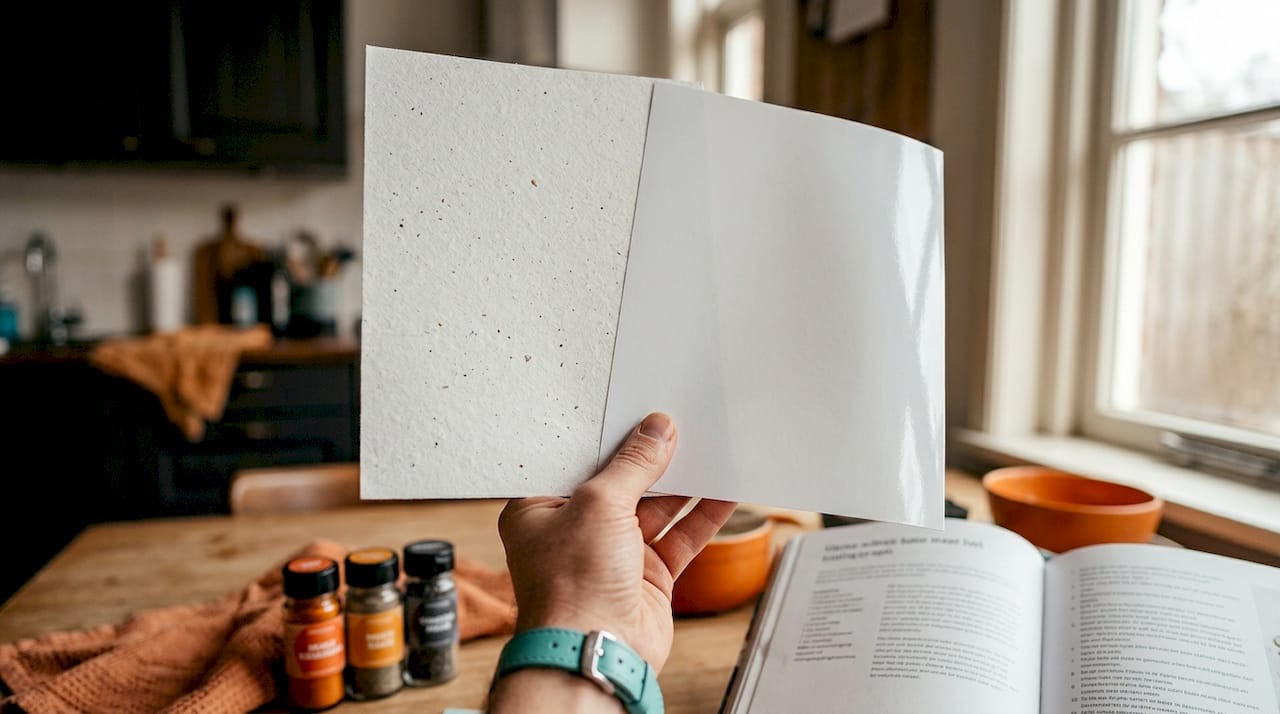
The feed properties are at least as important as ink absorption. Paper that is too thick, too smooth, or too moist causes paper jams in the printer. Manufacturers such as Navigator and Steinbeis test their paper for static charge, bending stiffness, and moisture content to minimize jams. This makes printing paper a technical product, not just a sheet of white paper.
The whiteness of printing paper is expressed in CIE values. A higher value, such as 161 CIE for premium paper, provides sharper contrasts and more vibrant colors. Standard office paper is typically around 146 to 150 CIE. This difference is noticeable with photos and colorful presentations, but barely perceptible with black-and-white text.
What types of printing paper are there and what is the difference?
Coated paper has a coating that makes the surface smooth and color-intensive, while uncoated paper looks more natural and matte. This is the most fundamental distinction within the world of printing paper, and it directly determines which paper you need for a specific project.
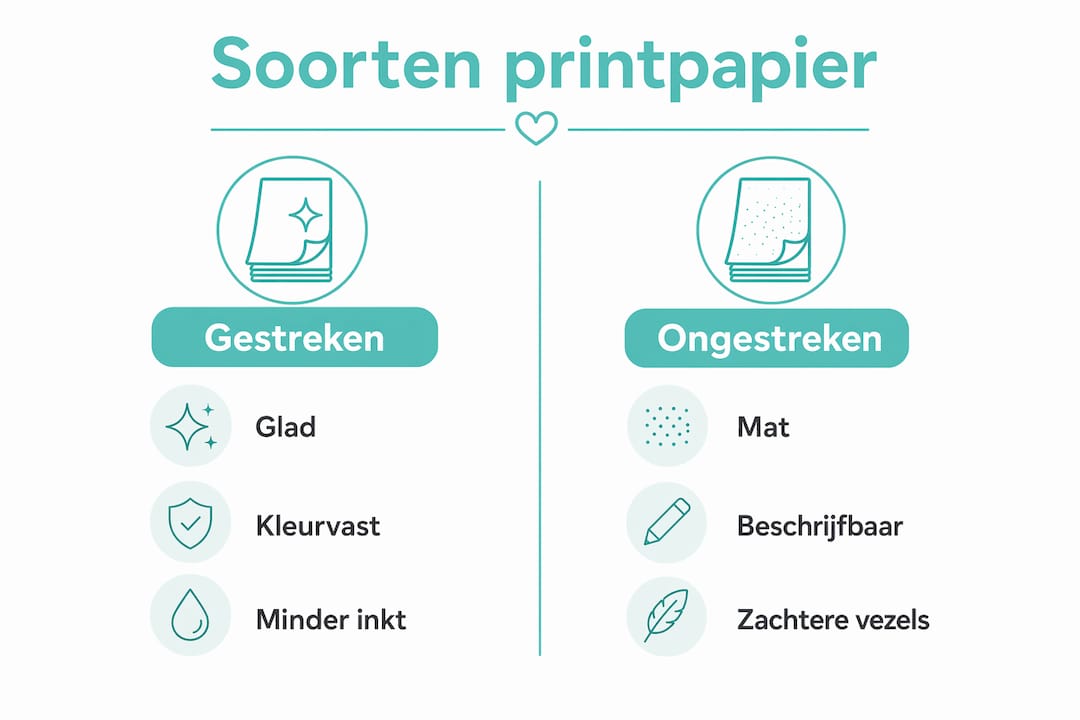
Coated paper: glossy and colorfast
Coated paper absorbs less ink and produces brighter colors. The coating seals the paper fibers, keeping ink droplets on the surface and preventing them from soaking in. The result is a sharp, colorfast image with high detail reproduction. This makes coated paper the best choice for print jobs with many images, such as folders, flyers, and brochures. Glossy coated paper provides the most vibrant colors, while matte coated paper offers a sophisticated look without a mirror effect.
Uncoated paper: matte and writable
Uncoated paper absorbs more ink and is more writable. Its open fiber structure provides a softer, more natural-feeling surface. Texts are easily readable without reflection, which reduces eye strain during prolonged reading. Standard office paper, letterhead, and book paper are almost always uncoated.
The choice between coated and uncoated paper depends on function and appearance. See the table below for a quick overview.
| Property | Coated paper | Uncoated paper |
|---|---|---|
| Surface | Smooth, with coating | Rough, natural |
| Color reproduction | Bright and colorfast | Less intense |
| Ink absorption | Low (stays on surface) | High (soaks in) |
| Writability | Moderate | Good |
| Typical application | Flyers, photos, brochures | Office, books, letterhead |
Pro-tip: Choose coated paper for print materials you want to stand out visually, and uncoated paper for documents people read or write on. More explanation on this distinction can be found in the article about the difference between matte and glossy.
What does paper weight mean and which weight should you choose?
The grammage of printing paper determines its thickness and stiffness, expressed in grams per square meter (g/m²). The higher the number, the heavier and thicker the paper. This has direct consequences for the appearance, print quality, and suitability for specific applications.
Standard office paper weighs 80 g/m². This weight is light enough for smooth feeding in most printers and copiers, yet sturdy enough for normal documents. Paper at 90 g/m² feels noticeably sturdier and is suitable for reports and presentations that require a slightly more professional appearance.
| Weight (g/m²) | Application |
|---|---|
| 80 g/m² | Standard office, daily use |
| 90 g/m² | Reports, presentations |
| 100 to 120 g/m² | Invitations, letterhead |
| 130 to 200 g/m² | Folders, posters, flyers |
| 200 g/m² and heavier | Business cards, luxury print materials |
Paper above 160 g/m² does not always fit in standard office printers. Always check your printer's specifications before purchasing heavier paper. Many inkjet printers from brands like Canon and Epson support paper up to 300 g/m² via a special input tray, while laser printers from HP or Brother are often limited to 160 to 200 g/m².
For the same grammage, paper can still feel different due to variations in stiffness and thickness ratio. This is due to the fiber composition and production process. Two sheets of 120 g/m² from different brands can noticeably differ in stiffness. Therefore, always test a small number of sheets before ordering a large quantity.
Pro-tip: Use 80 g/m² for daily documents and emails you print. Choose 120 g/m² or higher for materials you hand out to clients or guests, such as invitations or product information.
Which applications suit which printing paper?
The choice of paper type depends on what you are creating, how it should look, and how it will be used. This principle applies to every type of print material, from a simple invoice to a luxury brochure.
Office and daily use
For standard office use, uncoated paper of 80 g/m² is the norm. Documents, emails, invoices, and internal reports are almost always printed on this weight. The paper is inexpensive, widely available, and compatible with all common printers. Brands like Navigator and Xerox supply this paper in reams of 500 sheets, suitable for high-volume use.
Marketing materials and flyers
Flyers are printed on coated or uncoated paper with grammages between 135 and 350 g/m², depending on use and desired appearance. For mass distribution, such as flyers in mailboxes, choose 135 to 170 g/m². For luxury flyers at events or in stores, use 250 to 350 g/m². The higher weight gives a premium feel that reinforces the message.
- Flyers for mass distribution: 135 to 170 g/m², coated or uncoated
- Brochures for clients: 130 to 250 g/m², preferably matte coated
- Posters and displays: 170 g/m² and higher, glossy coated for maximum color reproduction
- Business cards: 300 g/m² or heavier, possibly with laminate or UV varnish
Folded materials and brochures
For folders and brochures, a specific rule applies: matte paper folds better than glossy paper. Glossy paper creates white fold lines because the coating breaks when folded. Matte coated paper or uncoated paper provides a clean fold without visible damage. For brochures, a weight of 130 to 250 g/m² is recommended, depending on the number of pages and desired stiffness.
Creative print materials
For creative projects such as posters, art prints, or decorative paper, special paper types are available. Textured paper, such as linen or hammered paper, gives an artisanal look. Photo paper is coated for maximum color reproduction with inkjet printers. Transparent paper or colored paper offers additional possibilities for designers and hobbyists. More about the best paper types for stores can be found in Kadopapier's overview.
How do you use printing paper environmentally consciously?
The CO₂ emissions from paper production amount to 1.71 kg per kg of new paper, compared to 0.83 kg for recycled paper. Recycling thus yields a saving of approximately 38% in CO₂ emissions. This makes the choice for recycled printing paper one of the most direct ways to reduce the environmental impact of printing.
Practical steps for environmentally conscious printing paper use:
- Choose recycled paper with an FSC or PEFC certificate for certified origin
- Print double-sided where possible; this directly halves paper consumption
- Use print preview to avoid unnecessary pages
- Set the printer to draft quality for internal documents
- Save paper scraps for scratch use instead of discarding them immediately
Environmentally conscious printing is becoming increasingly important, with suppliers including sustainability in their product range alongside quality. Brands like Steinbeis and Nautilus offer fully recycled printing paper that is barely inferior in quality to new paper. Certification marks such as FSC, PEFC, and the Blue Angel eco-label provide assurance of sustainable forestry and responsible production. More about choosing the right paper certification mark can be found in Kadopapier's explanation.
Key Insights
The right paper choice requires aligning grammage, finish, and application, with coated paper enhancing color printing and uncoated paper working better for text and folding.
| Point | Details |
|---|---|
| Definition of printing paper | Special paper for printers with controlled ink absorption and smooth feeding. |
| Coated versus uncoated | Coated paper gives bright colors; uncoated paper is more readable and writable. |
| Choosing grammage | 80 g/m² for office, 130 to 200 g/m² for folders and flyers, heavier for business cards. |
| Folding and finish | Matte paper folds better than glossy paper, which creates white fold lines when folded. |
| Sustainability | Recycled paper emits approximately 38% less CO₂ than new paper. |
Paper choice makes more of a difference than you think
After years of working with various paper types, I'm repeatedly struck by how often people draw the wrong conclusion: they think more expensive paper is automatically better. That's not true. A flyer on 350 g/m² glossy paper looks impressive, but if you have to fold it for an envelope, you'll get unsightly white creases that completely ruin the appearance. The fault lies not with the paper itself, but with the combination of weight, finish, and application.
What I also frequently see: people putting heavy paper into a standard office printer without checking the specifications. The result is a paper jam, a damaged printer, or a print with streaks. The average office printer is designed for 80 to 120 g/m². Anything above that requires checking the manual or a special input tray.
My advice is simple: start with the end use. Will the document be read, folded, distributed, or framed? That answer determines the weight and finish. Feel free to experiment with textured paper or recycled paper for creative projects. The look of hammered or linen paper for an invitation or business card is something that people immediately notice and remember. Sustainable printing does not have to be a compromise. Recycled paper from brands like Steinbeis now performs at the same level as new paper, even for color printing.
— M
Ordering printing paper and packaging materials from Kadopapier
Kadopapier offers a wide range of paper types for office, creative printing, and packaging applications. Whether you are looking for standard printing paper for daily use, coated paper for flyers, or special paper for creative projects: the assortment is tailored to both private and business customers. Orders placed before 15:00 on weekdays are shipped the same day. Free shipping applies from 100 euros excluding VAT. Visit the Kadopapier webshop for the full range of printing paper, wrapping paper, tissue paper, and related packaging materials.
FAQ
What exactly is printing paper?
Printing paper is special paper designed for use in printers and copiers, with properties that ensure good ink absorption and smooth feeding. It differs from ordinary paper due to its controlled fiber structure, whiteness, and surface treatment.
What paper weight is suitable for a standard printer?
Most office printers are suitable for paper from 80 to 120 g/m². Heavier paper, such as 160 g/m² or more, requires a special input tray or a printer that supports this weight.
What is the difference between coated and uncoated printing paper?
Coated paper has a coating that makes the surface smooth and displays colors brightly, ideal for flyers and photos. Uncoated paper has an open structure, absorbs more ink, and is better suited for text and writable use.
How do I choose sustainable printing paper?
Choose paper with an FSC or PEFC certificate and consider recycled paper. Recycled printing paper emits approximately 38% less CO₂ than new paper and, with modern brands like Steinbeis and Nautilus, is comparable in quality.
Why does glossy paper show white lines when folded?
The coating on glossy paper breaks when folded, resulting in visible white lines. For folded items such as folders and brochures, matte coated or uncoated paper is the better choice.