
Best Industrial Packaging Solutions for Large-Scale Logistics
Choosing the right packaging solution for large-scale production and distribution is no easy task. Every choice has direct consequences for costs, logistical efficiency, and your company's ecological footprint. Corrugated cardboard, plastic pallet containers, octabins, or automated packaging lines: each type has specific advantages and disadvantages depending on your supply chain. This article compares the most common industrial packaging solutions based on real-world data, sustainability parameters, and logistical performance, enabling you to make an informed decision.
Table of Contents
- Key Selection Criteria for Industrial Packaging Solutions
- Overview of the Main Industrial Packaging Solutions
- Comparison Table: Materials vs. Performance and Environmental Impact
- Special Applications and Edge Cases: Logistics, Transport, and LCA Trade-offs
- Automation and Innovative Mechanisms for Efficient Industrial Packaging
- Decision-Making: How to Choose the Best Solution for Your Industry
- Want to Know More or Directly Implement Sustainable Packaging Solutions?
- Frequently Asked Questions about Industrial Packaging Solutions
Key Insights
| Point | Details |
|---|---|
| Corrugated Cardboard: Recycling Champion | Corrugated cardboard packaging is almost entirely recyclable and offers high CO2 savings. |
| LCA Reveals Choices | No single material should always be preferred; an LCA analysis determines the most sustainable option for your situation. |
| Automation Pays Off | Automated packaging lines increase speed and reduce environmental impact through more efficient material use. |
| Transport Dictates Material | For long distances, lightweight packaging is often more environmentally friendly than heavy reusable options. |
| Specialist as an Ally | Seek advice from experts to find the optimal balance between logistics, sustainability, and costs. |
Key Selection Criteria for Industrial Packaging Solutions
Before choosing a packaging type, it's essential to establish the right criteria. Not every solution fits every situation. The following factors largely determine which direction you should take.
- Load capacity and stackability: Can the packaging handle the weight of your product, even with multiple layers on a pallet?
- Product protection: Does the material protect against moisture, shocks, and temperature fluctuations?
- Recyclability and CO2 impact: What is the environmental impact over the entire life cycle?
- Cost structure: What are the initial costs versus the total costs over multiple usage cycles?
- Logistical compatibility: Does the packaging fit optimally into containers and on pallets?
A Life Cycle Analysis (LCA) is a method to calculate the total environmental impact of packaging, from raw material to waste processing. Prioritize customized, logistically optimized, and recyclable solutions based on such an LCA assessment. This prevents you from making a choice that seems sustainable on paper but, in practice, emits more CO2 due to extra transport weight.
When assessing sustainable packaging material, the possibility of recycling gift packaging also plays a role, even in an industrial context. Also, check out Nefab solutions for a broad overview of optimized industrial packaging.
Pro-tip: Always link your selection criteria to your logistical needs. Packaging that perfectly fits a 40-foot container directly saves on transport costs per unit.
Overview of the Main Industrial Packaging Solutions
With the selection criteria clear, let's now look at the most commonly used packaging types in industry. Each type has its own area of application.
Pallet containers are available in corrugated cardboard, plastic, and wood. They are heavy-duty and suitable for bulk shipping over long distances. Corrugated cardboard variants are fully recyclable. Plastics are reusable but require a higher initial investment.
Octabins are octagonal cardboard containers, ideal for dry bulk cargo such as granules or powdered products. They are lightweight, stackable, and easy to recycle. Pallet containers are economical and environmentally friendly, while octabins excel with unstable loads.
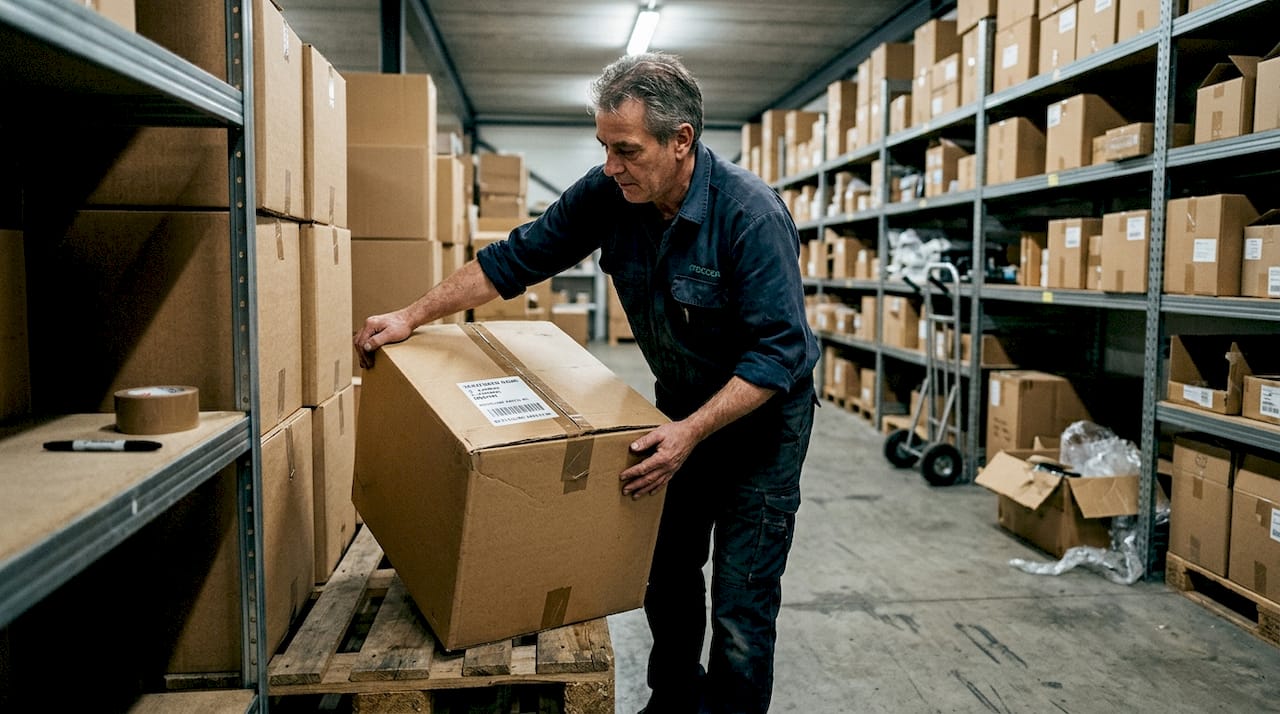
Corrugated cardboard boxes are the most flexible option. Available in various thicknesses (single-wall, double-wall, triple-wall) and sizes. Fully recyclable and widely applicable.
Plywood and wooden crates are used for very heavy or fragile products, such as machinery or precision instruments. They offer maximum protection but are heavier and more expensive.
Plastic variants such as HDPE crates are reusable, resistant to moisture and shock, and suitable for closed-loop systems. The higher purchase price is recouped through intensive reuse.
| Packaging Type | Reusable | Recyclable | Load Capacity | Application |
|---|---|---|---|---|
| Corrugated Box | No | Yes | Medium | General use |
| Cardboard Pallet Container | No | Yes | High | Bulk shipping |
| Octabin | No | Yes | High | Dry bulk cargo |
| HDPE Crate | Yes | Limited | High | Closed-loop systems |
| Wooden Crate | Limited | No | Very High | Heavy/fragile goods |
For more options, check out the reusable industrial packaging guide or explore more industrial packaging possibilities with specialized suppliers.
Comparison Table: Materials vs. Performance and Environmental Impact
Now that the individual options have been explained, a direct comparison based on sustainability data follows.
| Material | Weight | Reuse | Recycling | CO2 Savings | Applications |
|---|---|---|---|---|---|
| Corrugated Cardboard | Light | No | Up to 87% | High | General, retail, export |
| Wood | Heavy | Limited | Low | Medium | Heavy goods |
| HDPE Plastic | Medium | Yes | Limited | Medium | Closed-loop systems |
| EPS (Styrofoam) | Very Light | No | Low | High for transport | Cold chain, export |
The figures are clear. Nefab packaging achieves an average of 31% CO2 reduction compared to standard alternatives. At the same time, the cardboard industry shows that an 87% recycling rate is achievable with a circular approach, combined with 8% lower fossil emissions.
Even more striking: the paper industry halved its CO2 emissions since 2005 thanks to innovation and recycling. This makes corrugated cardboard one of the strongest choices if sustainability is a high priority for you.
For practical tips on efficient packaging and logistics and insights on CO2 savings in shipping boxes, you can find additional information in our knowledge base.
Special Applications and Edge Cases: Logistics, Transport, and LCA Trade-offs
In addition to standard applications, there are situations where the usual choice is not the best. Transport distance and chain type play a decisive role here.
- Cold chains and long routes: EPS is often the better choice here. Its low weight significantly reduces transport emissions.
- Closed distribution chains: Reusable HDPE crates are more efficient here because return logistics are organized.
- Single use over long distances: Corrugated cardboard scores well on recyclability but weighs more than EPS.
- Complex multimodal routes: Every kilogram counts here. Lightweight packaging reduces the total CO2 footprint per unit.
LCA analyses show that there is no universal winner. The optimal choice always depends on the context of use, transport distance, and reuse cycle.
Concrete research confirms this: for long distances, EPS is more environmentally friendly than HDPE, while for short routes and closed-loop systems, reusable plastic is preferred. A comparative LCA study of packaging provides the methodology to calculate this for your own situation.
For more background on regulations and sustainability, read our analysis on insights into eco-packaging materials.
Pro-tip: Have your entire supply chain analyzed by a specialist before making a definitive material choice. Small differences in transport distance or return frequency can completely reverse the outcome.
Automation and Innovative Mechanisms for Efficient Industrial Packaging
Material is just one part of the equation. How you package also determines efficiency and material consumption. Automation plays an increasingly important role here.
- Flowpacking (center seal, box motion, rotary): Suitable for flexible packaging with high density and speed. Ideal for food, consumer products, and pharmaceutical articles.
- Casepackers: Automate packing into boxes, trays, and crates. Reduce manual labor and increase consistency.
- MAP packaging (Modified Atmosphere Packaging): Possible via hermetic box motion seals. Extends shelf life without additional preservatives.
- Robotization: For complex packaging lines with varying product sizes, robotization offers maximum flexibility.
Automation via flowpacking and casepackers leads to processing speeds of up to 200 packages per minute and better seal integrity. This directly translates into less material waste and lower costs per unit.
Also, check out our information on sustainable plastic bags for additional insights into material efficiency. For technical details on casepacking techniques, we refer to specialized machine suppliers.
Pro-tip: Consider robotization for complex packaging lines if you are looking for economies of scale. The payback period for high volumes is often less than two years.
Decision-Making: How to Choose the Best Solution for Your Industry
All the preceding information summarized into a practical step-by-step plan. Use this as a guide for your next packaging decision.
- Inventory your requirements: Note weight, volume, transport routes, temperature requirements, and return logistics.
- Select three candidates: Choose the three most suitable packaging types based on the comparison table.
- Perform an LCA comparison: Calculate the environmental impact over the entire life cycle for each type.
- Coordinate with logistics and purchasing: Check if the chosen solution fits within existing processes and budgets.
- Pilot and evaluate: Test the solution on a small scale before fully scaling up.
- Benchmarking: Compare your results with industry averages and adjust where necessary.
Full supply chain optimization requires benchmarking and alignment with business goals. There is no single winner that applies to every situation. Additional LCA insights help you weigh the right parameters.
For inspiration on reusable gift packaging and how sustainability also works in smaller packaging formats, our knowledge base offers additional background.
Want to Know More or Directly Implement Sustainable Packaging Solutions?
Kadopapier.net offers a wide range of packaging materials for both retail and industrial applications. Whether you are looking for decorative finishing or functional protective packaging, the offer is directly available. For example, check out the sustainable packaging decoration for professional presentation, or choose curling ribbon for packaging as a finishing touch for your product packaging. For a complete overview of all available innovative packaging solutions, navigate directly to the product range. Ordered Monday to Friday before 3:00 PM, shipped the same working day. Free shipping from 100 euros excl. VAT.
Frequently Asked Questions about Industrial Packaging Solutions
What are the most sustainable materials for industrial packaging?
Corrugated cardboard and paper score highest on recyclability and CO2 impact. The paper industry halved its CO2 emissions since 2005. For reuse, plastics like HDPE in closed-loop systems are often more practical.
What should I consider for packaging for long-distance transport?
For long distances, material weight and transport emissions are significant factors. For long-haul routes, EPS is more environmentally friendly than reusable HDPE because its lower weight significantly reduces transport emissions.
Can automation contribute to more sustainable packaging?
Yes. Automation leads to more efficient packaging with less material waste and higher processing speeds, which reduces the overall environmental impact per unit.
How do I compare the environmental impact of different packaging?
Use an LCA study to weigh all relevant parameters. An LCA compares impact categories such as CO2, energy consumption, and reusability in the right context for your specific chain.