
Sustainable wrapping paper: environmentally friendly and stylish
In the Netherlands and Belgium, 74% of consumers consciously choose sustainable packaging , especially during the holidays. Traditional wrapping paper often contains plastic coatings that make recycling impossible. This guide shows which materials are truly eco-friendly, how to recognize common misconceptions, and provides practical tips for stylish, waste-free wrapping. You'll learn to make conscious choices that help the climate.
Table of contents
- Introduction to sustainable wrapping paper
- Materials and production of sustainable wrapping paper
- Environmental impact and recycling of wrapping paper
- Common misconceptions about sustainable wrapping paper
- Legislation, certifications and cooperation in the Netherlands and Belgium
- Practical tips and creative ways for sustainable packaging
- Conclusion and future of sustainable wrapping paper
- What does kadopapier.net offer for sustainable packaging?
- Frequently asked questions about sustainable wrapping paper
Key Points
| Point | Details |
|---|---|
| Sustainable paper without plastic | Environmentally friendly materials such as recycled paper, kraft paper and grass paper are fully recyclable without harmful coatings. |
| FSC certification guarantees quality | This quality mark guarantees responsible forest management and transparent paper production. |
| Glossy paper is often not durable | Glitter and metallic layers contain plastic and make recycling difficult, despite their attractive appearance. |
| Packing without tape saves waste | Folding techniques and natural ribbons make packaging reusable and fully compostable. |
| European cooperation stimulates standards | The Netherlands, Belgium, France, and Luxembourg have been working together since 2025 on uniform sustainability requirements for packaging. |
Introduction to sustainable wrapping paper
Sustainable wrapping paper is made from materials that are recyclable or compostable after use without harming the environment. It avoids plastic coatings, synthetic glitter, and chemical bleaching agents that burden ecosystems. Instead, it uses natural fibers, plant-based inks, and water-based adhesives.
Traditional wrapping paper often contains plastic coatings, glitter, or metallic layers that hinder recycling and lead to increased waste. After the holidays, millions of pounds of wrapping paper end up in landfills. Most traditional paper cannot be recycled because it's covered with tape, synthetic bows, and non-biodegradable decorations.
Consumers are increasingly choosing sustainable alternatives. Research shows that younger generations, in particular, are willing to pay extra for environmentally friendly packaging. They value transparency regarding origins and production processes. Companies are responding with a wider range of certified products.
Key features of sustainable wrapping paper:
- Recycled material or sustainably sourced fibers
- Free from plastic coatings and synthetic additives
- Biodegradable or fully recyclable
- Vegetable inks without heavy metals
- Certifications such as FSC or PEFC for forest responsibility
Choosing sustainable paper immediately reduces your ecological footprint. Every sheet of traditional paper requires water, energy, and chemicals during production. By making a conscious choice, you support companies investing in green production and the circular economy.
Materials and production of sustainable wrapping paper
Sustainable paper is often made from recycled materials, agricultural waste, or FSC-certified forests, which reduces the impact on nature. These materials offer the same quality as traditional paper but with significantly lower environmental costs. Production uses less water and energy.
Recycled paper uses waste paper as a raw material. The process saves up to 70% energy compared to virgin paper. Modern recycling techniques produce strong paper without compromising quality. Kraft paper remains popular for its natural look and strength.
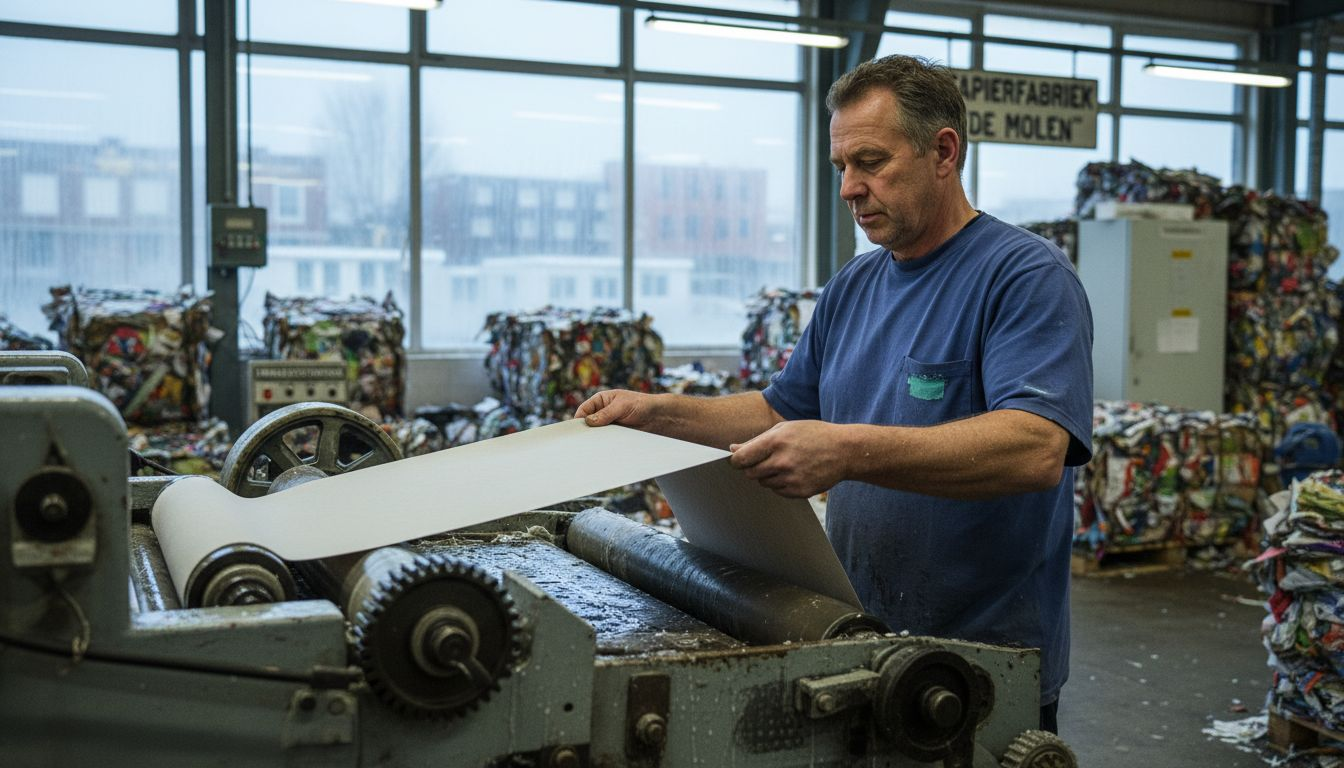
Grass paper is an innovative option made from dried grass. It requires minimal water during production and grows quickly. Agricultural waste like straw and sugarcane offers similar benefits. Tree-free paper like PaperWise utilizes these waste streams.
FSC certification guarantees that wood comes from responsibly managed forests. The system monitors social and ecological standards throughout the entire production chain. Consumers can rely on this label for transparency and quality.
Commonly used sustainable materials and production:
- Recycled paper with at least 80% recovered fibers
- Kraft paper without chemical bleach
- Grass paper with fast regrowth and low water footprint
- Agricultural waste paper made from straw or sugar cane
- FSC-certified paper with forest responsibility
| Material | CO2 emissions | Water consumption | Recyclability |
|---|---|---|---|
| Traditional paper | High | 300 liters/kg | Limited by coatings |
| Recycled paper | 70% lower | 100 liters/kg | Complete |
| Grass paper | 75% lower | 2 liters/kg | Complete |
| FSC kraft paper | 50% lower | 150 liters/kg | Complete |
Production processes increasingly use renewable energy. Solar and wind power further reduce the carbon footprint. Some manufacturers achieve carbon neutrality through offset programs and efficient logistics.
Environmental impact and recycling of wrapping paper
Plastic coatings and glitter make recycling virtually impossible and contribute to high waste rates around the holidays. Traditional paper containing these additives must be incinerated or landfilled. This wastes valuable resources and increases the environmental impact.
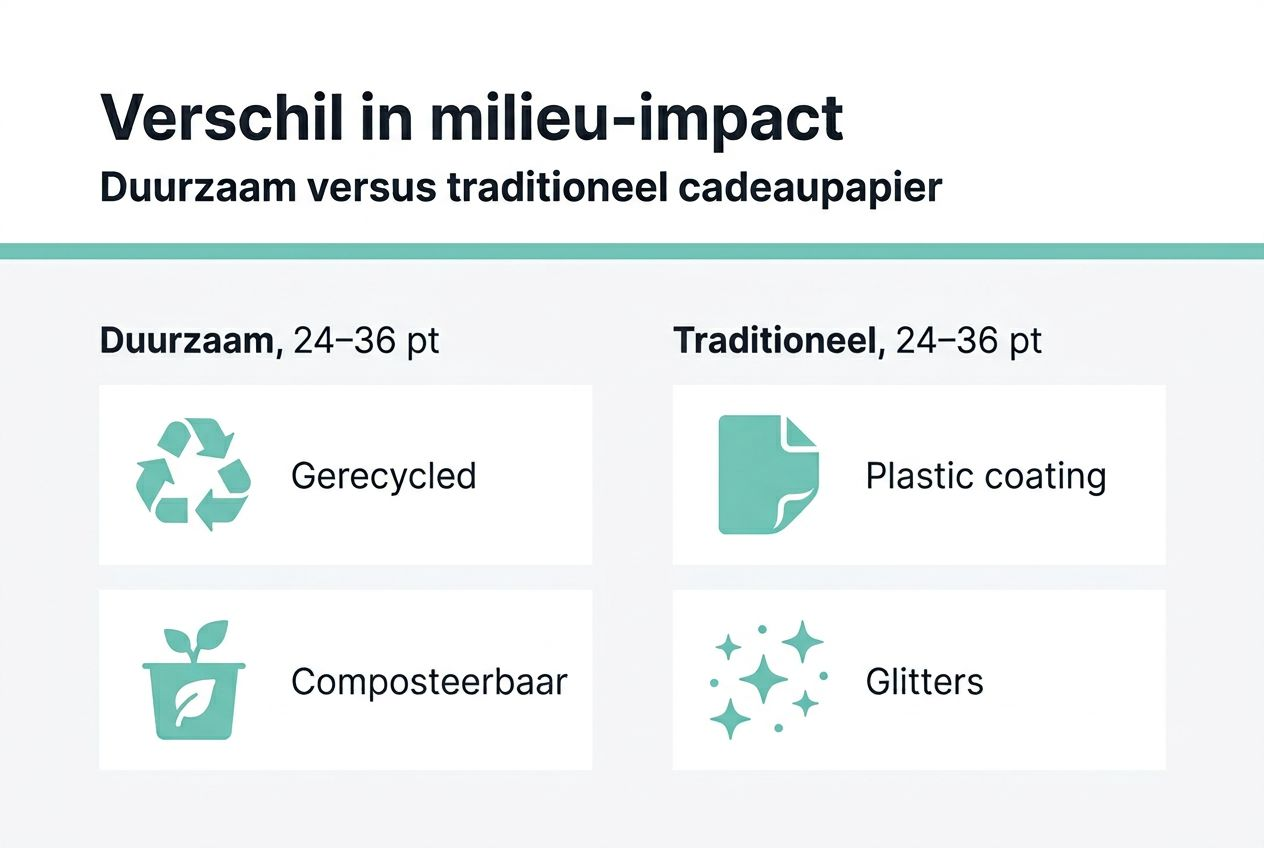
Recycling facilities cannot separate mixed materials. Plastic films and metallic layers contaminate paper pulp. As a result, millions of kilograms of potentially reusable paper are lost. Sorting facilities remove this paper from the recycling stream.
Sustainable paper choices significantly reduce waste and CO2 emissions. Uncoated paper can go straight into the paper recycling bin. It is converted into new paper with minimal energy loss. Composting is possible with fully biodegradable paper.
Advantages of paper packaging without coatings:
- Direct recycling in standard paper flow
- No contamination of recycled material with plastic
- Compostable in home compost within 12 weeks
- Lower transport costs due to lighter weight
- Reduced dependence on new raw materials
| Paper type | Ease of recycling | CO2 footprint | Compostable |
|---|---|---|---|
| Shiny with plastic | Impossible | 850g CO2/kg | No |
| With glitter | Impossible | 900g CO2/kg | No |
| Recycled without coating | Very easy | 250g CO2/kg | Yes |
| Kraft paper of course | Very easy | 300g CO2/kg | Yes |
| Grass paper | Very easy | 200g CO2/kg | Yes |
Transport and storage also influence the total impact. Locally produced paper reduces transport emissions. Compact packaging reduces the logistics footprint. Choose suppliers that prioritize green transport.
Pro tip: Make sure paper has a clear recycling label and use tape sparingly or not at all when wrapping. Natural alternatives like string and stamps work perfectly.
Common misconceptions about sustainable wrapping paper
Glossy paper is often mistakenly thought to be sustainable, but it often causes recycling problems. The gloss usually comes from a thin, non-degradable plastic coating. This coating bonds with the paper fibers, making separation impossible.
Consumers confuse aesthetics with sustainability. Attractive paper appears high-quality and therefore better for the environment. Manufacturers use green colors and nature motifs to suggest eco-friendliness. The actual composition tells a different story.
Prints aren't automatically problematic. Water-based, vegetable-based inks are completely biodegradable. However, chemical inks containing heavy metals like lead and cadmium pollute groundwater. Certifications provide clarity about the types of ink used.
Reusability doesn't mean compostability. You can reuse traditional paper multiple times, but it ultimately remains waste. Truly sustainable paper returns to nature's cycle without residue. This distinction is crucial for environmentally conscious choices.
Confusion also arises regarding biodegradable plastic alternatives. Bioplastics only break down under industrial composting conditions. At home or in nature, they remain intact for years. Labels can be misleading without clear explanation.
Common misconceptions about sustainable paper:
- Glossy paper is luxurious so better for the environment
- All printed patterns use chemical inks
- Reusable paper is automatically compostable
- Green colors on packaging guarantee sustainability
- Bioplastic coatings are always environmentally friendly
Critically reading labels prevents disappointment. Look for specific certifications like FSC, PEFC, or Cradle to Cradle. Vague terms like eco-friendly or natural without substantiation are often greenwashing. Ask suppliers for specific production data.
Legislation, certifications and cooperation in the Netherlands and Belgium
The Netherlands, Belgium, France, and Luxembourg have been joining forces to promote more sustainable packaging in Europe since 2025. This collaboration aims for uniform standards and transparency. Joint lobbying in Brussels strengthens influence on European regulations.
The European Packaging and Packaging Waste Regulation sets strict requirements for recyclability. Starting in 2026, all packaging must be at least 65% recyclable. Plastic coatings on paper do not meet this standard. Manufacturers are investing heavily in alternatives.
Extended Producer Responsibility (EPV) obliges producers to contribute financially to waste collection. Those using materials that are difficult to recycle pay higher rates. This encourages circular design and innovation in materials.
FSC certification remains the gold standard for paper products. The system monitors the entire production chain, from forest to finished product. PEFC offers similar guarantees, focusing on smaller forestry operations. Both certifications are internationally recognized.
Regional initiatives support local production. Belgium encourages short supply chains with subsidies for sustainable packaging innovation. The Netherlands focuses on a circular economy with waste prevention as a priority. Collaboration accelerates the transition to sustainable systems.
Relevant certifications and regulations:
- FSC for responsible forest management and a transparent chain
- PEFC with a focus on small-scale forestry
- EU Ecolabel for low environmental impact
- Cradle to Cradle for circular design
- OK Compost for home compostability
Transparency increases through digital traceability. QR codes on packaging provide information about origin and production. Blockchain technology guarantees data reliability. Consumers can make informed choices with complete knowledge.
Practical tips and creative ways for sustainable packaging
Wrapping methods without adhesive and using natural ribbons reduce plastic waste and make the packaging reusable. Origami folding techniques hold paper in place without adhesives. This traditional Japanese method works surprisingly well with modern wrapping paper.
Furoshiki uses square cloths to wrap gifts. The technique is centuries-old and infinitely reusable. Cotton or linen cloths become part of the gift. Recipients can continue to use them for their own wrapping.
Natural ribbons made of jute, hemp, or cotton replace plastic bows. These materials are biodegradable and compostable. Dried flowers, twigs, or pine needles add a personal touch. Creativity makes packaging unique and eco-friendly.
Reusable gift boxes made of sturdy cardboard will last for years. Choose neutral colors that suit different occasions. Decorate with natural elements that change with each occasion. This investment will save you money and waste in the long run.
Stamps and handwritten labels replace printed cards. Use vegetable ink on recycled paper for personalized messages. These details show care for the recipient and the environment. It requires minimal extra time and has a big impact.
Practical packing tips and creative ideas :
- Learn basic origami folding for boxes and envelopes
- Collect natural decorations such as pine cones
- Use old newspapers or cards as characteristic wrapping paper
- Save ribbons and bows for reuse
- Choose neutral base colors for seasonal use
Pro tip: Invest in sturdy, reusable gift boxes that you can reuse year after year and decorate with seasonal natural elements. This saves money and creates tradition.
Workshops and online tutorials teach advanced techniques. Libraries and environmental organizations regularly organize free sessions. YouTube offers endless inspiration for all skill levels. Sharing knowledge strengthens sustainable communities.
Conclusion and future of sustainable wrapping paper
Sustainable wrapping paper combines eco-friendly materials with practicality. FSC certification, recycled paper, and vegetable-based inks form the foundation. Avoiding plastic coatings and synthetic embellishments makes recycling possible. Making conscious choices starts with a critical look at labels and product information.
The market for sustainable wrapping paper is growing , and innovations in materials and production continue to evolve. Consumers are demanding transparency, and companies are responding with better products. Grass paper and agricultural waste paper are gaining ground as mainstream alternatives.
Innovations are focused on CO2 neutrality throughout the entire production chain. Renewable energy is becoming standard in factories. Offset programs neutralize remaining emissions. Social responsibility is receiving greater attention with fair wages and working conditions.
Education remains crucial for wider adoption. Schools and community centers organize workshops on sustainable packaging. Social media spreads best practices and creative ideas. Influencers demonstrate that environmental awareness and aesthetics go hand in hand.
Future developments include smart packaging with biodegradable electronics. These can communicate product properties and provide recycling instructions. Technology and sustainability reinforce each other. The transition to a circular economy is accelerating.
Awareness is growing, but action remains necessary. Every conscious purchase promotes sustainable production. Together, consumers and producers are building a green future. Sustainable wrapping paper is more than a trend; it's becoming the new normal.
What does Kadopapier.net offer for sustainable packaging?
Kadopapier.net offers a wide range of sustainable packaging materials that combine style and environmental awareness. The selection includes recycled wrapping paper, natural ribbons, and reusable alternatives. Each product is selected for its quality and eco-friendliness.
Luxurious organza ribbons in various colors provide a professional finish without fraying. These ribbons are reusable and add elegance to any gift. The wide selection of colors suits various occasions and seasons.
Reusable organza bags offer an elegant alternative to traditional wrapping paper. These bags last for years and drastically reduce paper waste. Recipients appreciate the practical luxury they can keep using.
Visit Kadopapier.net for inspiration and high-quality products that enhance your sustainable wrapping experience. The range is constantly expanding with new eco-friendly options. Customer service is happy to help you make conscious choices.
Frequently asked questions about sustainable wrapping paper
What is the difference between sustainable and traditional wrapping paper?
Sustainable wrapping paper contains no plastic coatings, synthetic glitter, or chemical bleaches. It's made from recycled materials, FSC-certified wood, or agricultural waste. Traditional paper often uses virgin pulp with chemical treatments and plastic layers for sheen. The main difference lies in recyclability and the environmental impact of production.
How do I recognize truly sustainable wrapping paper in the store?
Look for certifications like FSC, PEFC, or OK Compost on the packaging. Feel the paper; sustainable options often feel less smooth because they don't have a plastic coating. Read the ingredients and check for terms like recycled, biodegradable, or vegetable ink. Avoid paper with glitter, metallic prints, or strong sheen.
Can I use glossy paper if I want to be environmentally conscious?
Glossy paper usually contains plastic coatings that make recycling impossible. Instead, choose matte paper with a natural finish. Some brands offer a gloss finish through mechanical processing without plastic, but this is rare. Always check labels and certifications. For a festive look, natural stamps and ribbons work better than glossy coatings.
Which packaging methods are best for the environment?
Tape-free origami folding techniques are ideal because they keep paper completely reusable. Furoshiki with cloth offers infinite reusability. Use natural ribbons made of jute or hemp instead of plastic bows. Decorate with dried flowers or twigs that are compostable. These methods virtually eliminate waste.
Which certifications provide assurance about sustainability?
FSC and PEFC guarantee responsible forest management and a transparent production chain. The EU Ecolabel confirms low environmental impact throughout the entire lifecycle. OK Compost certifies home compostability within 12 weeks. Cradle to Cradle assesses circular design and safe materials. These certifications are independently verified and internationally recognized.
Recommendation
- 7 Types of Tissue Paper and Their Uses for Gift Shops – Kadopapier.net
- Plain Silver with Stripes 30-100cm - Luxury Gift Wrapping Paper – Kadopapier.net
- Wrapping Paper Colored Stripes - 30/100cm x 200m Gift Wrap – Kadopapier.net
- Eco-friendly gift wrapping: sustainable and stylish wrapping – Kadopapier.net