
Foldable Bag: Your Practical and Stylish Guide
TL;DR:
- A foldable bag is not a quick fix for forgotten groceries, but a durable, space-saving alternative. These bags stand out due to their strong materials, versatility, and reusability, making them popular for gift packaging and promotional material. Quality heavily depends on material choice, construction, and maintenance, making conscious purchase and care essential.
A foldable bag is not just an emergency solution when you forget your groceries. That's the most persistent misconception. A closer look reveals that modern foldable bags are available in sturdy materials, sleek finishes, and versatile sizes that are both functional and decorative. This guide goes beyond a superficial product description: you'll learn exactly what determines material choice, construction, and clever applications, so you can make the right choice for gift packaging, creative projects, or daily use.
Table of Contents
- What makes a foldable bag special?
- Importance of material choice and construction
- Making your own foldable bag: creative tips
- Applications: from gift packaging to decorative project
- What most people miss when choosing a foldable bag
- Getting started with decorative materials or tools?
- Frequently asked questions about foldable bags
Key Insights
| Point | Details |
|---|---|
| Material and construction | The quality of material and seams determines the longevity of your foldable bag. |
| DIY possibilities | With a good pattern, sturdy lining, and proper haberdashery, you can easily make a personalized bag. |
| Creative and practical | A foldable bag combines practical carrying capacity with a unique, decorative look. |
| Conscious choice pays off | Don't just look at appearance, but especially at the closure, structure, and maintenance for lasting enjoyment. |
What makes a foldable bag special?
The strength of a foldable bag lies in one feature that almost no other packaging material has: it takes up virtually no space when not in use. You fold it into a compact package, sometimes smaller than a smartphone, and effortlessly store it in a drawer, bag, or cabinet. That's why more and more people are consciously choosing this type of bag, both at home and in a business context.
Foldable bags for daily use focus on compact storage and durable materials with practical pouch solutions. A 48 by 42-centimeter bag folds back into a pouch just a few centimeters in size. This is no coincidence, but the result of thoughtful sewing and the right fabric choice.
What distinguishes a foldable bag from a classic carrier bag?
Many people see a foldable bag as a derivative of a regular carrier bag. That's not entirely accurate. The two products are designed with different purposes in mind.
| Feature | Foldable bag | Classic carrier bag |
|---|---|---|
| Compactness | Folds into small pouch | Remains large |
| Weight | Light, often under 150 grams | Heavier due to construction |
| Material | Polyester, recycled PET, cotton | Paper, plastic, cotton |
| Reusability | High, washable | Limited |
| Applications | Gift, groceries, promotion | Primarily retail transport |
| Price | Variable, including budget | Often low, one-time use |
Classic paper carrier bags are handy for a single purchase, but get damaged by moisture after one use. A foldable bag made of recycled PET lasts for years, if well-maintained.
For those who want to understand foldable bags as an alternative to disposable packaging, the article on understanding reusable gift bags is a logical next step.
Popular as a gift and promotional item
The popularity of foldable bags as gifts or promotional items is rapidly increasing. Companies and creative makers are increasingly choosing these bags as an alternative to traditional gift packaging. The reason is practical: the recipient doesn't throw the bag away, but reuses it. This keeps the brand or message visible, long after the initial giveaway.
Suppose you, as a creative maker, visit a local market. You could give products in a paper bag, but a foldable bag with your own design or color immediately makes a different impression. Professional, thoughtful, and attractive. The difference is visible to every customer.
Here are the main advantages:
- Compact and lightweight: always fits in another bag or pocket
- Stylish: available in prints, solid colors, and various sizes Reusable: less waste, more value for the recipient
- Versatile: from daily groceries to exclusive gifts
- Customizable: printing, color, or label of your choice
Importance of material choice and construction
Not every foldable bag is equal. The big difference lies in what the bag is made of and how the parts are attached. Those who ignore this often buy the same cheap bag repeatedly.
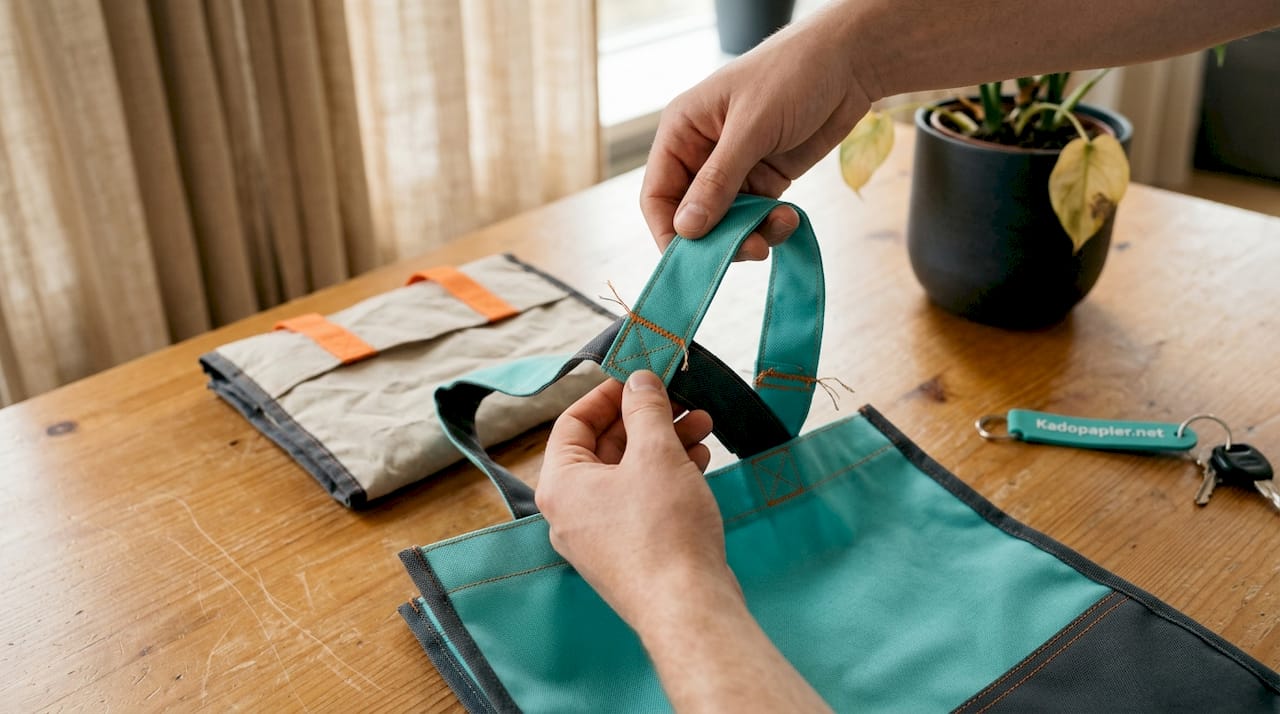
Material quality and construction determine carrying capacity and lifespan, especially with frequent use. Reinforced seams, sturdy handles, and solid closures are crucial.
Comparison of common materials
| Material | Strength | Weight | Durability | Suitable for |
|---|---|---|---|---|
| Polyester | Good | Light | High | Daily use |
| Recycled PET | Very good | Light | High | Eco-conscious applications |
| Cotton | Good | Medium | High with good care | Gift, market |
| Non-woven fabric | Moderate | Very light | Low | Single use |
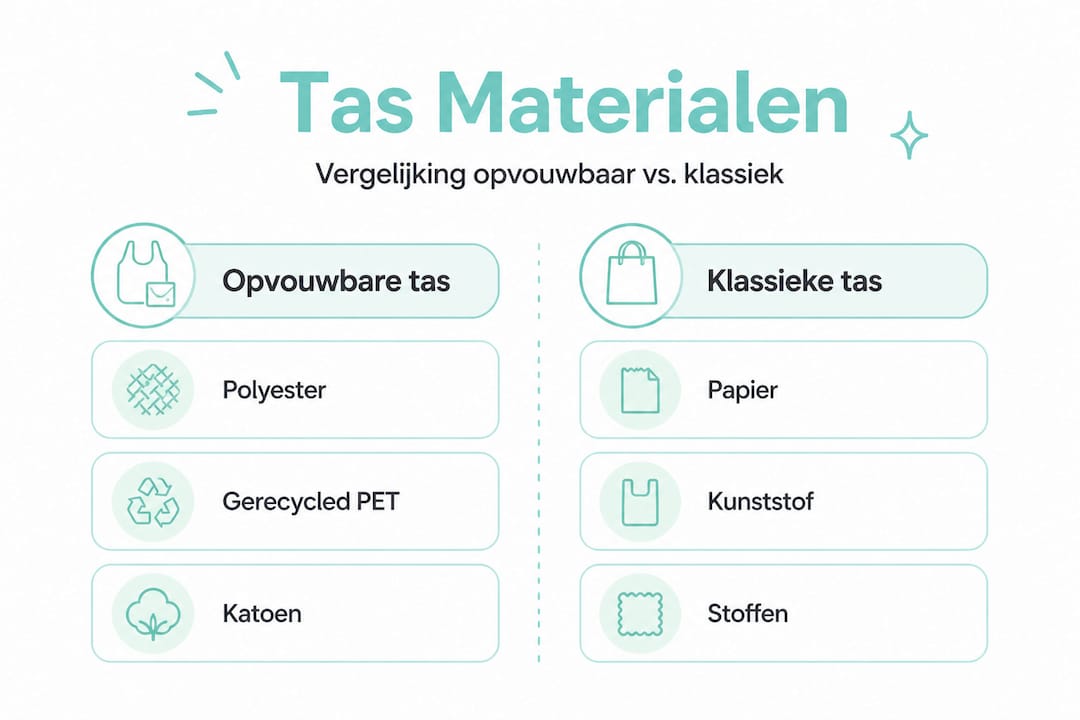
Polyester is the most common material in foldable bags. It is lightweight, strong, and resistant to moisture. Recycled PET adds a sustainability argument: the fabric is made from processed plastic bottles, reducing the ecological footprint. Cotton feels more luxurious but requires more maintenance and is slightly heavier.
Seams, reinforcements, and closures
The quality of the seams is one of the most underestimated factors when choosing a bag. A double seam at the stress points of the handles significantly increases the load the bag can handle. A single seam tears more easily, especially if you regularly carry heavy items.
Closures also determine how long a bag lasts. A low-quality zipper jams or breaks after dozens of uses. A magnetic clasp or snap button is a good alternative, but also requires sturdy attachment to the bag itself.
Practical checklist when buying a foldable bag:
- Check the seams at the handles. Are they double-stitched or just single?
- Pull the handles. Does the attachment feel sturdy, or does the fabric give way?
- Test the closure at least five times in a row. Does it work smoothly?
- Examine the fabric up close. Is the weave dense or open and thin?
- Feel if the bag feels water-repellent. This is visible if water beads on the surface.
- Check if there is an interlining. This gives the bag shape and sturdiness.
For those who regularly transport heavy groceries or gift packages, it is worthwhile to consult the guide on choosing sturdy shopping bags. There you will find additional specifications for bags that are heavily used daily.
“A poor-quality bag most often fails at the zipper or due to tearing fabric at the handles. These are precisely the points you should thoroughly check when purchasing.”
Pro-tip: Preserve the water-repellent layer of your bag by not throwing it in the washing machine for every small stain. Remove dirt with a damp cloth and mild soap. If water repellency is lost, use a fluororesin-based waterproofing product. This will make the coating last the longest.
Making your own foldable bag: creative tips
Making your own foldable bag is achievable for anyone with a sewing machine and basic sewing experience. The end result is a unique, personalized bag that you can tailor precisely to your wishes. Think about the color, material, size, and finish.
DIY projects for bags use a combination of outer fabric, reinforcement, and details such as webbing, zippers, and interlining, with extra attention to securely attaching the handles. This is precisely the sequence that also works for a self-made foldable item.
Those who prefer to work without a sewing machine will discover that felt offers special possibilities. Felt bags in origami style are made from 100 percent recycled felt without lining, which gives the bag immediate shape retention. Ideal for those who want to make a simple but structural bag without complicated construction.
Step-by-step: how to get started
- Choose the outer fabric. Use sturdy cotton, canvas, or polyester for the exterior. Avoid thin or stretchy fabrics: they provide too little stability to the bag.
- Add an interlining. Thermal interlining gives the bag shape and makes it sturdier without adding weight.
- Cut the fabric to size. A standard foldable bag has an outer panel of approximately 45 by 40 centimeters, plus a 10-centimeter wide bottom.
- Stitch the sides and bottom closed. Use a double seam of at least 1.5 centimeters. This increases strength at the most vulnerable points.
- Attach the handles with a cross stitch. This is the strongest attachment pattern for handles. Stitch a square with a cross inside at the endpoint of each handle.
- Add a closure. A snap button, magnetic clasp, or Velcro strip works well. Zippers also work, but require a bit more sewing experience.
- Optionally sew an inner pocket. Handy for small items and gives the bag a professional look.
Pro-tip: For handles, always use straps made of braided cotton or polyester with a width of at least 2.5 centimeters. Narrower straps will dig in if the bag is heavily loaded. Stitched handles made from double fabric are a good alternative if you want a fully fabric-on-fabric result.
For decorative inspiration and personalized DIY projects, the articles on making DIY gift bags and making DIY gift packaging are excellent starting points.
Materials and haberdashery you need
Here's an overview of what you minimally need for a basic bag project:
- Outer fabric: canvas or sturdy cotton, at least 50 x 90 cm
- Lining fabric: light cotton or polyester for the inside
- Interlining: thermal or sew-in, matching the fabric size
- Webbing for handles: braided polyester or cotton webbing, 2 x 60 cm
- Closure: magnet, snap button, or zipper of your choice
- Thread: strong polyester thread in a matching color
- Accessories: label, hook, decorative ribbon, or embroidered patch
Want to refine the finish? Then also check out the gift bags choosing guide for additional ideas on closures and decorative elements that also suit homemade bags.
Applications: from gift packaging to decorative project
A foldable bag is more than just a carrying device. Its applications range from elegant gift packaging to functional promotional gifts and creative decorative objects. This versatility is precisely what makes it so attractive to hobbyists and consumers.
Foldable bags are increasingly used as gift packaging or practical promotional items in retail and by hobbyists. The advantages are clear: the recipient receives a usable object, not a piece of disposable paper.
As gift packaging
A foldable bag as gift packaging works particularly well for gifts without a fixed shape, such as clothing, accessories, or multiple small items. You put everything in the bag, close it with a ribbon or bow, and the package immediately looks neat. No fumbling with wrapping paper, no tape that won't stick to round surfaces.
Advantages as gift packaging:
- Reusable by the recipient: the bag doesn't go straight into the trash
- Stylish without extra decoration: the bag speaks for itself
- Flexible in size: from small jewelry pouch to spacious shopper size
- Combinable with ribbon or card: easily finished
- Environmental benefit: less paper waste per package
As a corporate gift or promotional item
Companies choose foldable bags as promotional gifts because they remain visible for a long time. A bag with a company logo, in a representative color, carries its message on every subsequent shopping trip of the recipient. That's branding without extra marketing costs.
Customization options are extensive. You can choose a subtle color scheme that matches a corporate identity, a logo embroidery, printed text, or a combined label. Most manufacturers offer custom work from a certain minimum order quantity.
Pro-tip: For corporate gifts, always choose a neutral color or a color that suits the recipient well. Bright colors stand out, but are less likely to be used if they don't match the recipient's style. Dark blue, anthracite, and natural are safe choices with high reuse value.
Decorative use at home, at a fair, or as a goodie bag
A foldable bag also functions outside the context of packaging. Displayed on a shelf at an exhibition, filled with products as a goodie bag, or decorated as a prop in a display window: the bag fits into many creative environments. The structure and material determine whether the bag stands upright or hangs loosely.
For more concrete gift bag inspiration for shops and creative makers, you'll find extensive examples of how to use a foldable bag decoratively on various occasions.
Practical advantages at a glance:
- Space-saving: multiple folded bags fit in a small box
- Multi-purpose: gift packaging, goodie bag, promotional item, decoration
- Time-saving: no wrapping paper, no complex folding patterns needed
- Stylish for any occasion: birthday, wedding, product launch, or market
What most people miss when choosing a foldable bag
There's a pitfall many buyers fall into: they choose based on price or appearance, forgetting that neither guarantees quality. A bag might look great in a product photo but show signs of wear after three uses.
Cheap bags often fail due to tearing fabric or weak closures. This perfectly illustrates why conscious material selection is more beneficial than simply choosing by price. A bag that is twice as expensive but lasts ten times longer is, by definition, more economical.
The most common mistake is relying on the label "sustainable" or "reusable" without checking what that concretely means. These terms say nothing about the fabric's thickness, the quality of the seams, or the strength of the closure. Always check the product specifications or ask the supplier for them.
A second misunderstanding is that maintenance doesn't matter. That's not true. Proper maintenance helps maintain water-repellent properties, which is essential for the lifespan of foldable bags. A bag washed too hot loses its coating. A bag stored wet can develop mold.
The best approach is simple:
- Buy consciously. Check specifications, not just the price.
- Test the closure and seams upon receipt.
- Clean the bag with a damp cloth, not in the machine.
- Re-impregnate the fabric if water repellency decreases.
- Store the bag dry and folded.
A good foldable bag is not an impulse buy. It's a conscious choice, just like any other quality product. The guide on choosing sturdy shopping bags offers additional technical criteria for those who want to know what retailers and large consumers look for when purchasing.
The hard truth is that many people buy the same cheap bag multiple times, when for slightly less than double the price, they could have purchased a product that would last for years. That's not saving. That's a loss.
Want to get started with decorative materials or tools yourself?
A homemade or purchased foldable bag truly comes to life with the right finish. Think of a neat bow, a decorative ribbon, or an elastic band that holds the bag together when folded. Kadopapier.net offers a wide range of accessories that perfectly complement creative packaging projects. For example, you'll find decorative elastic in various colors and widths, ideal as a closure or decorative element for foldable bags. Those who want to finish with atmosphere and a seasonal feel will find a refined option for festive presentations with organza Christmas ribbon. View the full range of decorative materials and packaging and immediately find what you need for your next project.
Frequently asked questions about foldable bags
What material is best for a foldable bag?
Recycled PET and sturdy cotton are popular because they are lightweight, strong, and durable. Both materials are suitable for compact storage and daily use.
How do I ensure the bag remains sturdy, even with frequent use?
Look for reinforced seams, strong handles, and securely attached closures for the most carrying capacity. Material quality and construction directly determine how long the bag lasts under regular stress.
Can I easily make a foldable bag myself?
Yes, with a basic pattern, good fabric, and haberdashery, you can easily make a personalized, sturdy bag. DIY sewing projects use a combination of fabric, lining, and reinforcement for sturdy results.
How do I make a foldable bag water-repellent?
Choose a coated or impregnated fabric and clean the bag carefully to preserve the layer. Proper maintenance is important for maintaining water-repellent properties in bags.
For what occasions is a foldable bag suitable?
They are ideal as gift packaging, promotional items, daily shopping bags, or creative DIY projects. Foldable bags are increasingly used as gift packaging or corporate gifts by both consumers and retailers.