
Shipping Boxes for Wine Bottles: Safe and Efficient
TL;DR:
- Correct shipping boxes reduce transit damage and save costs.
- Special wine shipping boxes offer optimal protection through thick material, inserts, and shock absorption.
- Good packaging improves customer experience and strengthens your brand identity.
Incorrect packaging costs you more than you think. With improper packaging, you have a 60% chance of damage, leading to returns, replacement costs, and dissatisfied customers. Conversely, you can save up to $7,500 per 10,000 bottles by choosing the right shipping box. In this article, you will learn what characteristics a good wine shipping box has, what variants are available, and how concrete tips can help you minimize transit damage. This way, you can make every shipment a reliable and customer-friendly experience.
Table of Contents
- Why Special Shipping Boxes for Wine Bottles Are Indispensable
- Key Characteristics of Good Wine Shipping Boxes
- What Variants Are There? A Comparison by Bottle Shape and Application
- Practical Tips: How to Prevent Transit Damage and Returns
- Our Vision: Why Well-Packaged Wine Bottles Offer More Than Just Damage Prevention
- Discover the Complete Range for Safe and Festive Wine Shipping
- Frequently Asked Questions About Wine Bottle Shipping Boxes
Key Insights
| Point | Details |
|---|---|
| Customization prevents damage | Shipping boxes with inserts and the correct size virtually eliminate all damage during transport. |
| Different bottle shapes, different requirements | Bordeaux, Burgundy, or Schlegel bottles require suitable boxes or inserts for maximum safety. |
| Filling is crucial | Always use air cushions or bubble wrap to ensure bottles do not shift. |
| Good packaging strengthens customer relationships | Neat, sturdy packaging not only prevents returns but also increases the likelihood of repeat purchases. |
Why Special Shipping Boxes for Wine Bottles Are Indispensable
Wine bottles are heavy, fragile, and irregularly shaped. A standard shipping box is simply not designed for them. During transport, boxes are exposed to vibrations, shocks, stacking pressure, and temperature fluctuations. Without proper protection, breakage is a real risk.
The consequences of transit damage go beyond a broken bottle. You face:
- Returns and replacement: Each damaged bottle costs you twice: the original shipment and the replacement. Reputation damage: A customer who receives a broken bottle will share their experience. Online reviews are quickly written.
- Loss of repeat purchases: A bad first experience prevents a second order.
- Claim handling with carriers: Without proof of adequate packaging, a carrier often will not compensate for the damage.
“With traditional methods, the breakage rate is 2 to 5%. With advanced shipping boxes, this drops below 1%.”
That difference may seem small, but with large volumes, it adds up quickly. Suppose you ship 500 bottles monthly. With 5% breakage, you lose 25 bottles per month. With less than 1%, that's fewer than 5. Annually, this saves dozens of bottles and hundreds of euros in direct costs, not to mention the indirect damage to your customer relationships.
Special shipping boxes are designed to solve precisely these problems. They keep bottles in place, absorb shocks, and prevent bottles from hitting each other or the outer wall. More information on wine bottle packaging in retail shows how shops and event organizers apply this in practice.
Customer experience starts upon arrival. A sturdy, neat box immediately inspires confidence. A crumpled or damaged box does the exact opposite, even if the bottle is intact. Do you want to know how shipping boxes protect wine bottles on a technical level? The construction of a good wine shipping box is decisive in this regard.
Now that it's clear why shipping wine bottles is risky, let's look at how you can minimize these risks.
Key Characteristics of Good Wine Shipping Boxes
So, what exactly are the features you should look for when choosing a suitable shipping box?
Material thickness and sturdiness are the starting point. Double-walled corrugated cardboard is the standard for wine shipping. It absorbs external pressure and prevents the box from collapsing when stacked. Single-walled cardboard is too flexible for bottles of 750 ml or heavier.
Inserts (also called trays or dividers) are the core of any good wine shipping box. They hold each bottle individually in place and prevent bottles from colliding. A common size for a 3-bottle insert is 315x105x355 mm. Inserts and air cushions prevent movement and contact of bottles with the outside of the box.
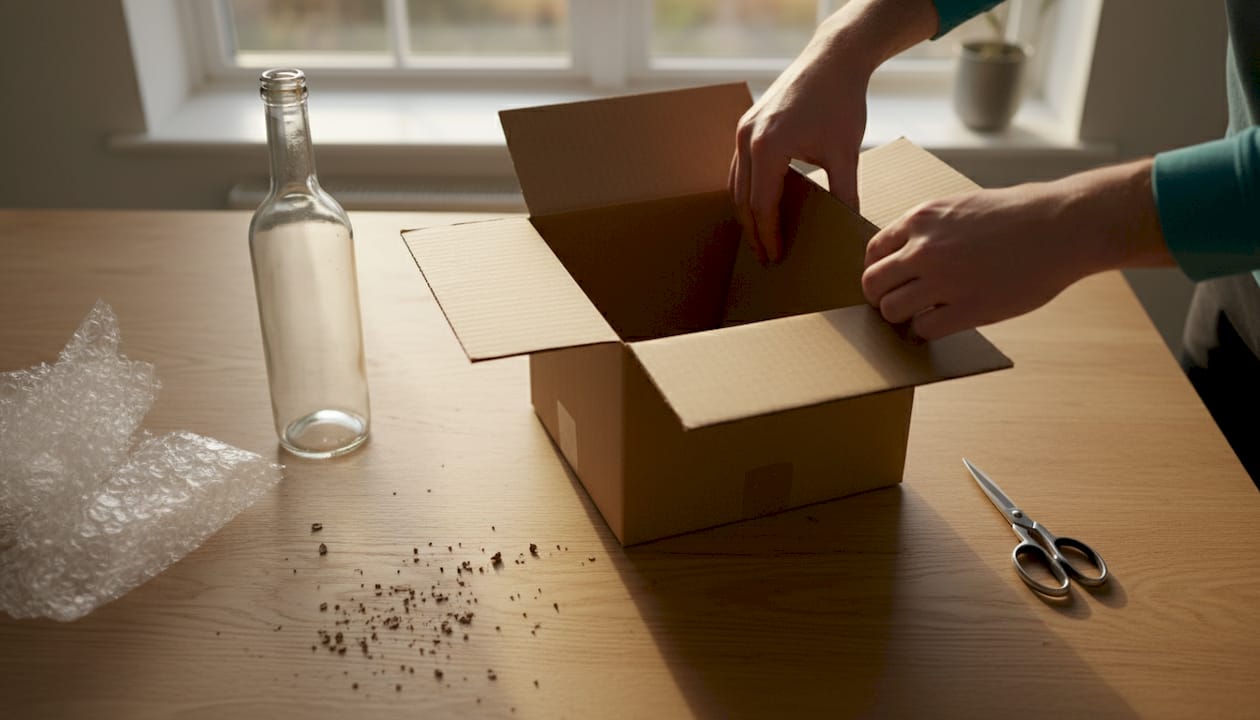
Shock absorption is the third pillar. Some boxes have foam inlets or air-filled cushions integrated into the walls. This is especially relevant for couriers who do not always handle packages gently.
Here is a comparison of the most commonly used materials:
| Material | Strength | Weight | Suitable for |
|---|---|---|---|
| Double-walled corrugated cardboard | High | Medium | Standard wine shipping |
| Single-walled corrugated cardboard | Medium | Low | Local delivery, short distance |
| Foam inlets | Very high | High | Premium and fragile bottles |
| Cardboard with air cushions | High | Low | International shipping |
For handy packing methods that you can combine with the right box, there are practical steps you can apply directly. And if you are unsure which box construction is most suitable, the guide on cardboard boxes for shipping provides a clear overview.
When choosing the right size, the box should contain as little empty space as possible. Too much play means that bottles can move.
Pro tip: Always measure the height of your bottles including any capsule or cork. Bordeaux bottles are slimmer than Burgundy bottles, and Champagne bottles are wider. Never use a universal size for all bottle types at once.
What Variants Are There? A Comparison by Bottle Shape and Application
Now that the basic features are clear, let's compare the most popular variants by application.
There are specific boxes for various bottle types such as Bordeaux, Burgundy, and Schlegel, each with its own safety criteria. This is not a minor detail: a Burgundy bottle has a wide shoulder and will not fit into a narrow Bordeaux box. Use the wrong size and the insert will no longer provide protection.
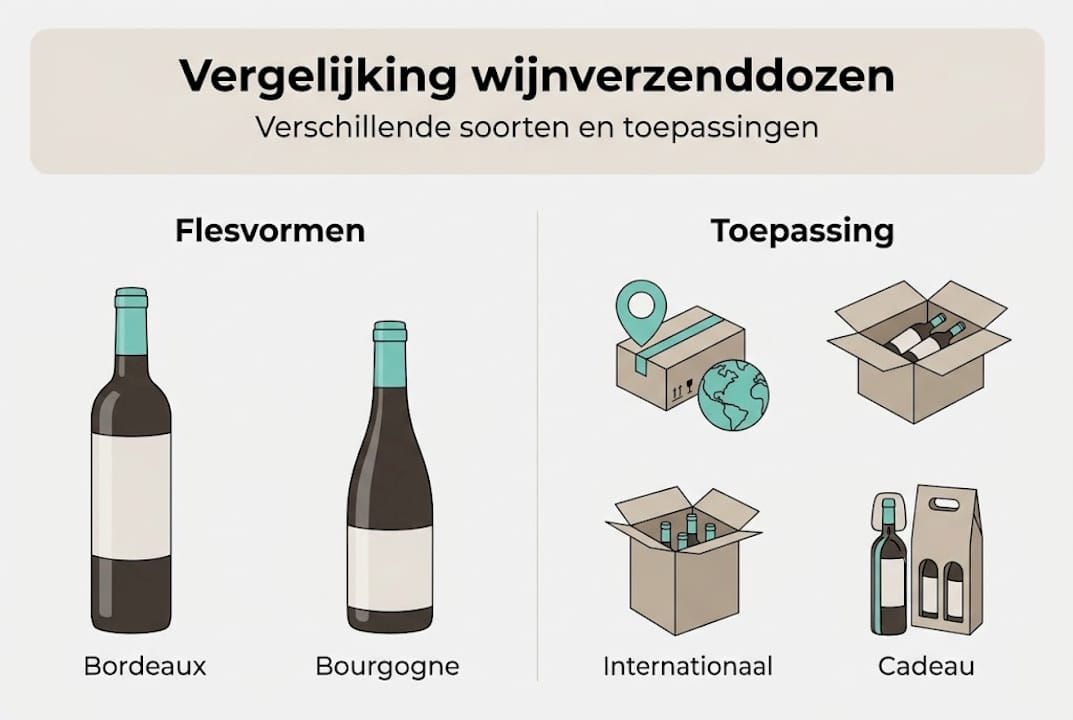
Here is an overview by bottle type and application:
| Bottle Type | Characteristic | Recommended Box Type |
|---|---|---|
| Bordeaux | Slim shoulder, standard size | Single or 6-bottle box with narrow insert |
| Burgundy | Wide shoulder, conical shape | Box with wide inserts |
| Champagne | Wide and heavy, high pressure | Reinforced box with foam |
| Schlegel (Riesling) | Long and narrow | Special slim insert |
Variants by application:
- Single boxes: Ideal for single bottle sales, gift shipping, or sample bottles.
- Multi-bottle boxes (3, 6, or 12 bottles): Efficient for bulk orders and wholesale shipments.
- Premium boxes: Featuring printed finishes or satin inserts, suitable as gifts or for wine subscriptions.
- Basic boxes: Functional, without extra decoration, for internal logistics or B2B shipments.
International shipping involves additional requirements. Alcohol is subject to excise regulations, and customs rules vary by country. Packaging must withstand longer transit times, higher vibration levels, and sometimes extreme temperatures. A box that works fine for a domestic order may be insufficient internationally.
Temperature-sensitive shipments, such as young white wines or sparkling wines, sometimes require insulated boxes or thermal packaging. This is a separate category specifically designed to limit temperature fluctuations. View the complete overview of wine boxes for a detailed understanding of all available options per situation.
Practical Tips: How to Prevent Transit Damage and Returns
Having the right box is not enough. Correct use makes all the difference. When using special shipping boxes and proper void fill, customer reviews report 0% damage. This is proof that execution is just as important as product choice.
Follow these steps for optimal protection:
- Check the size of your bottle and box. Measure the height and diameter of the bottle. The box should have a maximum of 1 cm play on all sides once the insert is in place.
- Place the insert correctly. The insert must sit firmly and not slide loosely. Check this by shaking the box before closing.
- Fill all empty space. Use bubble wrap, paper shreds, or air cushions to fill remaining space. Empty space is the enemy of safe transport.
- Seal the box securely. Use wide packing tape on all seams, including the bottom.
- Be aware of temperature risks. Avoid shipping in extreme heat or freezing temperatures without insulated packaging. Process shipments with temperature risks as quickly as possible.
- Check international requirements. For international shipments, include the correct customs documentation and ensure the packaging meets the requirements of the destination country.
Pro-tip: Use shipping bags and void fill material as an extra layer of protection around the bottle before placing it in the insert. This is especially useful for bottles with irregular shapes or fragile labels.
Another point often overlooked: the label. A damaged label upon arrival gives an unprofessional impression, even if the bottle is intact. Wrap the bottle in tissue paper to protect labels during transport.
- Always use double-walled cardboard for shipments weighing over 500 grams per bottle.
- Avoid reused boxes with damaged corners or flimsy cardboard.
- After packing, check if the box moves when you lift and shake it.
Our Vision: Why Well-Packaged Wine Bottles Offer More Than Just Damage Prevention
The focus on breakage rates and cost savings is understandable. But there's another aspect that's at least as important: how packaging affects your customer's experience.
A sturdy, well-finished box communicates carefulness. Customers who receive wine in neat, professional packaging are more likely to repurchase. This isn't sentiment; it's logic: the packaging is the first thing the customer sees, touches, and judges.
This applies even more strongly to wine gifts. The box is part of the gift. A plain brown box with tape over it undermines the value of the wine inside. A neat, possibly decorated box enhances that value.
Packaging is also a brand story. Every shipment is a touchpoint. Those who invest in quality and appearance build loyalty and word-of-mouth advertising. This yields more than just savings on breakage. Get inspired by creative possibilities through creative wine packaging and discover how you can turn every shipment into a gift moment.
Discover the Complete Range for Safe and Festive Wine Shipping
Are you ready to elevate your wine shipping? At Kadopapier.net, you'll find everything you need. From sturdy shipping boxes in various sizes to decorative void fill material and finishing accessories. Give your shipment extra flair with a soft pink curling ribbon or opt for elegant white gift decoration curlpins for a festive finish. Whether you're shipping one bottle or a hundred bottles: the full range at kadopapier.net is suitable for every size and occasion. Ordered Monday to Friday before 3:00 PM, shipped the same business day.
Frequently Asked Questions About Wine Bottle Shipping Boxes
What size box is suitable for 3 wine bottles?
An insert box measuring 315x105x355 mm is designed for 3 standard bottles, ensuring they remain safely separated during transport.
What is the difference between a regular box and a special wine shipping box?
A wine shipping box has inserts and shock absorbers that prevent movement and breakage. A regular box does not offer this protection, which is why advanced shipping boxes reduce breakage to under 1%.
Is additional void fill material like bubble wrap really necessary?
Yes. Filling with air cushions or bubble wrap eliminates empty space in the box and prevents the bottle from moving, significantly reducing the chance of damage.
Which shipping boxes are suitable for international wine shipments?
International shipments require boxes that comply with alcohol and excise regulations of the destination country and offer extra protection for longer transit times and higher vibration levels.