
Choose the best kraft paper packaging: sustainability and design
TL;DR:
- Retailers can choose sustainable and professional packaging materials by paying attention to the recyclability and composition of kraft paper. Using the Recyclecheck score helps in making informed choices and improving environmental positioning. Strategically combining different kraft paper products enhances brand experience and complies with future regulations.
As a retailer or artisanal entrepreneur, you know the dilemma: you want packaging that looks professional, aligns with your brand identity, and is environmentally responsible. Kraft paper scores on all three, but the market is vast, and not every roll or bag is what it seems. A coating that enhances appearance can reduce recyclability. A cheap alternative can turn out to be more expensive when customers take the product home and the packaging comes back as a complaint. In this article, you will read which selection criteria truly matter, which types are available, and how to make smart choices for your specific situation.
Table of Contents
- Key Criteria for Kraft Paper Packaging
- Popular Types of Kraft Paper Packaging for Retailers
- Comparison: Which Type of Kraft Paper Packaging Suits Your Store?
- Practical Tips for Retailers: Smart Choices & Responsible Recycling
- Why Choosing Kraft Paper Packaging Deserves More Attention
- Your Sustainable Presentation Starts with Smart Packaging Materials
- Frequently Asked Questions about Kraft Paper Packaging
Key Insights
| Point | Details |
|---|---|
| Check recyclability | Always use tools like Recyclecheck to assess whether kraft paper packaging can truly be recycled with old paper. |
| Choose paper type consciously | Unbleached kraft paper generally scores highest on sustainability and recyclability. |
| Combine decoratively | Choose matching ribbon and decorations to make your gift packaging visually appealing yet environmentally friendly. |
| Pay attention to regulations | New criteria determine whether coated packaging is still recyclable; check current rules. |
Key Criteria for Kraft Paper Packaging
Now that we have clarified the challenge, it's time to look at the most important criteria for retailers to make a good choice. Poor criteria lead to poor choices, even if the packaging looks good. Three layers determine the suitability of each packaging option.
The first layer: basic fiber and composition
The basic fiber is the foundation. Unbleached kraft paper contains long fibers that are strong and excellently recyclable. Bleached or white kraft paper has slightly shorter fibers due to the chemical bleaching process but is still highly recyclable, provided there are no interfering additives. The benefits of kraft paper compared to, for example, plastic or mixed materials, are clear at this point: the paper is recognizable to recycling facilities and fits into the existing infrastructure for old paper.
The second layer: construction and processing
How the paper is processed into a bag, roll, or tote makes a big difference. Self-sealing bags with an adhesive strip, bags with a film window, or packaging with an extra laminating layer require more attention. A polyethylene laminating layer improves moisture resistance but can limit recyclability. Adhesives and varnish layers are less problematic but also warrant verification. The construction partly determines whether the packaging can go into old paper or must be disposed of as residual waste.
The third layer: end of life cycle
This is where you, as an entrepreneur, make a difference to your customer. Can the packaging be easily recycled, or does it require special actions? Transparency about the end of life cycle is increasingly a selling point, especially for stores with a sustainable positioning. Recycling your customers' gift packaging starts with the choice you make now.
Recyclecheck as a practical tool
The Recyclecheck 2026 offers an up-to-date, practically applicable recycling score for paper and cardboard packaging. Even single-sided laminated paper and cardboard can be classified as 'easily recyclable' with a sufficient 4evergreen score. This is relevant: you can thus also use more processed packaging, as long as the score supports it.
Never rely solely on a supplier's marketing claim. Always ask for the Recyclecheck score or a comparable objective assessment. Claims like "eco" or "green" are not standardized and mean nothing without substantiation.
- Check if the product has an up-to-date Recyclecheck score for the eco packaging material you are considering.
- Ask your supplier for the exact fiber compositions and coatings.
- See if the packaging meets Dutch recycling criteria for old paper.
- Combine recyclability with your own aesthetic requirements, not the other way around.
Pro-tip: Bookmark Verpact's Recyclecheck. Type in the packaging category, enter the properties, and you'll get an immediate indication. This takes a maximum of five minutes per product and saves you discussions afterward with conscious customers.
Popular Types of Kraft Paper Packaging for Retailers
With the selection criteria clearly laid out, here's an overview of the most commonly used packaging variants, including their specific advantages and disadvantages. A practical classification helps retailers choose between unbleached/brown, printed, or coated kraft paper, depending on appearance and recyclability.
Unbleached brown kraft paper
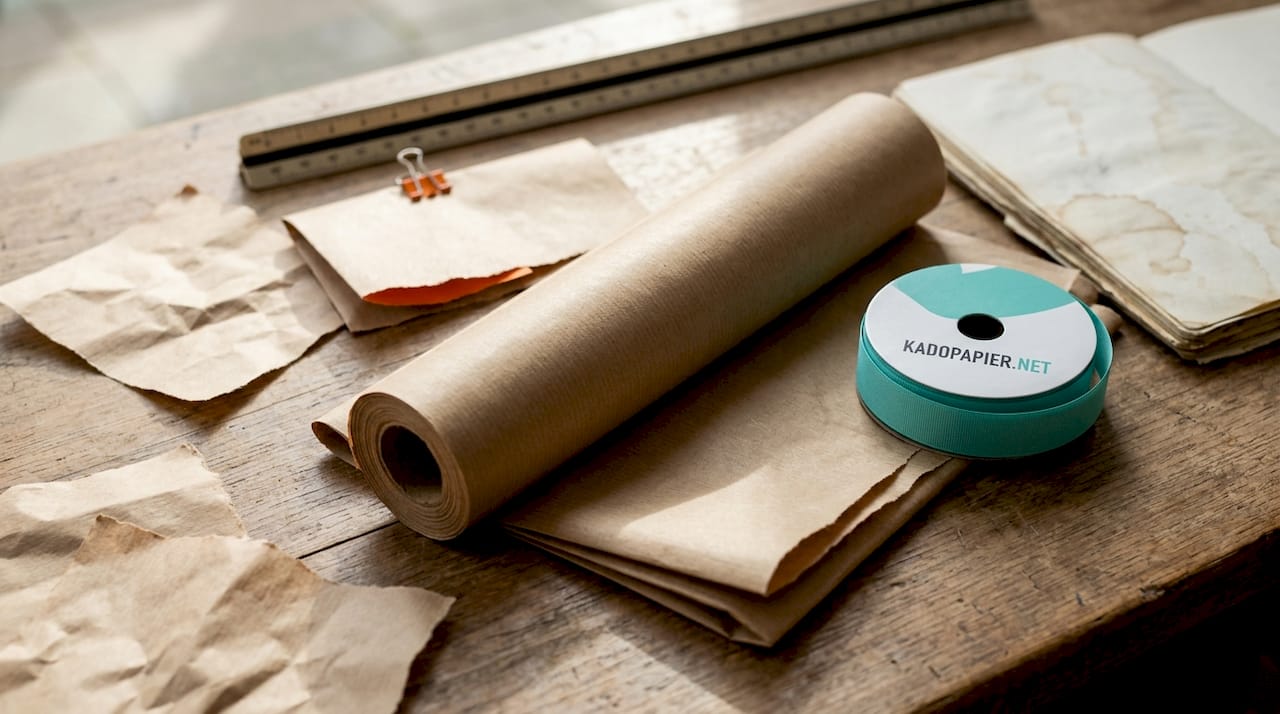
This is the basic variant. Brown in color, rough in texture, and recognized as the most recyclable type. Long fibers, no bleaching process, and a neutral coating make this the safest choice for retailers who prioritize sustainability. The natural look appeals to customers who value authenticity and craftsmanship. For boutiques, delicatessens, cheese shops, and artisanal roasters, this is a logical choice. You can read more about its applications in what is kraft paper.
White kraft paper and printed kraft paper
White kraft paper offers more possibilities for brand identity communication. You can print your logo, a pattern, or a seasonal theme on a white background, which increases branding potential. Recyclability is slightly lower than with unbleached paper, but when using the right types of ink (water-based, without heavy metals), the packaging remains easily recyclable. For brown paper bags, the same reasoning applies: even with brown variants, processing partly determines the score.
Coated or laminated kraft paper
Coatings and laminates improve moisture resistance and visual appeal. Glossy coated kraft paper attracts attention on shelves and in display windows. The limitation is recyclability. A polyethylene laminate significantly lowers the Recyclecheck score unless the product achieves a 4evergreen score of 90 or higher. Aqueous coatings and dispersion coatings score better. Always ask about the type of coating before placing an order.
Special packaging forms
In addition to sheets and rolls, there are kraft bags that are ready for use in the store. Window bags with a transparent part made of cellophane or PLA offer product visibility but require attention during recycling. Self-sealing bags are practical but often contain a plastic closure that must be removed separately. Luxury kraft bags with braided handles are popular for gift packaging but belong to a different price segment.
- Unbleached kraft paper (rolls/sheets): High recyclability, low price, limited design options.
- White kraft paper: Good design options, slightly lower recyclability, average price.
- Printed kraft paper: Maximum branding, variable recyclability depending on ink and finish.
- Coated/laminated kraft paper: Best appearance, lowest recyclability unless scored well.
- Kraft bags and totes: High ease of use, pay attention to closures and window materials.
- Luxury kraft bags: Premium appearance, higher cost, good for gift environments.
Pro-tip: Combine unbleached kraft paper as standard wrapping material with a printed white bag for smaller purchases. This maintains brand experience for special moments without every purchase requiring expensive coated packaging. This works well for jewelry, cosmetics, and small items.
Comparison: Which Type of Kraft Paper Packaging Suits Your Store?
Now that the characteristics of the different types are clear, the comparison table below will help you choose for your situation. The use of the 4evergreen score and current Dutch guidelines offers nuance on what counts as 'easily recyclable', even for coated products.
| Type of packaging | Recyclability | Appearance | Sturdiness | Relative price |
|---|---|---|---|---|
| Unbleached kraft paper | Excellent | Natural/crafty | Good | Low |
| White kraft paper | Good | Neutral/versatile | Good | Average |
| Printed kraft paper | Variable | Strong/branded | Good | Average/high |
| Coated kraft paper | Moderate to good | Luxurious/glossy | Very good | High |
| Laminated kraft paper | Moderate (depending on score) | Luxurious/sturdy | Excellent | High |
| Kraft bag (uncoated) | Excellent | Natural | Good | Low/average |
| Window bag | Moderate | Functional/transparent | Good | Average |
| Luxury kraft bag with handle | Variable | Premium | Excellent | High |
The table provides an initial direction. Practice requires refinement per supplier and per product specification. Use the table as a starting point, not a final conclusion.
Smart combination within your assortment
You don't have to choose just one type. Many successful stores strategically combine multiple variants:
- Unbleached kraft paper as standard for everyday purchases. Customers recognize it as a sustainable signal, and it costs little.
- Printed white kraft paper for gift purchases. Branding enhances the brand experience when the customer arrives home.
- Laminated luxury bag for the more expensive product line. Premium feel justifies a higher price.
- Kraft bags for small or loose items. Quick packing, little material waste.
Sustainability and design are not opposites. The right combination of packaging types enhances your appearance and your sustainable message simultaneously. The choice is not either/or, but both/and.
Points of attention for wrapping paper recycling are also relevant for packaging with extra layers. Inform your staff about which packaging can go into old paper and which cannot. Customers appreciate this information. Also, don't forget that types of tissue paper play a supplementary role in the presentation of products in kraft paper packaging. Tissue paper in the bag or box enhances the experience without affecting the recyclability of the outer packaging.
Practical Tips for Retailers: Smart Choices & Responsible Recycling
As a final section for you as a retailer: this is how you translate knowledge into a smart and visibly sustainable practice. Knowledge without action has no value. The step-by-step plan below is directly applicable.
Step-by-step plan for selecting your packaging
- Determine the purpose of the packaging. Is it for daily purchases, gift packaging, or transport? The purpose guides the strength requirements and the desired level of appearance.
- Check the composition. Ask your supplier about the type of paper, coating, and laminate. Unbleached kraft paper without coating is the safest starting point.
- Obtain the Recyclecheck score. Use tools like Recyclecheck to genuinely assess whether packaging can be put with old paper, instead of relying solely on claims. This is a concrete, free action that every retailer can perform.
- Combine with appropriate decoration. Ribbons, stickers, and tags add appeal without compromising the recyclability of the basic packaging, provided they are removed before recycling.
- Inform your customers. A small card in the bag or a sticker on the pouch stating "can be recycled with old paper" gives customers certainty and strengthens your sustainable brand position.
- Evaluate annually. Recycling standards change. The Recyclecheck is updated annually. Schedule an annual review to reassess your packaging choices.
Checklist for supplier offers
Do you receive an offer from a new supplier? Use this quick checklist:
- Is the exact fiber composition known? Yes or no.
- Is there a coating or laminate present? What type?
- Does the product have an up-to-date Recyclecheck score? High or low?
- Does the ink comply with European standards for printing inks on packaging?
- Are the dimensions compatible with your current presentation and packaging workflow?
- What is the minimum order quantity and delivery time?
By asking these questions as standard with every new supplier, you save time, discussions, and costs afterward. Suppliers who are serious about sustainability will answer these questions without hesitation.
Communication to the customer
Customers appreciate concrete information. "This bag can go with the old paper" is more valuable than "this product is sustainable." The link between recycling gift packaging and your store experience is an opportunity to build trust. Small actions, such as a sticker or a printed explanation on your packaging counter, cost little but have a measurable effect on customer perception.
Pro-tip: Create a simple poster or card for your counter with the question "Do you know how to recycle your packaging?" and a brief explanation. Customers will remember this and associate it with your store. This kind of micro-information strengthens your position as a conscious entrepreneur without needing large marketing budgets. The impact of eco-packaging on customer experience is greater than many retailers expect.
Why Choosing Kraft Paper Packaging Deserves More Attention
After all the practical insights, finally a sharp look at what retailers often overlook. Most entrepreneurs who select kraft paper packaging do so based on two criteria: price and appearance. That is understandable. You work with margins, you want your store to look good, and you don't have time for extensive material analyses. But this is precisely where things often go wrong.
Packaging that appears recyclable but has a polyethylene coating ends up in residual waste among environmentally conscious customers. These customers sometimes send an email. Sometimes they say nothing but don't come back. The damage is subtle but real. And the frustrating part: the solution would have been simple. Five minutes of Recyclecheck would have made all the difference.
There is also a larger trend that makes this urgent. The European Packaging and Packaging Waste Regulation, or PPWR for short, is placing increasingly higher demands on the recyclability of packaging. This applies to manufacturers but ultimately also to retailers. Those who already know which packaging performs well now will not have to re-examine their entire product range later.
What we notice in practice: retailers who consciously choose transparent sustainability, meaning not just a claim but a substantiated choice, build a loyal customer base faster. This applies not only to the big players. A local bookstore that explains why they use unbleached kraft paper and where it comes from has more credibility than a chain that prints "eco" on a plastic bag.
The advantages of kraft paper are not only technical. They are also commercial. A conscious packaging choice is a means of communication. Use it. Not as a marketing gimmick but as a true positioning. Customers quickly see through greenwashing. Real choices, supported by scores and facts, do convince.
The combination of sustainability and experience is precisely the area where independent stores win against large chains. Large chains standardize. Small stores differentiate. Your packaging is part of that differentiation, even if it just seems like a bag or a roll of paper.
Your sustainable presentation starts with smart packaging materials
Have you been inspired? Then discover the practical possibilities at Kadopapier. A strong kraft paper packaging also deserves the right finishing. Ribbons, decorative elastic, and organza Christmas ribbon are the details that transform a bag or box into a complete gift presentation. At Kadopapier, you will find a wide range of decorative elastic that seamlessly combines with kraft paper in all designs. For seasonal presentations, organza Christmas ribbon is a popular choice that complements the sustainable base of kraft paper with a festive finish. Ordered before 3 PM? Shipped the same business day. Free shipping from 100 euros excl. VAT. This way, you quickly have everything you need for a professional and sustainable presentation.
Frequently asked questions about kraft paper packaging
What makes kraft paper packaging 'highly recyclable'?
Packaging is considered highly recyclable if it contains unbleached or bleached paper fibers without disturbing coatings or laminates, and if its Recyclecheck 2026 score is sufficient. Even single-sided laminated variants can score well with a high 4evergreen score.
Can coated or laminated kraft paper go into paper recycling?
Sometimes it can. If the product achieves a 4evergreen score of 90 or higher via the Recyclecheck, it is considered highly recyclable. Always check this against Verpact's current assessment list.
What look does kraft paper give to gift packaging?
Kraft paper has a natural, authentic look that suits artisanal and sustainable positioning. Customers associate it with quality and honesty, which enhances the experience of the gift.
How can I, as a retailer, easily check if my packaging is recyclable?
Use Verpact's Recyclecheck or ask your supplier for the corresponding score. This tool assesses actual recyclability, not just marketing claims.