
Choosing bubble envelopes: optimal protection
TL;DR:
- Many retailers believe that any bubble mailer automatically offers sufficient protection, but this is a misconception. Different types vary greatly in cushioning, material strength, and water resistance, which is especially important for fragile products. Quality control and the right material choice are essential for good shipping and satisfied customers.
Many retailers and shippers assume that any envelope with bubbles automatically offers sufficient protection. This is a persistent misconception. In practice, there is a big difference in cushioning, material strength, and water repellency between the various types. For gift shops and e-commerce companies that send fragile products, choosing the right bubble mailer is not a minor detail. In this article, you will learn exactly what to look out for: from material composition and closure system to quality control and application in daily practice.
Table of Contents
- What are bubble envelopes and how do they work?
- Pros and cons: material choices and functional differences
- Quality criteria and specifications: what should you pay attention to?
- Application tips for retailers and gift shippers
- Our experience: why selection is more important than it seems
- More inspiration and packaging solutions
- Frequently asked questions about bubble envelopes
Key Insights
| Point | Details |
|---|---|
| Not every envelope suffices | Pay attention to differences in material, waterproofness, and effective protection of bubble mailers. |
| Always test samples | Dimensions and protective effect vary by brand and batch, so experience is essential. |
| Attention to recycling | Align material choice with customer expectations and your store's sustainable policy. |
| Smart combination with decoration | An attractive appearance and good protection reinforce each other for gift shipments. |
What are bubble envelopes and how do they work?
A bubble envelope, also known as an air-cushioned envelope or padded envelope, always consists of two main layers. The outer layer is made of kraft paper or plastic film. The inner layer consists of air-cushion film, also known as bubble wrap or bubble film. Both layers are glued or laminated together, and the envelope has a self-adhesive closure at the top.
The protective effect comes from the air-cushion layer, which absorbs impacts from drops or pressure during transport. Small air bubbles, filled with air, temporarily deform on impact and then return to their original shape. This is called impact dampening (also known as shock absorption). The thicker the bubbles, the more energy they absorb.
The exterior does not automatically provide complete waterproofness; consider a water-resistant outer layer or extra protection in wet conditions.
A common mistake is assuming that impact dampening and waterproofness are the same. A kraft paper outer layer absorbs moisture. In rain or on a wet sorting belt, this can cause problems. Plastic outer layers are water-repellent, but they are not the same as completely waterproof. This distinction is crucial for retailers who ship products outdoors or in varying weather conditions.
Bubble envelopes are popular with:
- Gift shops sending small decorative items or jewelry
- Online retailers shipping electronics or cosmetics
- Book sellers and archive companies
- Card makers and stationery sellers
For packaging tips for small gifts, the sizing of the envelope is at least as important as the material. A product that is too loose in an oversized envelope will move during transport and still get damaged, despite the bubbles.
The closure also deserves attention. Self-adhesive strips are standard and work well for single use. Resealable variants are slightly more expensive but convenient for returns or showroom models. For automated shipping, you need to check if the closure is strong enough to withstand the sorting process of parcel services, because not every self-adhesive strip can handle that without problems.
Pros and cons: material choices and functional differences
The outer layer largely determines how the envelope performs in practice. Two materials dominate the market: kraft paper and plastic film. Both have clear advantages and disadvantages depending on your specific application.
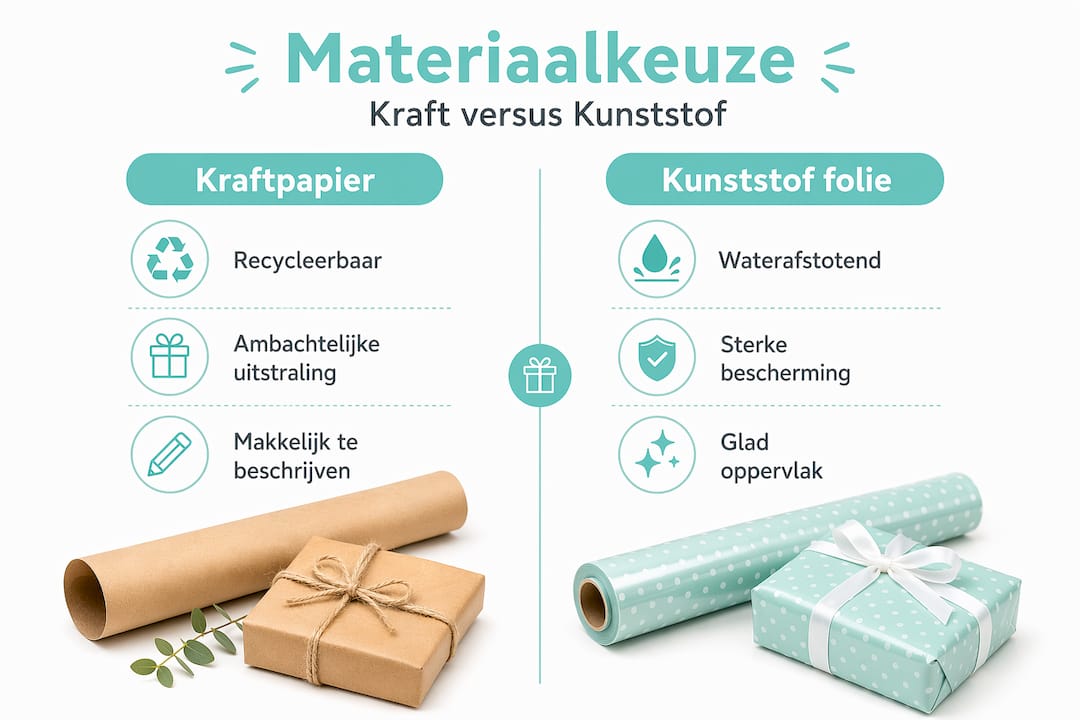
Kraft paper is the classic choice. It feels artisanal, can be written on with a pen or sticker, and fits a sustainable brand experience. It is also more recyclable than plastic. On the other hand, kraft paper absorbs moisture. With prolonged exposure to rain or humid storage conditions, it loses structure and protection.
Plastic film is water-repellent. Products in a plastic bubble envelope will survive a short rain shower without damage to the exterior. The material also tears less easily. Disadvantage: it is less environmentally friendly, harder to recycle, and some parcel services accept certain sizes or weights in plastic envelopes differently than in paper variants.
| Property | Kraft Paper | Plastic Film |
|---|---|---|
| Water Repellency | Low | High |
| Recyclability | High | Low to medium |
| Writable | Yes | No (without label) |
| Tear Sensitivity | Medium | Low |
| Presentation/Appearance | Natural, artisanal | Functional, glossy |
| Price | Comparable | Comparable |
| Automated Sorting | Good | Good to better |
Pro-tip: When purchasing, specifically pay attention to how the envelope reacts during automated sorting. Cushioning and behavior during automated sorting are decisive; packaging that appears protective may still fall short if the cushioning fails in practice on the fast-moving sorting belts of large parcel services.
In addition to the outer material, the thickness of the air-cushion layer also plays a role. Standard bubbles have a diameter of approximately 10 mm. Large bubbles (diameter 25 mm or more) offer more protection against heavy impacts but also make the envelope thicker and heavier. This can affect shipping costs for weight- or size-based tariffs.
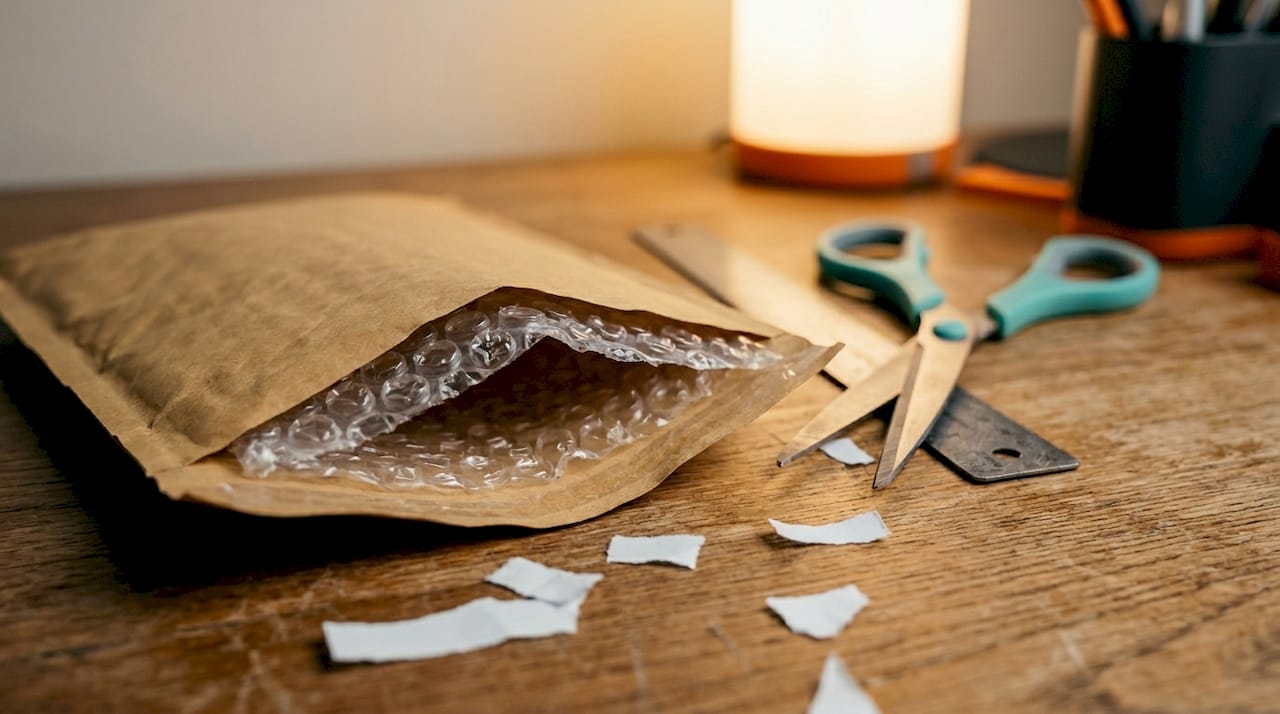
For retailers looking for DIY packaging tips, the combination of material and bubble size must be adapted to the product. A light silk scarf needs less cushioning than a ceramic figurine. Consciously adjust this, because packaging overkill costs unnecessary money and material.
Environmentally conscious customers are increasingly paying attention to the packaging they receive. If you, as a retailer, choose a recyclable kraft paper bubble envelope, it also communicates something positive about your brand. More information about sustainable recycling of gift packaging helps you make a conscious choice that aligns with your customers' expectations.
Quality criteria and specifications: what should you pay attention to?
Buying a bubble mailer based on price alone is a risk. Quality differences lie in details that you only discover when something goes wrong: a shipment gets damaged, a closure fails, or the envelope just doesn't fit the product. A structured approach to purchasing prevents this.
The first step is to check the sizing. Every bubble mailer has an inner and outer dimension. The inner dimension determines how much product you can place. The outer dimension is relevant for postage categories and label placement. Note: dimensional tolerances per brand can vary, so you should always measure the actual inner dimension and not blindly rely on the product description.
Here is a step-by-step approach for quality control:
- Determine the required inner dimension based on your best-selling products, plus 1 to 2 cm extra allowance for easy placement and closure.
- Check the closure type: a self-adhesive strip must be strong enough for the weight of the contents and the sorting process.
- Assess the grammage of the outer layer: a heavier outer layer (expressed in grams per square meter, g/m²) is stronger but also heavier.
- Test the air-cushion layer: press the bubbles; they should offer resistance and not deflate immediately.
- Always request samples before ordering a large batch. Send a test package via the parcel service you normally use.
- Compare batches: even from the same supplier, two batches of the same model may differ slightly in material thickness or closure.
| Specification | What you check | Acceptable tolerance |
|---|---|---|
| Inner dimension (mm) | Actual available space | Max. 5 mm deviation from specification |
| Outer dimension (mm) | Label surface and postage category | Max. 5 mm deviation |
| Closure strip | Adhesive strength and width | Minimum 30 mm wide |
| Bubble size (mm) | Cushioning capacity | Standard 10 mm, heavy 25 mm |
| Outer layer grammage (g/m²) | Sturdiness | Minimum 80 g/m² for daily use |
Pro-tip: Keep the specification sheets from your regular supplier in an easy-to-reference document. For each new order, compare the stated specs with the previous batch. This helps you quickly identify deviations before you've used a large batch.
For retailers looking for luxury packaging options combined with functional protection, the closure type is also a presentation detail. A neat, straight closure without a crookedly applied strip looks professional to the recipient. For packaging tips for small products, it also applies that an oversized envelope gives the recipient the impression that something was hastily packaged. Sizing and presentation go hand in hand.
Application tips for retailers and gift shippers
You now know what bubble envelopes are and how to assess them. The practical question is: how do you use them effectively in the store and for shipping? Here are concrete application tips.
Start with the sizing. Always choose an envelope whose inner dimension is 1 to 2 cm larger than the product. This allows enough room to properly seal the closure, but not so much that the product shifts. For jewelry and small decorative items, you can add an extra piece of tissue paper or tissue film for a presentable appearance and additional cushioning.
Check waterproofness in wet conditions. If you send products sensitive to moisture, such as paper products, cards, or silk, a plastic outer layer or an extra bag inside the envelope is advisable. Waterproofness is not guaranteed; a kraft paper outer layer does not provide complete protection in prolonged wet weather. This is a real risk, especially in autumn and winter.
Here is a practical checklist for effective preparation:
- Select the correct envelope size based on the product plus extra space.
- Check that the air cushion layer is intact before use (no punctured bubbles).
- Wrap fragile items in tissue paper or tissue film for extra protection and presentation.
- Seal the envelope tightly and check that the strip adheres completely.
- Apply the address label to a flat, visible surface.
- Check the exterior for tears or weak spots.
- Store envelopes dry and flat, not in tall stacks that flatten the bubbles.
For gift shipping, presentation also plays a role. A kraft bubble envelope with a nicely printed address label and a decorative sticker looks significantly more professional than a plain brown envelope. Small additions like a personal card or a ribbon make a difference to the recipient. This is especially relevant for gift shops that want to distinguish themselves on brand experience. More ideas can be found in budget-friendly packaging for gift shops.
Pro-tip: Actively inform your customers about the recyclability of the packaging. Add a small card with the text "This envelope is made of recyclable kraft paper" or similar. This enhances the customer experience and aligns with the demand for sustainable and stylish packaging. Environmentally conscious customers specifically appreciate this, and it costs little extra.
Also consider practical storage rules in the store. Always store bubble envelopes horizontally or upright in a dry place. Damp storage affects the adhesive strength of the closure and can damage the air cushion layer. A stack of more than 30 envelopes high will lead to flattened bubbles at the bottom during prolonged storage, which reduces the cushioning quality.
Our experience: why selection is more important than it seems
In practice, we see that most problems with bubble envelopes do not arise from a bad supplier, but from a lack of selection process. The misconception "any bubble envelope is good enough" costs stores money annually: damaged shipments, returns, customer complaints, and reputational damage. This can be prevented.
The most underestimated risk is the variation between batches from the same supplier. Filling behavior and size tolerances per batch can differ. A batch that worked perfectly last quarter may now differ slightly in air cushion thickness or closure. Those who do not test only notice this when problems arise.
Even premium brands are no exception. The production processes of bubble film and outer layers depend on raw materials and machine calibrations that can vary. No brand offers a guarantee of absolute consistency across all batches. That is an uncomfortable truth, but it is the reality that buyers must take into account.
Our advice is concrete: build a structured testing process. Order a minimum of 10 samples from each new supplier. Send them via the parcel service you normally use, with the same products you normally send. After receipt, assess the condition of the closure, the air cushion layer, and the outer layer. Document the results. This takes a week and involves a small investment, but it prevents problems with hundreds or thousands of shipments.
Processes in the store must align with realistic scenarios. An envelope that performs perfectly in dry office conditions can still fail on a wet loading dock in January. Therefore, also test under less ideal conditions if you know your products undergo such journeys. A professional approach to packaging always considers the weakest link in the shipping process, not just the ideal scenario.
The retailers who best understand this establish internal quality standards: minimum grammage of the outer layer, maximum size tolerance, minimum bubble size. These standards apply to every supplier, every brand, every batch. This ensures consistent quality regardless of who delivers. This is precisely the approach that works scalably, especially as shipping volume grows.
More inspiration and packaging solutions
Functional protection and a representative presentation are not mutually exclusive. At Kadopapier.net, you will find not only bubble envelopes and packaging materials, but also the decorative finishing that truly makes your shipment stand out. Combine a sleek bubble envelope with a beautiful decorative elastic band for an instantly recognizable brand experience. If you are looking for something festive for the holidays or a seasonal collection, organza Christmas ribbon offers an elegant addition. For a striking accent on boxes, bags or envelopes, emerald curling ribbon is a practical and stylish choice. This way you build a consistent packaging experience that customers will remember.
Frequently asked questions about bubble envelopes
Are bubble envelopes always waterproof?
No, bubble envelopes with a paper exterior are usually not completely waterproof. Waterproofing is not a given; in humid conditions, choose a plastic outer layer or add extra protection.
What size bubble envelope do I need for small gifts?
Always measure the product and allow 1 to 2 cm extra space for optimal protection and easy closing. Provide demonstrable specifications such as internal dimensions to prevent products from being too loose and getting damaged.
How do I test the quality of a bubble envelope?
Always test with samples: fill, close, and send a test package to assess cushioning and sealing. Filling behavior varies by brand and can differ per batch, so testing each new batch is recommended.
Which material is best for sustainable shipping packaging?
Kraft paper is easily recyclable and aligns with an environmentally conscious brand strategy, while plastic offers better water resistance. Kraft paper is recyclable, plastic is water-repellent; align your choice with your customer needs and local recycling options.