
Minimalist Gift Wrapping: Stylish and Simple
TL;DR:
- Many gift wrappings are unnecessarily complicated, wasting materials that quickly end up in the bin. Minimalist packaging uses just one type of paper, a reusable cloth, and natural cords for a stylish and eco-friendly look. By consciously choosing simple materials and techniques, you save costs, reduce waste, and emphasize the gift itself.
Many gift wrappings are unnecessarily complicated: layers of glitter paper, plastic ribbon, stickers, and curls that end up in the bin after ten seconds. Minimalist gift wrapping turns this around. Less material, clear form, and all attention on the gift itself. The result: less waste, lower costs, and an appearance that stands out by what you omit rather than what you add. In this guide, you will learn what materials you need, how to wrap step-by-step, how to add personality anyway, and which mistakes to avoid.
Table of Contents
- Essentials for Minimalist Gift Wrapping
- Step-by-Step Minimalist Wrapping with Practical Examples
- Personal and Professional Personalization Without Excess
- Common Mistakes and How to Avoid Them in Minimalist Wrapping
- Expectations and Results: What You Can Achieve with Minimalist Gift Wrapping
- The Hidden Power of Minimalism in Gift Wrapping
- Discover Minimalist Wrapping Materials at Kadopapier
- Frequently Asked Questions about Minimalist Gift Wrapping
Key Insights
| Point | Details |
|---|---|
| Less Waste and Costs | Minimalist gift wrapping limits material use, making it cheaper and more environmentally friendly. |
| Simple Materials | The use of reusable cloths, natural paper types, and simple boxes forms the basis of minimalism. |
| Fast Wrapping Methods | Methods like folding and loop tying make the wrapping process efficient and stylish. |
| Subtle Personalization | Small labels and cords provide a personal touch without excess. |
| Conscious Gifting | Minimalism starts with making agreements and avoiding consumption pressure. |
Essentials for Minimalist Gift Wrapping
Now that you know why minimalist wrapping is valuable, let's discuss what materials you need to get started.
Minimalist packaging works with clear lines and subtle designs. This means: fewer materials, better chosen. Not ten types of ribbon, but one natural jute cord. Not three layers of paper, but one sheet of sturdy kraft paper that is beautiful on its own.
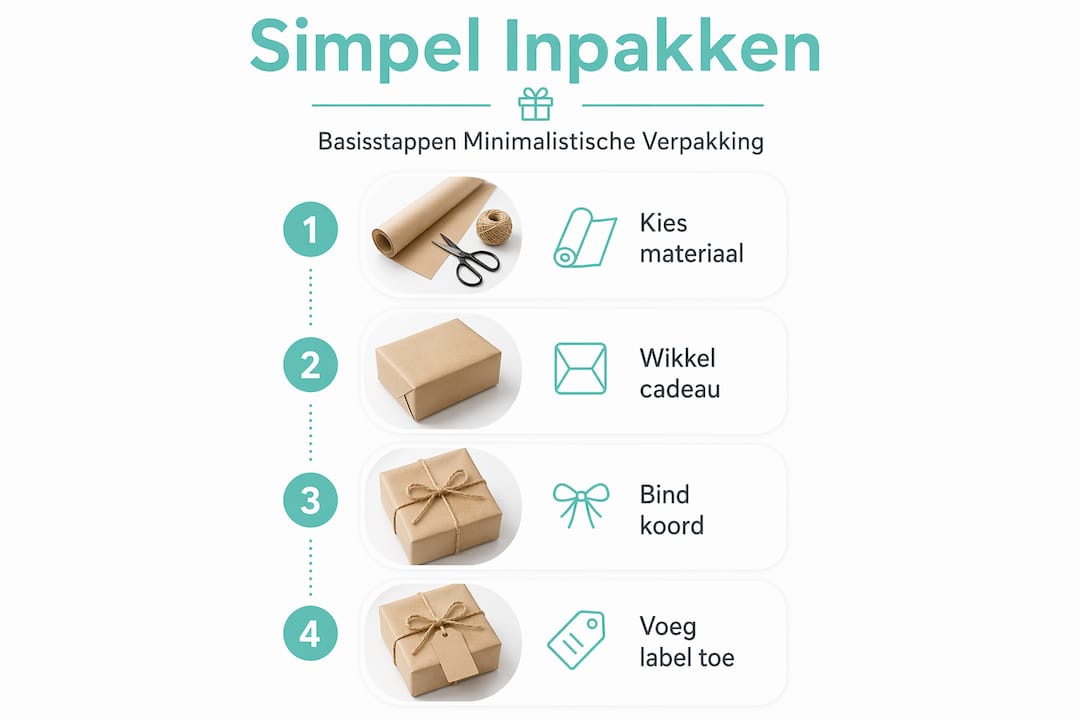
The smartest starting point is a small basic set. With it, you can wrap almost any gift, from a book to a bottle of wine, without having to rush to the store every time. Read more about using sustainable gift wrap if you also want to make material-conscious choices that protect the environment.
Basic Set for Minimalist Wrapping
| Material | Application | Sustainability |
|---|---|---|
| Kraft paper (natural or white) | Universal wrapping | Recyclable, biodegradable |
| Furoshiki cloth (50 × 50 cm) | Wrapping and tying | Completely reusable |
| Simple cardboard box | Small to medium-sized gifts | Recyclable |
| Natural jute or cotton cord | Closing and decoration | Biodegradable |
| Double-sided tape (narrow) | Invisible attachment | Less waste than wide tape |
| Small labels (3 × 5 cm) | Personal text | Minimal paper use |
A few concrete choices that make a difference:
- Choose kraft paper in natural or off-white over printed paper: it looks stylish without extra inks or lamination.
- Use one ribbon or cord as the sole decoration. Jute gives a warm, artisanal look. Satin works for more festive occasions.
- Avoid wide, adhesive tape. Double-sided tape holds just as well and is invisible.
- A furoshiki cloth replaces paper and box in one. You fold and tie the fabric around the gift, and the recipient keeps the cloth.
Pro-tip: Store your materials in one small box or basket. If everything is together, wrapping takes less time, and you automatically take less than if you search through three drawers.
Want to know how to prepare a minimalist package from start to finish? There you will find further steps and inspiration for a cohesive look.
Step-by-Step Minimalist Wrapping with Practical Examples
With the right materials, it's time to learn how to wrap minimally, with practical examples.
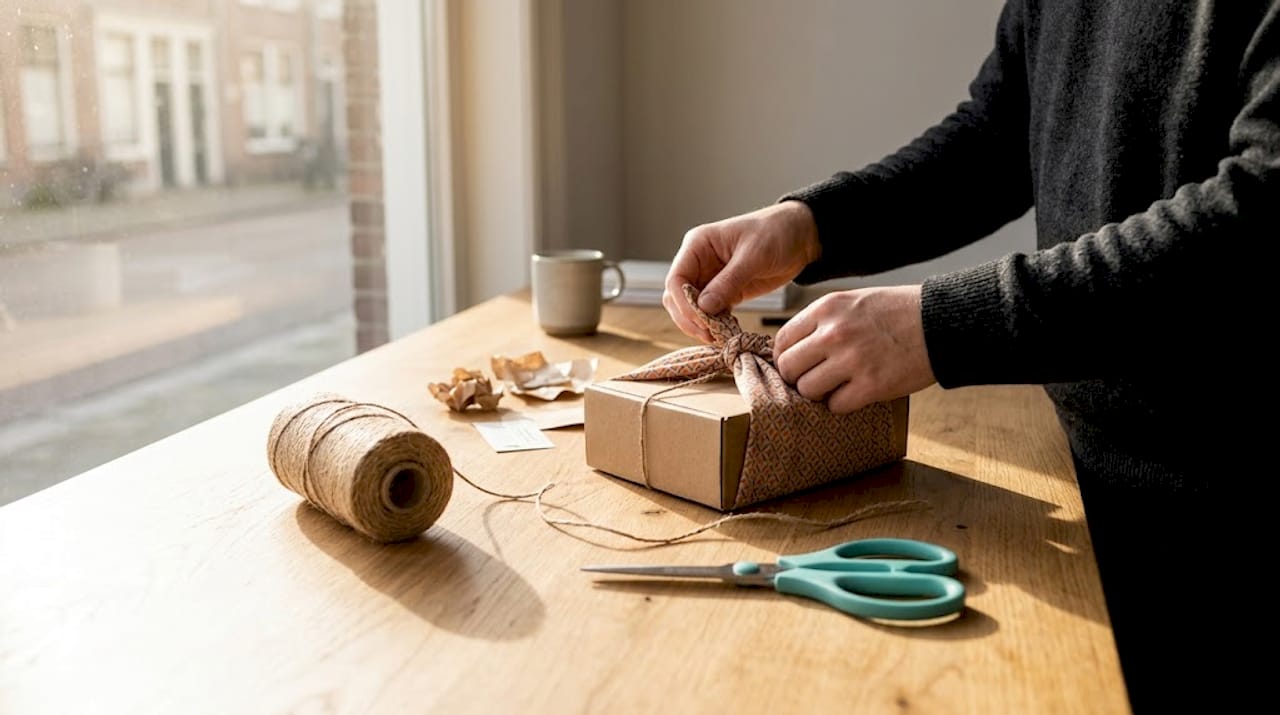
There are two methods that stand the test of time: the classic box method and the furoshiki technique. Both are fast, stylish, and require few materials. Below you will find a clear approach for each method.
Method 1: Minimalist Box in Two Steps
PURELEI's packaging approach shows how to achieve a premium look in two steps: folding and tying a loop. No ten actions, no pile of stuff.
- Place the gift centrally on the paper. Fold the sides tightly around the box. Use one piece of double-sided tape per side. Keep the corners clean and flat, no creases.
- Tie a cord or ribbon around it. One round around the width, one around the length. Tie a simple loop or bow. No extra decorations needed.
Method 2: Furoshiki Technique
Furoshiki is a zero-waste replacement for disposable packaging and works for almost all gift shapes by tying and folding.
- Lay the cloth in a diamond shape. Place the gift in the center.
- Fold the bottom point over the gift. Pull the top point over it.
- Take the left and right points. Tie them together on top of the gift in a bow.
- For round gifts (bottle, ball): place the bottle diagonally on the cloth, roll tightly, and tie the ends.
Materials per method
| Method | Required materials | Wrapping time | Reusable? |
|---|---|---|---|
| Box method | Kraft paper, tape, cord | 3 to 5 minutes | No (paper) |
| Furoshiki | Square cloth (50 × 50 cm) | 2 to 4 minutes | Yes |
| Paper bag | Bag, narrow ribbon or sticker | 1 to 2 minutes | Limited |
Pro-tip: Practice the furoshiki method once with a book before using it for an irregularly shaped gift. After that first time, you'll get the hang of it, and it will be faster than folding paper.
Need more practical help? Check out the minimalist wrapping step-by-step plan for small products and creative solutions. For businesses and events, the approach for minimalist business packaging is also worthwhile.
Personal and Professional Personalization Without Excess
Now that you know how to wrap, you'll learn how to add personality without losing the minimalist character.
Minimalism does not mean anonymous. It means that every choice is conscious. A small label with handwritten text says more than a plastic gift envelope full of confetti. Small labels and cords in a natural paper look are proven popular options for both private events and business gatherings.
A few concrete ways to add personality within strict frameworks:
- 3 × 5 cm label in natural-colored paper, attached with a piece of jute cord. Write the recipient's name or a short message with a black fine-liner.
- One decorative element that matches the theme: a dried eucalyptus twig, a small seal, or a single sticker. No more than one.
- Foil printing or blind embossing on the box or label for a premium look without extra decorations. This works well for business gifts.
- Color accent via ribbon: choose one color that suits the occasion. Dark green for Christmas, terracotta for autumn, white for wedding gifts.
For business applications, the same principle applies but on a larger scale. If you're wrapping fifty thank-you gifts for an event, you wrap them all identically: same paper, same cord, same label. Consistent and fast. See how you can use minimalist personalization as part of a broader customer experience.
Pro-tip: Create one template for your labels, both in terms of size and font. Print or write them all at once. This modular system saves time for large quantities and ensures a cohesive look without every package looking different.
Common Mistakes and How to Avoid Them in Minimalist Wrapping
To avoid disappointment, it is important to know and avoid the most common mistakes.
Minimalist wrapping sounds simple, but there are pitfalls that both beginners and advanced wrappers encounter. Most mistakes do not stem from a lack of material, but from too little forethought.
The most common mistakes:
- Adding too much at the last moment. You start minimalist but still add an extra sticker, extra ribbon, or extra paper. Set the limit before you start: one cord, one label, one sheet of paper.
- Choosing the wrong material size. A sheet of paper that is just too small leads to folds in the wrong place and extra tape. Measure first, then cut.
- Impractical materials for the recipient. Furoshiki cloth is ideal if the recipient knows what it is. When in doubt: include a small card with instructions on how to use the cloth.
- Not considering the occasion. Kraft paper with jute cord works perfectly for a birthday, but can feel too informal for a business gift to a new client.
- Wrapping without agreements about the gifting itself. Minimalist gifting starts with agreements to avoid consumption pressure, otherwise the packaging loses its meaning.
Conscious gifting is the basis for successful minimalist wrapping. The packaging is truly minimalist only if the choice of gift is also well thought out. Give less, give better.
Use the minimalist wrapping checklist to quickly make the right choices for each gift without forgetting anything.
Expectations and Results: What You Can Achieve with Minimalist Gift Wrapping
Finally, we look at the concrete results you can expect when you apply these minimalist techniques.
The benefits of minimalist wrapping are not only aesthetic. They are measurable. Less material use leads to less waste and lower costs per package, without compromising the appearance. On the contrary.
What you can expect:
- Cost savings. One sheet of kraft paper, a piece of cord, and a small label cost significantly less than a gift bag, tissue paper, sticker sheet, and plastic ribbon combined.
- Less waste. Kraft paper and jute cord are fully recyclable or biodegradable. A furoshiki cloth generates zero waste.
- Faster work. Fewer materials mean fewer choices and fewer actions. A well-practiced furoshiki technique takes less than three minutes.
- Clearer focus on the gift. A sleek package draws attention to what's inside, not to the outside. That's exactly the intention.
- Reusable packaging as an extra gift. A beautiful cloth or a sturdy box is already useful for the recipient itself.
Did you know? Households in the Netherlands generate an average of 25 percent more waste during the holidays than the rest of the year. A large part of this is packaging material. One minimalist choice per gift already makes an immediate difference.
Minimalist design packaging is also becoming increasingly popular in business. Companies that package their products or corporate gifts more simply but thoughtfully are more often perceived as premium, not less. The aesthetic of omission works. Do you want to know how to recycle packaging and thus close the sustainable circle? There you will find concrete steps and addresses.
The Hidden Power of Minimalism in Gift Wrapping
After years of working with packaging materials, one thing stands out: people confuse minimalism with cheap, and that's exactly where they go wrong.
A minimalist package is not the result of spending less. It is the result of choosing more sharply. Subtle luxury effects with limited decorations maintain a minimalist style but make the result premium and reusable. That is a fundamental difference.
The second misconception is that minimalist wrapping is boring. The opposite is true. Sleek gift packaging requires more craftsmanship than abundant packaging, not less. A perfectly folded corner without creases, a cord that is just tight enough, a label that hangs in the right place. Every detail is visible because there is nothing to hide it.
Furoshiki is not just a technique but a zero-waste principle that facilitates reuse and sustainable gifting. The philosophy behind it, the Japanese concept of respectfully enveloping a gift, changes how you think about packaging. It's not an afterthought. It's part of the gift itself.
For professionals and business gift wrappers, there's another argument: efficiency. A standard minimalist system, fixed materials, consistent actions, and fixed labels mean fewer decisions per gift. Fewer decisions mean working faster and fewer mistakes. For a hundred business gifts, this is not a minor detail; it's a significant time advantage.
Pro-tip: Combine one reusable element, like a cloth or a sturdy box, with one small luxury accent such as a piece of gold-colored cord or an engraved label. You maintain the minimalist aesthetic but add just enough value so that the gift feels special.
Minimalism in gift wrapping is not a trend. It's a choice that shifts attention from the exterior to the core: the gift, the gesture, and the relationship between giver and receiver.
Discover minimalist wrapping materials at Kadopapier
Are you ready to wrap minimally? At Kadopapier, you'll find a wide range of materials that directly align with the techniques in this guide. For that subtle luxury accent on a sleek package, organza Christmas ribbon is an excellent choice: light, elegant, and immediately visible without being intrusive. For simple gift packaging that still deserves a refined finish, decorative elastic offers a quick and stylish solution. If you want to add a specific color accent to your minimalist package, red organza ribbon is a proven choice for festive occasions. Order Monday to Friday before 3:00 PM, and your order will be shipped the same business day.
Frequently Asked Questions about Minimalist Gift Wrapping
What exactly are minimalist gift wrappings?
Minimalist gift wrappings use as little material as possible with a simple design that emphasizes the gift. Less material and a clear form typically lead to less waste and lower costs per package.
How do I wrap a gift using the Furoshiki method?
You lay a square piece of fabric flat, place the gift in the center, and tie the corners together on top of the gift. Furoshiki is a zero-waste alternative to disposable packaging, and the cloth remains fully reusable.
Can I still personalize a minimalist package?
Yes. Small labels and cords in a natural paper look add personality without breaking the minimalist character.
Why is minimalist gifting more than just wrapping?
Minimalist gifting starts with agreements to avoid consumer pressure. Without that conscious foundation, the packaging loses its meaning, no matter how sleek it is.
What materials are suitable for minimalist gift wrappings?
Kraft paper, Furoshiki cloths, and simple cardboard boxes with a subtle accent are the best choices. Reusable materials like Furoshiki cloth and natural paper combine minimalism with sustainability.
Recommendation
- 7 unique wrapping methods for seasonal gifts in stores – Kadopapier.net
- Ultimate gift wrapping checklist: creative and efficient – Kadopapier.net
- Designing luxury gift packaging for an impressive result – Kadopapier.net
- 7 Gift Voucher Packaging Tips for Gift Shops in the Netherlands – Kadopapier.net