
Types of Industrial Bags: Complete Guide for 2026
TL;DR:
- Industrial bags range from FIBCs to filter bags, depending on application and safety standards. Choosing the right bag requires precise alignment with product characteristics, certifications, and cost analysis. A multidisciplinary approach prevents problems and optimizes logistical and operational efficiency.
Industrial bags are specialized packaging designed to safely transport, store, and protect bulk goods, powders, granules, and chemicals in industrial environments. They differ fundamentally from consumer packaging: the requirements for load-bearing capacity, chemical resistance, and certification are significantly higher. The correct choice from the types of industrial bags directly determines the safety of your employees, the quality of your product, and the efficiency of your logistics. This overview provides professionals and businesses with a clear framework to quickly make the best choice.
What types of industrial bags exist?
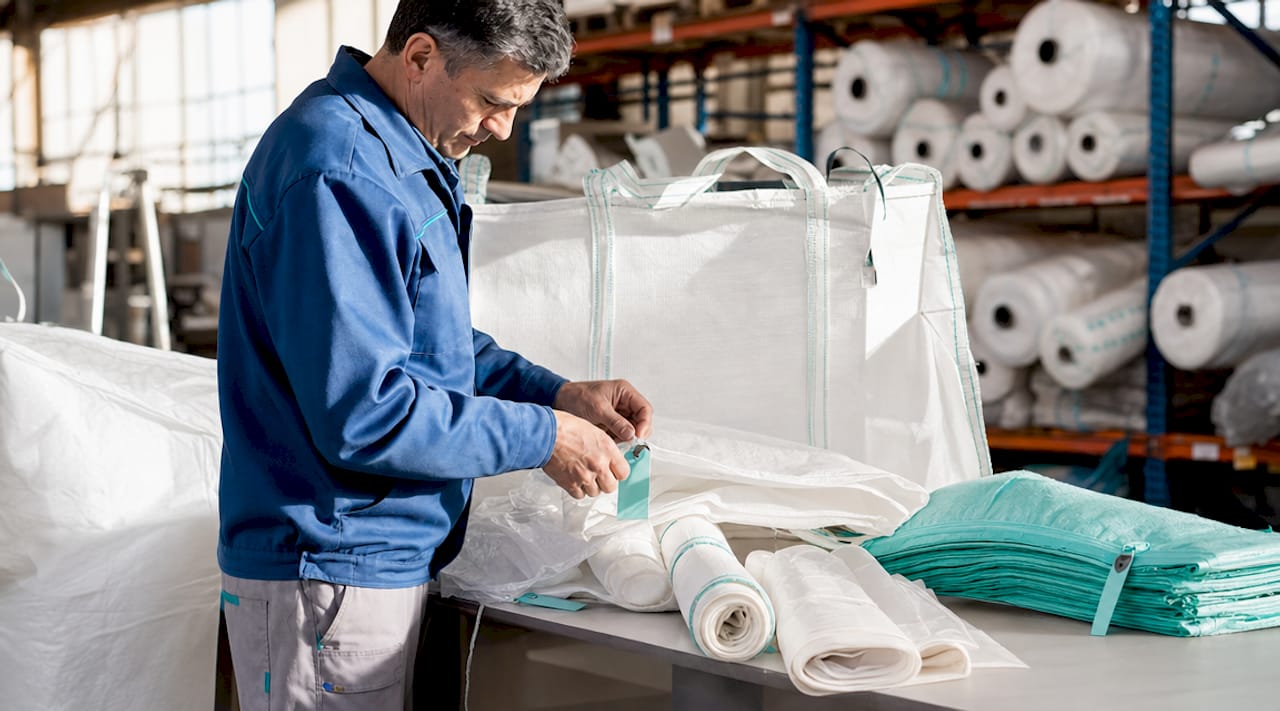
Industrial bags come in various forms, each designed for specific industrial applications. The most well-known category is FIBCs (Flexible Intermediate Bulk Containers), also known as jumbo bags or big bags. FIBCs have a load capacity of 500 to 2,000 kg and are widely used in the chemical, food, and construction industries. This makes them the most used bags for bulk goods worldwide.
Within the FIBC category, there are several subtypes:
- Standard FIBC: suitable for non-hazardous dry bulk goods such as sand, grain, and fertilizer.
- Coated FIBC: features an internal PE coating for moisture-sensitive products.
- Conductive FIBC (Type C): mandatory for flammable or explosive substances to prevent static discharge.
- Ventilated FIBC: with open weave for products requiring ventilation, such as potatoes or wood.
- Food-grade FIBC: complies with FSSC 22000 and BRCGS, with specific designs for hygienic bulk transport of foodstuffs.
In addition to FIBCs, there are other commonly used bag types for industry and retail:
- Valve bags: sturdy bags made of polypropylene or paper for products such as cement, fertilizers, and animal feed. They are resistant to mechanical stress and are often supplied in pallet format.
- Flat bags: simple, inexpensive bags without side gussets, suitable for dry food, grains, and light industrial products.
- Gusseted bags: have a fold on both sides, allowing them to hold more volume when filled. They are used for coffee, nuts, and chemical powders.
- Block bottom bags: stand upright due to their square bottom, which facilitates loading and stable stacking.
- Filter bags: used in industrial filtration for separating solid particles from liquids or gases. Absolute filter bags guarantee 99.9% particle retention, making them indispensable in the pharmaceutical and chemical sectors.
Pro-tip: Combine bag type with the required certification already in the specification phase. An FIBC that later needs to be exchanged for a conductive type costs twice as much as making the correct choice directly.
How do you choose the right industrial bag?
The selection of the right bag begins with a detailed set of requirements. This package includes product weight, particle size, moisture sensitivity, chemical properties, and transport method. A well-thought-out set of requirements prevents costly errors in industrial packaging and directly increases logistical efficiency.
The most important selection criteria at a glance:
- Product weight and volume: FIBCs carry 500 to 2,000 kg. Valve bags are suitable for 10 to 50 kg. Match the bag dimensioning to the weight to prevent overloading and damage.
- Material resistance: Plastic bags made of polypropylene or polyethylene offer moisture resistance. Paper bags breathe better but are less resistant to moisture. Choose based on ambient conditions during storage and transport.
- Safety standards and certifications: For dangerous transport, UN certifications such as UN 4G and 1A apply. For foodstuffs, FSSC 22000 and BRCGS are mandatory. Always check which standards apply to your sector.
- Chemical compatibility for filter bags: A filter bag must not only be selected based on micron value. The bag structure (needle felt or mesh) and the chemical composition of the liquid determine whether the bag functions or fails immediately.
- Total Cost of Ownership (TCO): The purchase price is only one factor. TCO analysis can reduce packaging costs by 15 to 25% by considering reusable solutions and circular principles. Labor, transport, and waste processing all count.
Pro-tip: Involve purchasing, production, and logistics jointly in the bag specification. Each department sees different risks, and the combination of these perspectives yields the most complete requirements.
Comparison of industrial bag types
The table below provides a quick overview of the most commonly used bag types for industry, their characteristics, and the most common applications.
| Bag Type | Capacity | Protection | Reusable | Suitable for | Typical Sector |
|---|---|---|---|---|---|
| Standard FIBC | 500 to 2,000 kg | High | Yes, multiple cycles | Dry bulk goods, granules | Chemicals, construction, agriculture |
| Conductive FIBC (Type C) | 500 to 2,000 kg | High + antistatic | Yes | Flammable powders and substances | Chemicals, pharmaceuticals |
| Food-grade FIBC | 500 to 1,500 kg | High + hygienic | Limited | Foodstuffs, sugar, flour | Food industry |
| Valve bag | 10 to 50 kg | Medium | No | Cement, fertilizers, animal feed | Construction, agri, retail |
| Flat bag | Up to 25 kg | Low to medium | No | Dry food, grains, powders | Food, retail |
| Gusseted bag | Up to 25 kg | Medium | No | Coffee, nuts, chemical powders | Food, chemicals |
| Block bottom bag | Up to 25 kg | Medium | No | Products that need to stand upright | Food, retail |
| Filter bag | N/A | High (99.9% retention) | No | Liquid and gas filtration | Pharmaceuticals, chemicals, water |
The table clearly shows that FIBCs are the only bags that support reuse over multiple cycles. This makes them interesting for companies with frequent bulk transport. Filter bags are the only category where capacity is not relevant: here, only filtering performance matters.
Trends and innovations in industrial bags for 2026
The industrial packaging market is moving fast. Four developments are already defining the choices companies will make in 2026:
- Recycled and bio-based materials: Manufacturers such as Starlinger and W&H are developing bags from recycled polypropylene (rPP) and bio-based polyethylene. These materials meet the same mechanical requirements as virgin plastic but reduce the carbon footprint of the packaging chain.
- Reusable and circular packaging solutions: Reusable packaging has higher acquisition costs but reaches its breakeven point after 5 to 15 use cycles. For companies with fixed transport routes, switching to reusable FIBCs or valve bags is financially attractive.
- Advanced certifications and compliance in 2026: The EU regulation for sustainable packaging (PPWR) sets stricter requirements for recyclability and reuse. Companies that already invest in certified bags now avoid costly adjustments later.
- Technological innovations: Anti-static bags for the electronics industry, moisture-regulating bags with silica gel integration, and RFID-labeled FIBCs for track-and-trace are no longer futuristic. They are available and already in use by major logistics players in the chemical and pharmaceutical sectors.
The supply chain packaging evolves with these trends. Companies that integrate packaging choices into their sustainability strategy also build compliance and cost reduction.
Practical tips for cost savings on industrial bags
Packaging costs vary by sector between 2 and 25% of the product value. This makes bag choice a serious cost item that must be actively managed. The following approach helps you reduce costs without compromising quality or safety:
- Calculate the total lifecycle costs: Labor for filling, transport, storage, and waste processing all contribute to the actual cost per bag. A cheaper bag that tears more often or requires more labor is more expensive than a qualitatively better option.
- Optimize bag dimensioning: A bag that is too large uses more material and takes up more storage space. A bag that is too small leads to overfilling and damage. Accurately match the dimensions to the product and pallet size.
- Invest in reusable bags for frequent transport: For fixed transport routes with more than five cycles per year, a reusable FIBC is more financially advantageous than disposable bags. Calculate the breakeven point based on your own transport frequency.
- Align bag choice with the production process: A bag that does not fit the filling machine or the palletizing line causes downtime and spoilage. Involve production planning in the specification to ensure compatibility.
- Draw up a detailed set of requirements: Environmental factors such as temperature, humidity, and UV exposure also determine which bag is suitable. On-site packaging with specialized teams increases safety and reduces damage during international transport.
Pro-tip: Ask suppliers for a TCO calculation in addition to the unit price. Suppliers who cannot provide this do not sufficiently understand your operational context to be a reliable partner.
More concrete strategies for reducing packaging costs can be found in Kadopapier's comprehensive guide.
Key Insights
The right industrial bag requires a choice based on product type, weight, safety standards, and total lifecycle costs, not just on purchase price.
| Point | Details |
|---|---|
| Bag type determines safety | Conductive FIBCs are mandatory for flammable substances. Never use a standard bag for hazardous products. |
| Certifications are not optional | UN standards and FSSC 22000 apply to specific products. Check this before purchasing. |
| TCO beats purchase price | Reusable bags reach breakeven after 5 to 15 cycles and structurally reduce operational costs. |
| Filter bags require chemical match | A filter bag that does not match the fluid chemistry will fail immediately, regardless of the micron value. |
| Set of requirements prevents errors | Establish specifications with purchasing, production, and logistics together for the most complete bag definition. |
Bag selection is not a purchasing decision, it is an operational choice
I see it time and again: companies treat the choice of industrial bags as a standard purchasing task. The cheapest provider wins, the bag is ordered, and only when problems arise, such as product damage, a failed audit, or a stopped line, is the question asked why more thought wasn't put into it.
The real problem is that bag selection is rarely approached multidisciplinarily. Purchasing looks at price, production looks at filling speed, and logistics looks at stackability. No one looks at the whole picture. The result is a bag that meets requirements on paper but causes problems in practice.
What I have learned: the most effective approach is a joint specification session before even a single quote is requested. Bring all stakeholders to the table, draw up the set of requirements, and let the supplier respond to those requirements. That sounds like more work, but it saves months of corrections afterward.
The trend toward sustainable and reusable bags makes this even more urgent. A reusable FIBC that does not fit your filling installation is not a sustainable choice; it is an expensive mistake. Integrate packaging choice into your process design, not as an afterthought but as part of production planning.
— M
Ordering industrial packaging from Kadopapier
Kadopapier offers a wide range of industrial packaging materials for companies that demand quality and reliability. From bags for bulk goods to specialized packaging solutions for retail and logistics: the assortment is aimed at both standard and custom applications. Orders placed before 3:00 PM on weekdays mean same-day shipping. Free shipping applies from 100 euros ex. VAT. View the full range of industrial packaging solutions or go directly to the product categories on kadopapier.net for an overview of available bags and packaging materials.
FAQ
What are the most commonly used types of industrial bags?
The most commonly used types are FIBCs (jumbo bags) for bulk goods, valve bags for cement and fertilizers, and filter bags for industrial filtration. Each type is designed for a specific application and load.
What certifications are mandatory for industrial bags?
For dangerous transport, UN standards such as UN 4G and UN 1A apply. For foodstuffs, FSSC 22000 and BRCGS are the standard. Always check which standards apply to your product and transport method.
How do you choose the right filter bag?
Choose a filter bag based on micron value, bag structure (needle felt or mesh), and chemical compatibility with the fluid to be filtered. An incorrect chemical match will lead to immediate failure, regardless of the filter fineness.
Are reusable industrial bags cheaper?
Reusable bags such as FIBCs have higher acquisition costs but reach their financial breakeven after 5 to 15 use cycles. For frequent transport, they are structurally cheaper than disposable variants.
What is the difference between a gusseted bag and a block bottom bag?
A gusseted bag has pleats on the sides that expand when filled, offering more volume. A block bottom bag has a square bottom and stands upright, allowing for stable stacking and efficient loading.