
Explanation of retail-ready packaging for retailers
TL;DR:
- Retail-ready packaging moves products directly from the shipping container to the store shelf with minimal handling, reducing labor costs. It consists of trays, displays, and shippers, adapted for various retail environments, and requires strict compliance with retailer specifications to avoid chargebacks. An integrated approach to design, logistics, and digital data flow is essential for success and maximum efficiency.
Retail-ready packaging is secondary packaging that moves products directly from the shipping container to the store shelf with minimal handling, without requiring staff to individually stock loose units. In the industry, these packages are referred to as SRP (Shelf Ready Packaging), RRP (Retail Ready Packaging), or PDQ (Pretty Darn Quick). They combine protection during transport, shelf presentation, and compliance with retailer requirements in one solution. For professionals and entrepreneurs in the retail sector, the explanation of retail-ready packaging is directly relevant: those who apply this system correctly reduce labor costs, minimize chargebacks, and improve product visibility on the shop floor.
What exactly is retail-ready packaging?
Retail-ready packaging is defined as secondary packaging that moves products directly from the shipping container to the store shelf with minimal handling. This means: an employee opens the packaging, places the tray or display on the shelf, and the product is ready for sale. No loose units need to be removed, rotated, or restacked.
The difference from normal packaging is fundamental. A standard cardboard box protects the product during transport but then requires additional handling on the shop floor. Retail-ready packaging eliminates that step. WH Skinner describes this with five criteria: easy to identify, open, shelve, shop, dispose. Each of these five points is a direct requirement for the design.
The terms SRP, RRP, and PDQ are used interchangeably in practice but refer to the same principle. PDQ is an informal term that emphasizes speed of placement. SRP and RRP are the common industry terms used by major retailers like Walmart, Costco, and Kroger. Suppliers to these chains receive detailed specifications that the packaging must meet.
What types of retail-ready packaging are there?
The most common forms are trays, displays, and shippers. Each type has a specific application area and a different balance between protection and presentation.
- Tray with perforation or tear strip: A corrugated cardboard box with a pre-cut opening. The employee tears off the top and places the tray directly on the shelf. Suitable for cans, bottles, and packaged snacks.
- Open tray (display tray): A low, open cardboard container without a lid. Products are immediately visible. Often used for candy, cosmetics, and small household items.
- Shipper display: A combined transport and display package that is placed as a freestanding display on the shop floor or at the end of an aisle. Suitable for seasonal products and promotional items.
- Pallet display: A full pallet of products that is moved as a single unit into the store. Used for bulk promotions in wholesale and hypermarkets like Costco.
- Clip strip: A strip with multiple products that is hung on an existing shelf or display. Compact and suitable for impulse purchases.
The choice for each situation depends on the type of retailer, shelf space, and product turnover rate. A comparison:
| Type of packaging | Application | Advantage |
|---|---|---|
| Tray with tear strip | Regular shelf, supermarket | Quick to open, protects during transport |
| Open display tray | End-of-aisle, promotional location | Maximum product visibility |
| Shipper display | Aisle, seasonal promotion | Combined transport and presentation |
| Pallet display | Wholesale, hypermarket | No extra handling, direct placement |
| Clip strip | Impulse zone, checkout | Minimal space, high visibility |
The visual impact of a well-designed retail-ready display is directly measurable. Effective SRP not only increases efficiency but also contributes to sales improvement through direct visibility and impulse purchases in retail. This makes packaging choice also a marketing decision.
What are the benefits of retail-ready packaging?
The most tangible benefit is time savings on the shop floor. Switching to shelf-ready packaging can reduce shelf stocking time by 30 to 50 percent. This is a direct reduction in labor costs, especially in high-turnover chains such as supermarkets and drugstores.
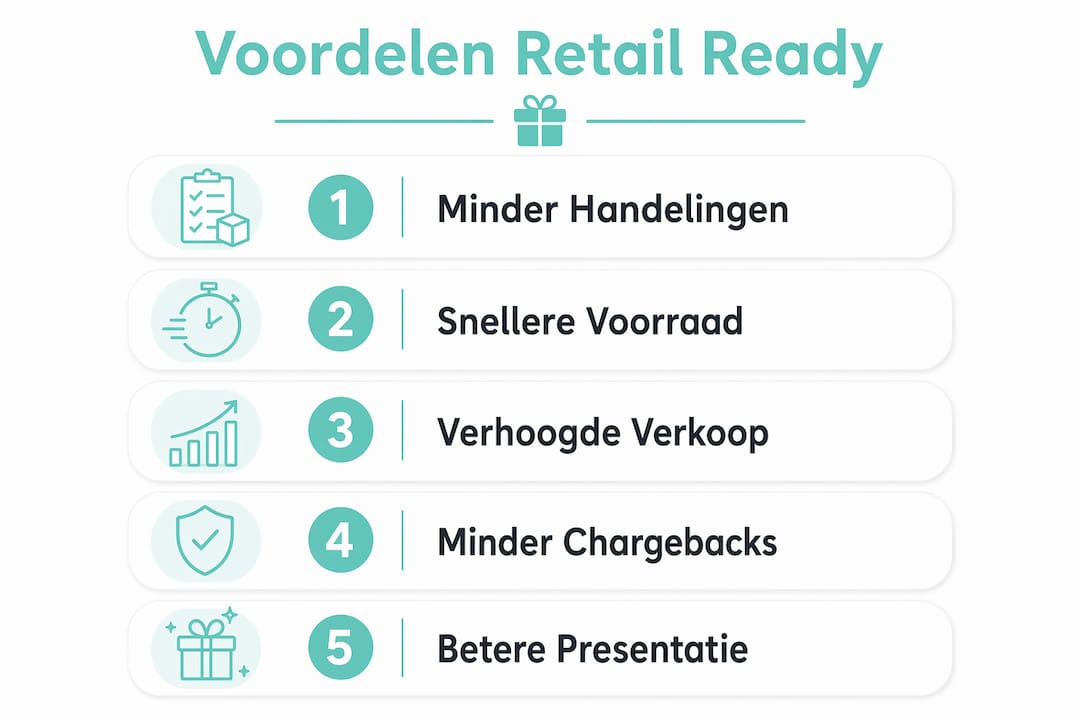
The benefits apply to both the retailer and the supplier:
- Fewer operations on the shop floor. Employees do not have to remove and stack individual products from boxes. One movement is sufficient.
- Lower risk of chargebacks. When the packaging is correctly executed, there are fewer reasons for retailers to reclaim costs from suppliers.
- Better product presentation. A uniform tray or display ensures a consistent appearance on the shelf, strengthening the brand image.
- Faster replenishment for high turnover. Fast-selling products can be replenished more quickly without extra sorting time.
- Improved retailer relationship. Suppliers who meet SRP requirements are considered more reliable by retailers, leading to better cooperation and sometimes better shelf positions.
The additional costs for the design and production of retail-ready packaging are recouped through fewer chargebacks and a better retailer relationship. This is not a theoretical promise: retailers like Walmart use explicit scorecards for supplier compliance, where packaging quality directly impacts the purchasing relationship.
Pro-tip: Calculate the total cost per unit, including labor costs on the shop floor. A more expensive SRP package is often cheaper than a cheap box that requires extra handling.
What requirements do retailers set for retail-ready packaging?
Retailers set detailed requirements for structure, dimensions, barcode placement, and labeling. Retailers demand efficiency on the shop floor, visibility, and clear presentation from shelf-ready packaging. This translates into concrete specifications that vary per chain.

For example, Walmart requires SRP packaging to comply with their Supplier Packaging Guidelines, including specific dimensions for shelf depth and height, GS1 barcodes on at least two sides, and a maximum pallet weight. Costco has strict requirements for the height of pallet displays and the readability of barcodes at a distance. Kroger uses its own compliance scorecard where deviations directly lead to chargebacks.
Common errors that lead to chargebacks or rejections:
| Error | Consequence | Solution |
|---|---|---|
| Incorrect number of units per tray | Chargeback due to counting error | Double-check during packing and shipping |
| Barcode not scannable or incorrectly placed | Rejection upon receipt | GS1 verification before shipping |
| Pallet too high or too heavy | Rejection at distribution center | Adjust pallet configuration to retailer specifications |
| Label information incorrect or missing | Chargeback due to labeling error | Match ASN data with physical packaging |
| Damage during transit | Return or chargeback | Test stacking strength and flute direction |
Chargebacks often arise from non-visible execution errors: quantities, barcodes, label scannability, and ASN data must exactly match the retailer's checks. This requires a physical-digital reconciliation for each shipment.
Pro-tip: For each new retailer, request a copy of their Supplier Packaging Guidelines before the first production process. Many chargebacks can be avoided by verifying specifications beforehand rather than correcting them afterward.
Compliance is not a one-time action. Retailers regularly adjust their specifications, and suppliers who do not keep up risk structural chargebacks. An internal control system with fixed checkpoints per production batch is the most effective approach.
How do you integrate retail-ready packaging into your supply chain?
Retail-ready packaging only works well if the entire packaging chain is correct. Primary, secondary, and tertiary packaging each have their own role: primary packaging protects the product itself, secondary packaging organizes products for handling and presentation, and tertiary packaging is for bulk logistics and is removed before the end consumer. An SRP tray is always a secondary package.
Integration requires attention at multiple levels:
- Design and testing. Stacking strength for SRP depends on board grade, flute direction, and tray height. Testing per production configuration is necessary to prevent structural failures during shipping. A tray that looks good on the production line may collapse during palletization if the flute direction is incorrect.
- Collaboration with packaging suppliers. Involve your packaging supplier early in the process. They know the material specifications and can advise on the correct board grade for your product and transport route.
- EDI and ASN data. Electronic Data Interchange (EDI) and Advanced Shipping Notices (ASN) are the digital backbone of SRP compliance. The data in your ASN must exactly match what is physically in the package. Good retail-ready packaging is not an endpoint, but a starting point for an integrated chain where accurate data flow via GS1 barcodes and ASN is key.
- Inventory management and replenishment. SRP packaging is designed for quick replenishment. This only works if the logistics behind the shelf are also correct: appropriate inventory levels, correct order quantities, and timely delivery to the distribution center.
- Quality control at multiple layers. Check not only the final product but also intermediate steps: counting per tray, label placement, pallet configuration, and the match between physical packaging and digital shipping data.
Pro-tip: Always test your SRP tray on the actual pallet configuration that goes to the distribution center. Stacking strength on a test bench is not the same as stacking strength under transport conditions with multiple pallet layers.
For more background on packaging materials in a retail context and the choices involved, Kadopapier provides additional information for professionals looking to optimize their packaging process.
Key insights
Retail-ready packaging is effective when design, material specifications, digital data flow, and retailer compliance are managed as one integrated system.
| Point | Details |
|---|---|
| Definition and purpose | SRP/RRP moves products directly to the store shelf with minimal handling. |
| Time savings on the shop floor | Replenishment time decreases by 30 to 50 percent with correct use of shelf-ready packaging. |
| Compliance is critical | Errors in quantities, barcodes, or ASN data directly lead to chargebacks from retailers. |
| Stacking strength testing | Board grade, flute direction, and tray height determine if the packaging survives transport. |
| Integrated approach | Primary, secondary, and tertiary packaging must be designed as a system. |
Retail-ready packaging in practice: what I have learned
After years of working with packaging solutions for the retail sector, one thing stands out to me: most problems with retail-ready packaging arise not from poor design, but from a lack of alignment between production, logistics, and the retailer themselves.
Suppliers invest in a beautifully designed SRP tray, have the proofs approved, and start production. Then, during the first delivery, it turns out that the barcode is in the wrong position for the distribution center's scanning equipment, or that the pallet configuration is one layer too high for the automated storage systems. The result: a chargeback that completely wipes out the margin on that first order.
What I consistently see with suppliers who do this well: they treat each retailer's Supplier Packaging Guidelines as a technical document, not a checklist. They verify every specification with their packaging supplier and their logistics team before the first production run. They test not only the product but also the entire pallet configuration under realistic transport conditions.
The trend towards sustainable retail-ready packaging adds an extra layer to this complexity. Retailers like Albert Heijn and Jumbo increasingly demand a certain percentage of recycled material in SRP packaging. This is a positive development, but it also means that suppliers must test whether recycled board grades offer the same stacking strength as virgin material. This is not always the case. Those who want to know more about sustainable packaging options and the legislation applicable to them would do well to inform themselves in time.
The balance between branding and logistical efficiency is also a point that remains underexposed. An SRP tray with a lot of printing looks good on the drawing board, but additional color layers can increase processing time on the production line and significantly drive up unit costs. My advice: start with function, then add branding. Not the other way around.
— M
Retail packaging solutions from Kadopapier
Kadopapier supplies packaging materials and decorative finishes that meet the presentation requirements of retail-ready packaging. For retailers and suppliers who also want to visually distinguish their SRP packaging, Kadopapier offers a wide range. This includes decorative elastic in color and metallic for sealing and presenting display trays, or luxury curling ribbon in emerald for a premium finish of seasonal displays and promotional packaging. Orders placed before 3:00 PM are shipped the same business day. Free shipping from 100 euros excl. VAT. View the full range at kadopapier.net.
FAQ
What is the difference between SRP, RRP, and PDQ?
SRP (Shelf Ready Packaging) and RRP (Retail Ready Packaging) are synonyms for the same packaging category. PDQ (Pretty Darn Quick) is an informal term that emphasizes the speed of placement and is mainly used in the American market.
How do retail-ready packages reduce chargebacks?
Chargebacks occur due to errors in quantities, barcode placement, label data, and pallet configuration. A correctly executed SRP package with verified ASN data eliminates most of these errors before shipment.
Which retailers have the strictest requirements for SRP packaging?
Walmart, Costco, and Kroger have detailed Supplier Packaging Guidelines with specific requirements for dimensions, GS1 barcodes, pallet weight, and label placement. Deviations directly lead to chargebacks or refusal at the distribution center.
How do you test the stacking strength of an SRP tray?
Stacking strength depends on board grade, flute direction, and tray height. Testing in the actual pallet configuration under transport conditions yields more reliable results than testing on a production bench.
Are retail-ready packages also suitable for small suppliers?
Yes. Smaller suppliers who deliver to regional chains or specialty stores benefit equally from the time savings on the shop floor. The investment in SRP design is scalable and recouped through fewer operations and an improved relationship with the retailer.