
Clothing packaging – Sustainability and customer experience
A beautifully wrapped garment instantly adds a special touch to the gift-giving season. For small boutiques in Central Europe, clothing packaging is about more than just protection—it's the first impression of your brand. Customers today are consciously seeking sustainable materials and appreciate packaging that's both stylish and eco-friendly. This guide explains how sustainable packaging materials enhance both the experience and your brand.
Table of contents
- Clothing packaging: definition and key terms
- Sustainable materials and their applications
- Smart wrapping methods during gift season
- Benefits for small boutiques and customers
- Avoid common mistakes when packing clothes
Key points
| Point | Details |
|---|---|
| Sustainable packaging is essential | Customers appreciate sustainable packaging and it increases the perceived value of your product. |
| Consistency in packaging methods | Choose one type of sustainable packaging and stick to it for better brand recognition. |
| Avoid common mistakes | Don't use plastic or too many layers of paper. This increases costs and reduces sustainability. |
| Choose the right materials | Investing in recycled and biodegradable materials is beneficial for both your boutique and the environment. |
Clothing packaging: definition and key terms
Clothing packaging is much more than just a box or a plastic bag. It's the protective layer around your products that the customer receives, touches, and sees before unpacking the garment.
For small boutiques in Central Europe, this moment is crucial. The packaging tells the first story about your brand before the customer even sees the actual garment.
What is included in clothing packaging?
Clothing packaging includes several elements:
- Primary packaging: the immediate protective layer around the garment (blotting paper, tissue paper)
- Secondary packaging: the box or bag that holds everything together (cardboard boxes, clothing shipping bags )
- Tertiary packaging: the shipping material for transport (padding, tape)
- Decorative elements: ribbons, stickers, labels that enhance the experience
Each layer has a function: protection, presentation, and brand identity.
The connection between sustainability and customer experience
Here's the interesting part. Sustainable packaging is no longer an added cost—it's a selling point. Customers want to know you're caring for their planet.
Sustainable packaging materials address the entire product lifecycle, from production to recycling. This means less waste, less transport, and a lower environmental impact.
This is good news for your boutique. A beautifully, sustainably packaged gift immediately creates more appreciation in the recipient.
Key concepts you should know
Recyclable materials include paper and cardboard that can be reused. These are the standard building blocks of modern clothing packaging.
Biodegradable materials break down in nature without leaving behind harmful substances. A step beyond recyclable.
Recycled content means the material has been used before. It requires less energy than making new material.
Carbon footprint is the amount of CO2 released during production and transport. Lower is better.
Sustainable packaging isn't just good for the environment—it also increases the perceived value of your product to the customer.
Why this matters for your boutique
You're a small boutique, not a mega-chain. This gives you an advantage: you can personally choose materials that reflect your values.
Customers who buy from you expect attention to detail. Sustainable, beautifully designed packaging shows you understand that.
Professional advice: Choose one sustainable material (e.g., brown kraft paper or plant-based tissue paper) and make it your signature. Consistency builds a stronger brand than multitudes.
Sustainable materials and their applications
Sustainable packaging materials are no longer a niche. They're available, affordable, and they work. For your boutique, this means concrete choices you can implement immediately.
It's not about being perfect. It's about being better than yesterday.
What materials are available?
Materials like recycled paper and molded pulp form the basis of modern sustainable packaging. These are not exotic or difficult to find.
The most practical options for clothing boutiques are:
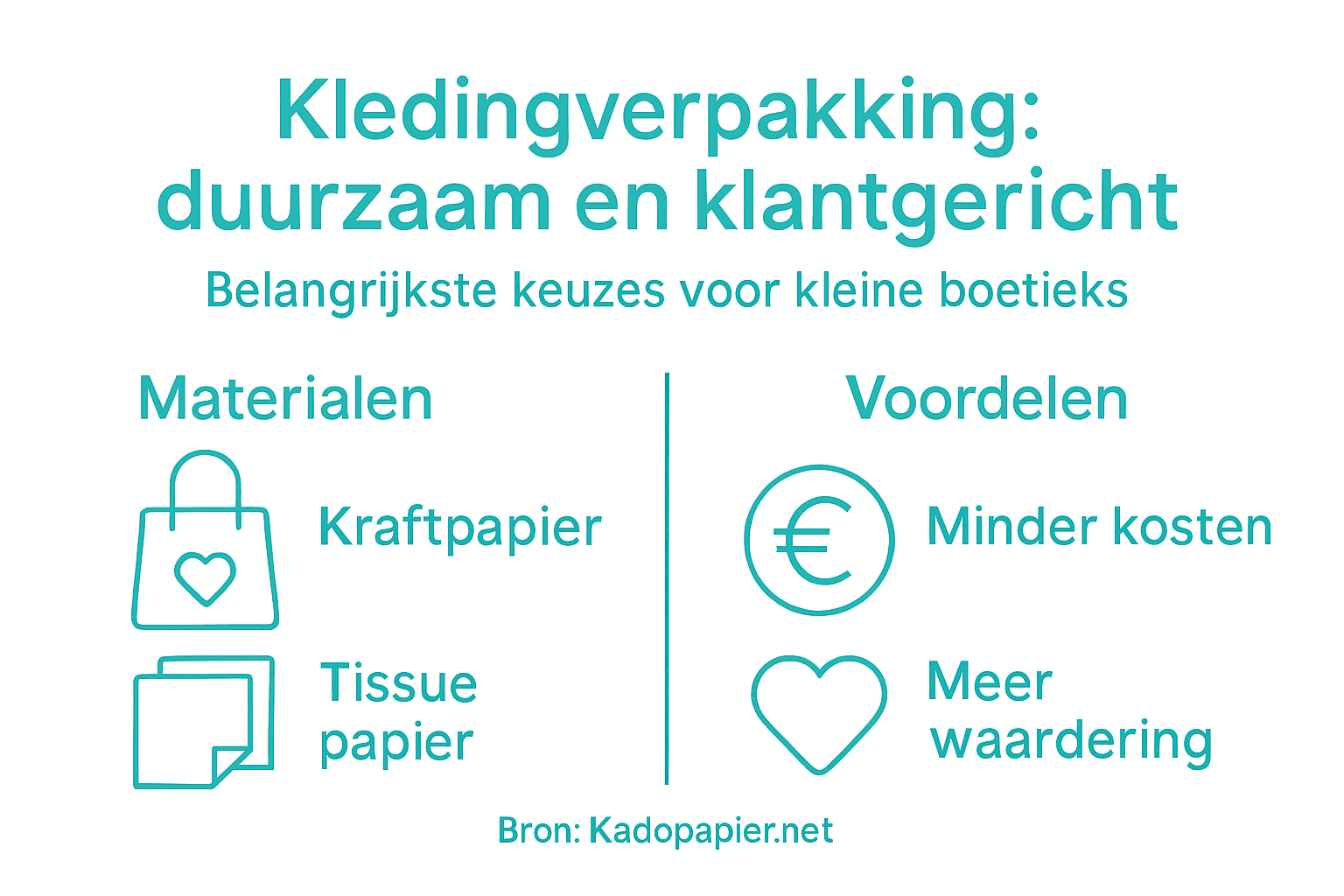
- Brown kraft paper: strong, recognizable, and fully recyclable
- Tissue paper: perfect for wrapping clothes, soft and elegant
- Molded pulp: sturdy boxes made from pressed paper fiber, no plastic required
- Recycled cardboard: the same cardboard boxes, but made from old materials
- Biodegradable plastic alternatives: only if you really need plastic
Each material has strengths and weaknesses. The choice depends on your product, your budget, and what your customers value.
Below you'll find a comparison of popular sustainable packaging materials for boutiques:
| Material | Environmental impact | Appearance | Reuse possibilities |
|---|---|---|---|
| Brown kraft paper | Low; completely biodegradable | Rustic, natural | Can be recycled or reused |
| Molded pulp | Made from leftover paper | Robust and simple | Compostable or recyclable |
| Bioplastic alternative | Biodegradable | Transparent, light | Limited reusability, compostable |
| Recycled cardboard | Limited energy consumption | Firm, neutral | Can be recycled again |
Practical applications in your boutique
It's simpler than you think. Here are some direct applications:
Primary packaging: Brown tissue paper or white tissue paper wrapped around each garment. This provides protection and elegance at the same time.
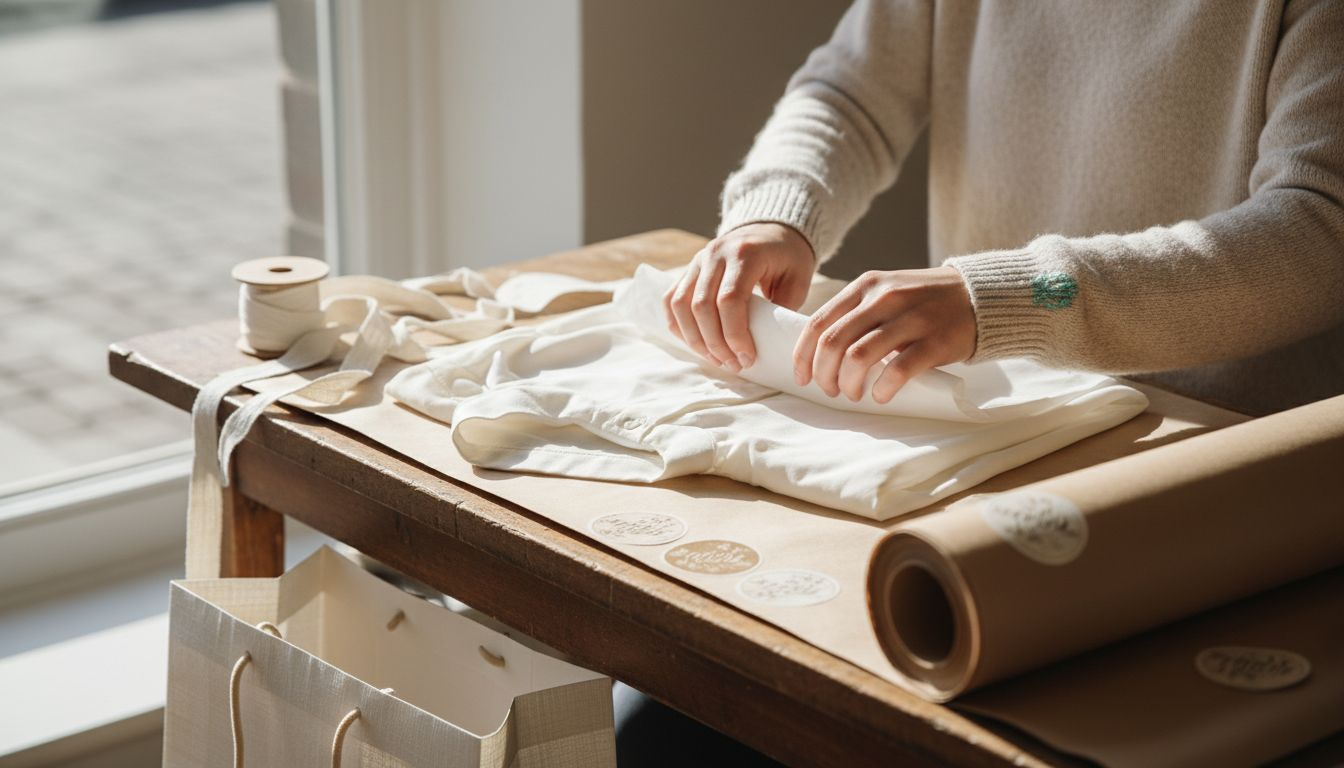
Secondary packaging: Strong, minimalist cardboard boxes or sustainable, environmentally friendly packaging materials . A simple logo design on kraft paper is much more valuable than cheap glossy paper.
Decoration: Brown ribbons, natural stickers, and simple labels. This reinforces your brand identity without adding clutter.
Why These Materials Work for the Gift-Giving Season
During the gift-giving season, recipients want to feel something special. Sustainable packaging feels conscious. It also feels like a gift for the environment.
A brown kraft paper package with a simple ribbon looks luxurious. It costs less than glossy paper, and it feels better.
Customers remember how a package feels before they open it. Sustainable materials create a better feeling.
Compare costs without sacrificing quality
Sustainable doesn't have to be more expensive. Brown kraft paper is often cheaper than printed glossy paper. Tissue paper is too.
The savings are in efficiency: you need fewer layers, less decoration, and less variety.
Professional Advice Order one sustainable base material in bulk (for example, 70 gsm brown kraft paper) and add a small, reusable detail—a simple ribbon or stamp—instead of trying to change everything.
Smart wrapping methods during gift season
The gift-giving season demands efficiency without sacrificing style. You have more orders, less time, and higher customer expectations. Smart wrapping methods save time and resources.
Good packaging isn't a luxury. It's part of your product.
Minimalism is your friend's workhorse
Innovative packaging methods use minimal, sustainable materials without sacrificing beauty. This is the secret.
Less paper means:
- Pack faster (fewer layers, less hassle)
- Lower costs (you order less material)
- Better experience (customers appreciate simplicity)
- Less waste (instantly sustainable)
A brown tissue paper shirt with a single ribbon looks more sophisticated than three layers of glossy paper with stickers. Customers notice this.
Practical step-by-step plan for busy periods
During the gift-giving season, speed and consistency are everything. Here's how to achieve that:
Preparation: Gather all materials in one workstation. Tissue paper, ribbons, stickers, boxes. Everything within easy reach.
Standardization: Define a single packaging method and do it the same way every time. This requires less mental energy and is faster.
Scalable method: Use unique packaging methods that are efficient but not too complicated. Tie a ribbon around it, put a sticker on it, and you're done.
The psychology of packing
People remember how something feels before they see what it is. This is your advantage.
A package that opens quickly without threaded paper feels better. Much less mess.
Use careful, clean packaging instead of overly complicated packaging. The customer will feel that you've been careful without extra layers.
The fastest packing is the best packing. Efficiency feels like care.
What to avoid during crowds
Many boutiques make the same mistakes when things get hectic:
- Using too many colors of paper (confusion, more time)
- Trying complicated folding techniques (mistakes, stress)
- Choosing thin materials that tear (must do again)
- No inventory management (running out of stock, last-minute purchase)
Choose strong materials, simple methods, and inventory management.
Timing and planning
The smart boutique plans ahead. Start stocking up four weeks before the season. Test your method with ten packages.
Do you need to adjust your procedures? Do it now, not during peak hours.
Professional advice: Create a simple packing card: a single image with your packing method, step by step. Train everyone on it. Uniformity under pressure is impossible without clear instructions.
Benefits for small boutiques and customers
Sustainable clothing packaging isn't a sacrifice. It's a win-win. For you. For your customers. For the planet.
Here are the concrete benefits you'll really notice.
For your boutique: lower costs, higher value
Sustainable materials don't cost more. Often less. Brown kraft paper is cheaper than printed paper. Tissue paper is too.
The real benefits go further:
- Lower purchasing costs: bulk purchasing of one material saves money
- Less waste: standard materials mean fewer errors
- Stronger brand: consistent design increases brand recognition
- Better profit margin: customers value sustainability and are happy to pay more
- Less stress: simple packaging is faster and easier
What's more, sustainable packaging helps your customers feel that you care about their environment . This builds trust.
This overview shows the business benefits of sustainable packaging at a glance:
| Advantage | Boutique | Customer | Environment |
|---|---|---|---|
| Lower costs | Lower purchasing costs | Less waste | Less waste |
| Stronger brand image | Consistent appearance | Better unboxing experience | More conscious image |
| More efficient processes | Pack faster | Less noise in packet | Less CO2 during production |
| Loyal customers | Repeat purchases | Positive feeling | Long-term involvement |
For your customers: a better experience
Customers want to know that their purchase means more than just the garment itself. Sustainable packaging tells that story.
What do they notice:
- Beautiful unboxing: a beautiful, minimalist package feels premium
- Lower waste: no paper mess when they open it
- Reusable materials: brown kraft can be reused or recycled
- Peace of mind: they know their choice is environmentally conscious
- Brand connection: beautiful packaging creates memories
The unboxing experience is the first moment your customer interacts with your brand after purchase. This is crucial.
Sustainable packaging says more about your brand than a thousand words of marketing.
The loyalty bonus
Customers who buy sustainably buy more often. They become loyal customers. This is no coincidence.
Sustainable packaging demonstrates integrity. Customers sense this. They return.
And they tell their friends. Word of mouth marketing is free marketing.
Business benefits that are less visible
Sustainable packaging opens doors:
- Regulations: EU standards are getting stricter; you are prepared
- Shipping costs: Lighter materials can mean lower shipping costs
- Team morale: your team feels better about the work
- Media attention: small boutiques that go sustainable get local attention
These benefits are not immediately visible, but they add up.
The truth about competition
Most small boutiques in Central Europe still use cheap, glossy paper for wrapping. Not you. This gives you an advantage.
You differentiate yourself without growing. That's the power of small businesses.
Professional advice Measure your current packaging costs per package, compare them with sustainable alternatives, and you will see that the break-even point comes sooner than you think.
Avoid common mistakes when packing clothes
The best way to package sustainably is to avoid mistakes that almost everyone makes. These mistakes cost you money, time, and customer trust.
Here are the mistakes you need to know.
Mistake 1: Using too many layers of paper
This is the classic mistake. More paper feels more luxurious, right? Not really. It feels unnecessary.
Overpacking means:
- More costs per package
- More waste for your customer
- Slower packing speed
- More difficult to recycle (thick, mixed materials)
A shirt wrapped in a single layer of tissue paper, tied with ribbon. Done. This looks better and costs less.
Error 2: Mixing materials without clarity
Recyclable packaging requires clean materials and clear labeling so customers can separate it correctly.
Many boutiques use:
- Plastic tape on cardboard (contaminates the cardboard)
- Glossy paper with plastic coating (not recyclable)
- Stickers with plastic backing (remains on the material)
- Synthetic nylon ribbons (non-biodegradable)
Choose one material type and stick with it. Brown kraft paper. Tissue paper. Natural ribbon. Done.
Mistake 3: Using Plastic When It's Not Necessary
Plastic adds nothing but problems. Yet, many boutiques opt for cellophane or transparent plastic wrappers "for presentation."
You don't need this. Brown kraft paper looks professional. Tissue paper does too. Plastic is a billion-year-old problem for short presentations.
Error 4: No thought about transportation
Your packaging needs to be stronger than you think. Materials that are too thin will tear, the contents will get damaged, and your customer will be upset.
Evaluate:
- Does the garment weigh more than 500 grams? Use sturdy cardboard.
- Sending by mail? Reinforce the corners with extra paper.
- Is it in a department store? Make sure it doesn't tear through the stack.
Error 5: No consistency between orders
Your first customer gets a nice brown kraft paper. Your twentieth customer gets a different colored cardstock. This feels sloppy.
Consistency builds brand identity. Unrest breeds doubt.
The worst packaging mistake is uncertainty. Choose one direction and stick with it.
Mistake 6: Claiming sustainability without actually doing it
Don't claim to be sustainable if you use plastic. This is called "greenwashing," and customers sense it.
They can see it's plastic. They can see you're lying. This damages your brand more than honesty.
The domino error
These mistakes add up. A plastic-coated box with paper ribbon on plastic tape. This isn't sustainable. This is confusing.
Start clean. One material. Durable. Consistent. Ready.
Professional advice : Create a simple checklist: What material am I using? Can my customer recycle it? Does it look consistent? If you're unsure, ask a regular customer and listen carefully to their answer.
Increase the impact of your sustainable clothing packaging with Kadopapier.net
The challenge for small boutiques lies in finding sustainable packaging materials that are not only environmentally friendly but also enhance the customer experience. The article emphasizes the importance of consistently using sustainable choices like brown kraft paper and tissue paper to build a strong brand identity while simultaneously reducing waste and costs. Do you want to make your gift wrapping faster and easier during busy seasons without compromising on quality or appearance?
At Kadopapier.net, you'll find a wide range of sustainable and high-quality packaging materials. From sturdy kraft paper to elegant tissue paper and natural ribbons, these products help you create the exact atmosphere your customers are looking for while simultaneously reducing your environmental footprint. Discover how simple, consistent choices can immediately reduce waste and enhance your brand experience. Visit our site and start improving your packaging processes today through Kadopapier.net and give your boutique the sustainable look it deserves.
Frequently Asked Questions
What is clothing packaging?
Clothing packaging is the protective layer around garments, consisting of primary, secondary and tertiary packaging, including decorative elements.
Why is sustainable packaging important for my boutique?
Sustainable packaging not only helps the environment, but also enhances the customer experience and increases the perceived value of your products.
Which sustainable materials are suitable for clothing packaging?
Suitable sustainable materials include brown kraft paper, tissue paper, molded pulp, and recycled cardboard. These materials are recyclable or biodegradable.
How can I optimize my wrapping methods during the gift-giving season?
Minimalism and standardization are key strategies. Use simple, durable materials to speed up packaging processes and reduce costs.
Recommendation
- Sustainable packaging materials: Environmental impact and regulations – Kadopapier.net
- Reusable Packaging: Complete Guide for 2025 – Kadopapier.net
- Eco-friendly gift wrapping: sustainable and stylish wrapping – Kadopapier.net
- Wrapping without wrapping paper: Creative and Sustainable – Kadopapier.net
- ESG real estate: l'ère de la preuve et de la résilience financière
- Fulfillment & Logistics | MoreShores
- Sustainable Electronics Recycling Guide - Syntax Spectrum